KKRT supplier relationships: what investors need to know
KKR operates as a diversified alternative asset manager and insurance owner-operator, monetizing through management and performance fees across private funds, direct-investment carry, and insurance premium spread and reinsurance flows via its insurance subsidiaries. KKRT’s supplier footprint reflects a global operating model with a blend of short‑term liquidity facilities and longer‑dated corporate credit capacity, concentrated insurance collateral flows, and routine third‑party operating commitments for offices and service providers. For investors and operators evaluating supplier and counterparty exposure, the profile is capital‑intensive, globally distributed, and financially self‑managed—with suppliers ranging from strategic insurance partners to corporate counterparties tied to discrete portfolio transactions.
Explore more supplier intelligence at https://nullexposure.com/ for a searchable view of these relationships.
How KKRT’s commercial model shapes supplier risk and value
KKRT’s business model mixes fee revenue from asset management with balance-sheet insurance economics through insurance subsidiaries. That hybrid structure makes some suppliers strategically critical (insurance counterparties, reinsurance and collateral arrangements) while others are standard operating vendors (landlords, administrators). The firm runs both short-duration liquidity facilities and a multi‑year corporate credit facility, which supports capital markets and general corporate needs while allowing flexibility for prepayment and extension. These financing layers indicate a contracting posture that is both transactional and committed: tactical short-term lines for liquidity and a durable revolver for strategic optionality.
For curated supplier research and operator due diligence, visit https://nullexposure.com/.
Supplier map — the specific relationships investors should track
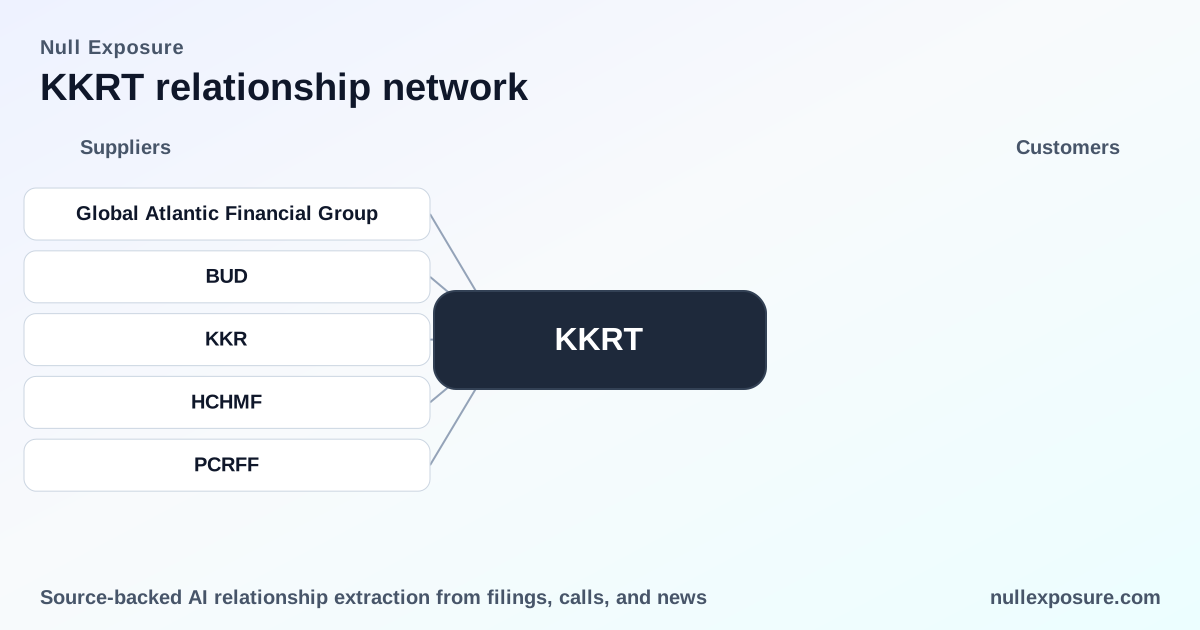
Below I cover every relationship surfaced in the supplier results and what each connection signals for counterparties and procurement teams.
Global Atlantic Financial Group
Global Atlantic manages retirement, life and reinsurance products for KKR’s insurance subsidiaries and holds significant collateral on reinsurers’ behalf — a substantial funding and counterparty node in KKRT’s insurance operations. According to a CityBiz report (FY2023), KKR’s insurance subsidiaries operate under the management of Global Atlantic Financial Group (https://www.citybiz.co/article/499878/kkr-appoints-dane-e-holmes-as-chief-administrative-officer/).
AB InBev (BUD)
AB InBev appears as a historical portfolio counterparty: KKR bought a beer brand from AB InBev in 2009 and sold it back in 2014, illustrating how KKRT uses buyouts and exits to generate realized gains rather than ongoing supplier dependence. This transactional history is recorded in a KED Global report (FY2025) that recounts the 2009 acquisition and 2014 divestiture (https://www.kedglobal.com/private-equity/newsView/ked202504100002).
KKR Registered Advisor LLC (KKR)
KKR Registered Advisor LLC manages the KREST vehicle and leverages KKR’s global real estate capabilities, linking asset management governance and advisor services to KKR’s platform. A CityBiz filing (FY2023) notes that KREST is managed by this affiliate and utilizes the broader KKR real estate team (https://www.citybiz.co/article/420944/krest-appoints-julia-butler-as-chief-investment-officer/).
Hitachi (HCHMF)
KKR has led carve‑outs of assets from large Japanese conglomerates including Hitachi, signaling the supplier role of corporate sellers and integration vendors when executing complex carve‑out transactions. KED Global coverage (FY2025) references these carve‑outs as part of KKR’s transaction experience (https://www.kedglobal.com/private-equity/newsView/ked202504100002).
Panasonic (PCRFF)
Panasonic is another named seller in KKR’s carve‑out playbook; these relationships highlight counterparty and transitional supplier risks tied to separated business units during acquisition and integration. KED Global reporting (FY2025) lists Panasonic among Japanese conglomerates involved in carve‑outs led by KKR (https://www.kedglobal.com/private-equity/newsView/ked202504100002).
Constraints and operating signals that matter to counterparties and investors
The collected constraint excerpts reveal an operating profile with clear commercial implications:
-
Contracting posture: mixed short‑ and long‑term commitments. KKRT maintains a short‑term revolving facility (KCM 364‑Day Revolving Credit Facility capped at $750 million expiring April 3, 2025) alongside a five‑year Corporate Credit Facility ($2.75 billion as of July 3, 2024, with an option to expand to $3.5 billion and a maturity in July 2029). This structure provides both tactical liquidity and strategic runway for multi‑year capital needs. (Details are drawn from corporate credit facility disclosures.)
-
Global footprint and distributed vendor base. Operating leases and office commitments exist in North America, Europe, Asia and Australia, consistent with a global supplier set and multi‑jurisdictional procurement and compliance considerations.
-
Insurance counterparty scale is material. Global Atlantic held $46.6 billion of collateral in funds‑withheld as of December 31, 2024, signaling large, high‑criticality financial flows through insurance-related supplier arrangements and reinsurance relationships.
-
Spend profile has dual bands. There are multimillion to multibillion dollar collateral and reinsurance exposures alongside routine mid‑six‑figure commitments for operating leases and third‑party administrators. This split defines where procurement should concentrate operational diligence versus where treasury/legal should focus credit and collateral controls.
-
Relationship stance is active and buyer‑oriented. Reinsurance schedules and borrowing agreements indicate active counterparties and a buyer role in ceded/assumed arrangements; credit agreements and lease schedules are current and operational as of the latest filings.
-
Covenant exposure judged immaterial by management. Corporate disclosures state that borrowing covenants do not materially restrict operations as of December 31, 2024, which investors should test against future leverage and liquidity scenarios rather than accept uncritically.
Investment implications and operational takeaways
-
Counterparty risk is concentrated in Global Atlantic and the insurance value chain. That node is a systemic supplier for KKRT’s insurance economics; monitoring collateral levels, reinsurance counterparties and regulatory capital treatment is essential.
-
Financing flexibility reduces short‑term supplier distress risk but raises maturity management importance. The five‑year revolver and short‑term KCM facility provide breathing room, but lenders’ consent for maturity extensions and the calendar of expirations require active treasury oversight.
-
Operational suppliers are globally dispersed but financially modest. Office leases and administrators are important for continuity but are generally manageable relative to balance‑sheet exposures.
For proprietary supplier screening or to deep dive into counterparties and constraint signals, see https://nullexposure.com/.
Final recommendation: prioritize diligence on insurance counterparty collateral and reinsurance arrangements, map the credit maturity calendar against projected cash flows, and maintain routine vendor controls for global leases and administrators. For a complete supplier risk view and actionable reports, visit https://nullexposure.com/.