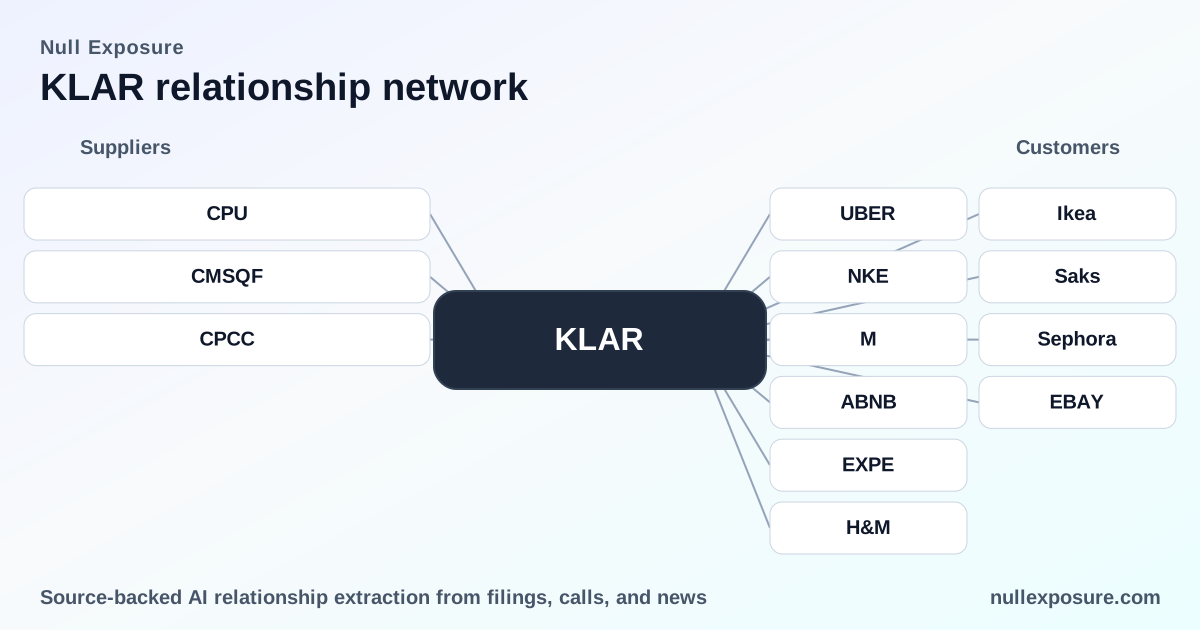
KLAR: Supplier relationships that matter for investors
Klar operates as a merchant-facing payments and consumer-financing platform; it monetizes through merchant fees, interest and interchange on consumer financing, and strategic integrations with payments infrastructure providers. Its supplier posture is concentrated around a small number of operational partners that enable core functions — custody/transfer administration for equity matters and payment rails for merchant acceptance — and those partnerships directly affect liquidity, share-transfer mechanics and merchant product distribution. Investors should view these suppliers as operational dependencies with outsized governance and market access implications. For deeper diligence on supplier exposure and disclosure trends, visit https://nullexposure.com/.
Why suppliers here are more than back-office vendors
Klar’s supplier set in the available coverage is not a long tail of commodity vendors: it includes a global transfer agent responsible for equity transfer mechanics and a major payments infrastructure partner that underpins merchant payment flows. That configuration creates two clear operational dependencies:
- Equity transfer and shareholder liquidity is centralized through a named transfer agent with explicit conversion and documentation processes that affect trading behavior and timing.
- Merchant payment processing and tokenization is routed through established payments infrastructure that extends Klar’s distribution and product capability into merchant platforms.
These are not peripheral integrations; they are critical to market functioning (share transferability) and revenue flow (merchant acceptance and tokenization). That concentration increases execution risk if either relationship degrades, and it elevates counterparty monitoring to a first-order item for investor diligence.
Supplier-by-supplier read (what the sources report)
Computershare — Klarna’s transfer agent handles share conversions and transfer restrictions. A series of March 2026 press releases and filings describe a required conversion process administered by Computershare, involving a submitted Letter of Transmittal before shares can be sold through U.S. broker-dealers other than Computershare, with processing times reported as 7–10 business days and specific counts of affected shares referenced. According to a Klarna release distributed via Ritzau and related outlets in March 2026, Computershare’s conversion mechanics directly affect shareholder trading flexibility. (Sources: Klarna press distribution via Ritzau / STT / BizWire, March 2026; additional reporting citing processing timing and share counts published March 2026.)
Stripe — Klarna uses Stripe’s payment ecosystem to extend flexible payment products to merchants via shared payment tokens. Market coverage in March 2026 highlights expanded agentic commerce capabilities and the use of Stripe’s shared payment tokens to deliver merchant payment flexibility and product distribution. That linkage supports Klar’s merchant-facing product expansion and alternative checkout flows. (Source: Finviz coverage of Klarna-Stripe strategic integration, March 2026.)
What each relationship implies for governance and liquidity
Computershare’s role is structural and time-sensitive: transfer-agent mechanics are legally and operationally determinative of when and how shares move into brokerage systems. The March 2026 communications make this explicit by prescribing a Letter of Transmittal and multi-day processing window; these are procedural gates that affect secondary-market liquidity for certain shareholder classes. Investors should treat Computershare as a governance and operational control point, not a routine vendor.
Stripe’s role is revenue and distribution-focused: shared tokenization and merchant integrations increase merchant uptake and retention, and they influence top-line growth cadence across geographies where Stripe operates. The presence of Stripe amplifies Klar’s go-to-market agility for checkout and pay-later products and therefore has direct revenue impact.
Company-level constraints and operating model signals
No explicit contractual constraints or limits were surfaced in the supplier relationship payload for KLAR. Treat that silence as an operational signal: there is currently no disclosed complexity in supplier contracts captured here, but the business model itself reveals structural characteristics investors must manage:
- Contracting posture: Klar relies on a small number of strategic suppliers for mission-critical services, which suggests negotiating leverage is asymmetrical and operational SLAs and transition plans deserve scrutiny at the board and audit-committee level.
- Concentration risk: Supplier concentration around transfer-agency and payments infrastructure elevates single-point-of-failure risk; the company’s contingency planning and secondary-provider arrangements should be a diligence focus.
- Criticality: The transfer agent governs shareholder liquidity mechanics while payment processors enable revenue flows; both relationships are operationally critical and could directly influence market perception and cash generation if disrupted.
- Maturity: Partners identified are established, global incumbents (a major registrar and an industry-leading payments platform), implying robust service capabilities but also potential vendor-bargaining asymmetries and standard contractual terms that favor scale providers.
Investors should treat these as company-level operational characteristics rather than isolated vendor facts.
Risks and practical diligence checklist
Klar’s limited visible supplier universe concentrates risk in two domains. Key items for active investors and operators to verify:
- Confirm contractual termination clauses, transition services and SLAs with the transfer agent to assess share-access continuity.
- Validate the implementation scope of Stripe tokenization across geographies and merchant segments to understand revenue dependency and migration complexity.
- Monitor public communications around share conversion mechanics and any backlog or processing delays that affect free float and trading liquidity.
- Review contingency plans for replacing or supplementing payment processing and transfer-agent services to quantify transition costs and timeline.
These checks convert headline supplier mentions into actionable governance and risk questions for the investor playbook.
For a concise vendor exposure briefing and ongoing monitoring setup, see https://nullexposure.com/.
Bottom line for investors
Klar’s supplier footprint in the available coverage is concentrated but strategically significant: Computershare controls equity transfer mechanics that affect shareholder liquidity, and Stripe underpins merchant payment distribution and tokenization that drive revenue growth. Both relationships are operationally essential and therefore deserve prioritized diligence in covenant review, contingency planning, and continuous monitoring.
For a vendor-risk scorecard and templated diligence questionnaires customized to Klar’s supplier profile, visit https://nullexposure.com/.