KLG supplier profile: what investors and operators need to know
KLG operates as a supplier that earns recurring revenues through contracted services and transitional support agreements with large consumer-facing companies. The company monetizes by delivering supply and integration services that can include longer-duration transition-service contracts; these arrangements create near-term revenue visibility but also concentration and operational obligations that change materially when transition services end. Investors should treat KLG as a supplier whose near-term cash flows and operational intensity are driven by the timing and completion of transitional contracts. For deeper diligence and tracking, visit the NullExposure homepage: https://nullexposure.com/.
Why this matters now: a concrete change in a headline relationship
KLG’s most visible recent mention in public sources relates to a winding down of transition services with Kellanova. According to a BakingBusiness article published March 10, 2026, KLG “expects to exit all transition services with Kellanova by mid-2025” (link: https://www.bakingbusiness.com/articles/63287-wk-kellogg-sheds-light-on-growth-paths-beyond-cereal). That exit is an operational inflection point: it converts a contractually intensive, integration-heavy revenue stream into a simpler supplier relationship or an opportunity to replace that revenue with higher-margin work.
Relationship coverage — the complete roster disclosed
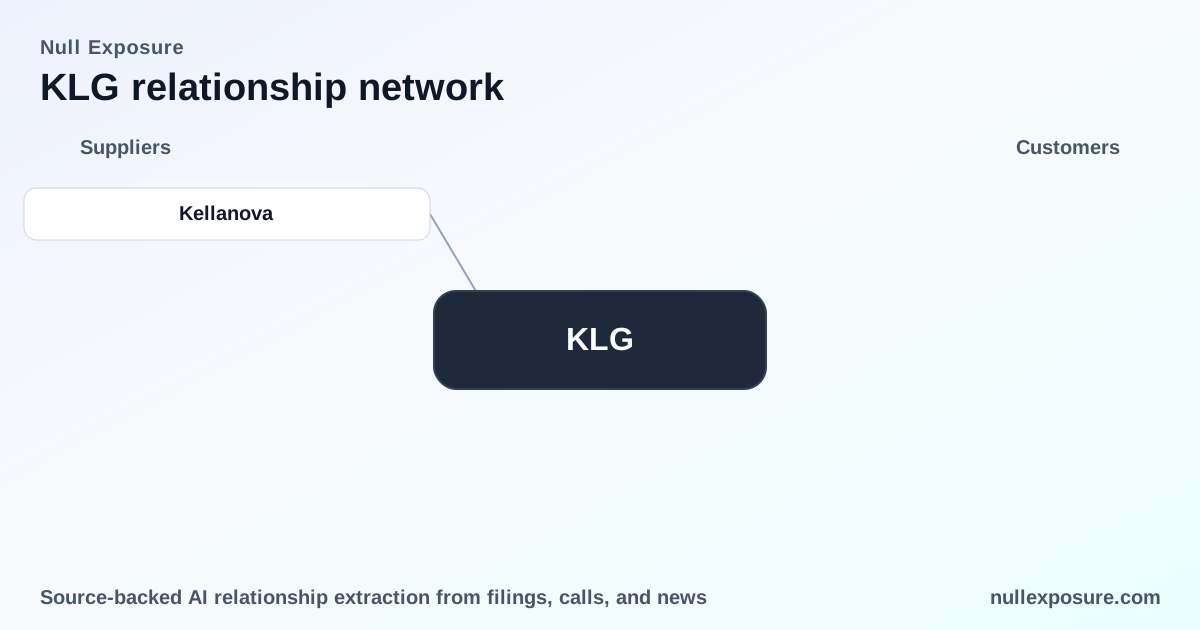
KLG’s publicly surfaced supplier relationships in the current review include a single explicitly documented partner:
- Kellanova — KLG expects to exit all transition services with Kellanova by mid-2025, signaling the end of a defined integration/support period and a structural change in how KLG delivers services to that counterparty. Source: BakingBusiness article, March 10, 2026 (https://www.bakingbusiness.com/articles/63287-wk-kellogg-sheds-light-on-growth-paths-beyond-cereal).
This article captures every relationship disclosed in the available results. There are no additional named partners in the current set of public snippets.
What the Kellanova change implies for KLG’s operating model
- Contracting posture: Exit of transition services indicates prior deep operational integration and a negotiated timeline for decommissioning support. That history implies KLG accepts multi-phase contracts that start with intensive integration and migrate to stable supply terms.
- Concentration risk: When a public mention centers on a single major counterparty, concentration becomes a potential investor concern. The Kellanova exit reduces operational obligations but also removes a built-in revenue line tied to transitional work.
- Criticality and maturity: The existence and wind-down of transition services show KLG can deliver complex, mission-critical work that reaches a transition-complete state. Exiting support suggests maturity in delivery but also a requirement to replace transition-service economics with ongoing supply or new contracts.
- Operational leverage: Transition services historically increase near-term working capital and operational effort; their cessation typically frees management bandwidth and may improve margins if replacement contracts are less resource-intensive.
Note: these are company-level signals inferred from the available public disclosure; there are no explicit constraints or additional contract excerpts in the dataset to attribute to any particular relationship.
How this change affects valuation and short‑term cash flows
- Revenue composition shifts. Transition services tend to be time-limited and operationally intensive; their end will reduce that category of revenue and could either lower total reported revenue or shift mix toward steady-state supply sales.
- Margin implications. Removing integration work usually reduces on-the-ground costs and variability, allowing gross margins to normalize if replacement contracts deliver comparable pricing.
- Balance sheet and working capital. Exiting transition agreements often reduces capital tied up in inventory, manpower and logistics, improving free cash flow conversion in subsequent quarters.
- Event risk. If Kellanova represented a large share of transitional revenue, the exit raises replacement risk; management is responsible for demonstrating customer retention under steady-state terms or securing new business.
Practical due diligence steps for investors and operator partners
For underwriters, operators, and investors evaluating KLG, focus diligence on these items:
- Confirm the quantum of revenue tied to transition services and the pace of de‑recognition after mid-2025.
- Review contractual terms that govern the end of transition services: termination penalties, ongoing supply pricing, and exclusivity clauses.
- Evaluate customer concentration beyond the publicly disclosed Kellanova mention — request a top-10 customer revenue breakdown and top counterparty exposure timelines.
- Assess margin profile post-transition: what pricing replaces transition-service fees and how cost structure adjusts.
- Validate operational readiness to scale replacement business or convert transition-client relationships into stable supplier arrangements.
- Inspect working capital cycle and any retention/escrow arrangements that could affect cash flow timing.
These steps will reveal whether the Kellanova exit is a de-risking event or a revenue cliff.
For immediate monitoring and structured supplier intelligence, consider a focused vendor-tracking approach; NullExposure maintains ongoing coverage and can centralize signals for portfolio due diligence: https://nullexposure.com/.
Key risks and where conviction comes from
- Risk — customer concentration: Public evidence centers on Kellanova; absent disclosure of a diversified customer base, concentration risk elevates.
- Risk — replacement execution: Management must convert transitional relationships into stable revenue or secure new contracts to sustain growth.
- Conviction drivers: The fact that KLG provided transition services at scale demonstrates operational capability and bargaining leverage during integration phases; exiting those services suggests the company completed a high-touch delivery and is moving to less resource-intensive operations.
Investors should value KLG on a forward-looking basis that reflects the post‑mid‑2025 revenue mix rather than historic transition-service run-rates.
Bottom line and next steps
KLG’s public footprint in this review is compact but material: the company is transitioning away from integration-heavy services to a more conventional supplier posture with Kellanova by mid-2025, a change that reshapes revenue mix, margins, and operational demand. This is a classic supplier lifecycle move — de-risking on one axis while shifting the onus onto sales and account management to maintain or grow revenue. For investors and operators, the critical questions are how much revenue is affected, how margins change, and whether management has credible replacement channels.
For ongoing tracking of KLG’s supplier relationships and to integrate this signal into portfolio workflows, visit NullExposure for continuous supplier intelligence: https://nullexposure.com/.
Contact the supplier intelligence team at NullExposure to set up customized alerts and get focused briefings on counterparty transitions.