KLRS: A concise read on the advisors and suppliers behind Kalaris Therapeutics
Kalaris Therapeutics operates as a clinical-stage ophthalmology therapeutics company focused on retinal disease and advances value through clinical progress and capital markets activity—principally equity placements and strategic transactions that fund R&D and underwrite development milestones. The company monetizes through financing rounds and potential future commercialization; its supplier and advisor roster signals a capital-intensive operating model that relies heavily on external legal, capital markets, and investor-relations partners to execute deals and steward investor communications. For a quick deep-dive on counterparty exposures and what they imply for operator and investor diligence, see Null Exposure’s coverage: https://nullexposure.com/.
Who shows up when Kalaris needs money, counsel and market-facing communications
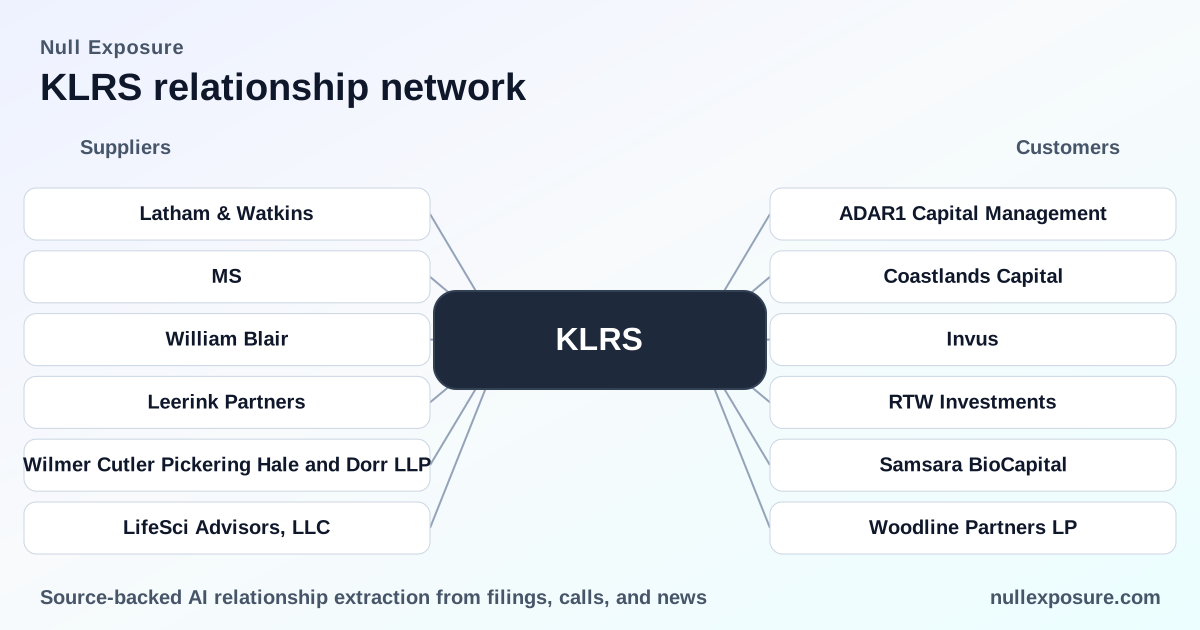
This is a compact supplier map: law firms handling transaction and merger counsel, investment banks placing equity, and investor-relations firms managing public messaging. Each relationship below is active in announced corporate events and public disclosures; taken together they demonstrate a deal-focused supplier posture rather than a vertically integrated commercialization engine.
-
Latham & Watkins — Legal advisor on private placement
- Latham & Watkins advised on Kalaris’ US$50 million private placement, providing transaction counsel for the financing announced in early March 2026. This indicates the company engaged a top-tier global law firm for placement documentation and regulatory work (LegalDesire, March 10, 2026: https://legaldesire.com/latham-watkins-advises-on-kalaris-therapeutics-us50-million-private-placement/).
-
Morgan Stanley — Lead placement agent for the financing
- Morgan Stanley served as a lead placement agent on the oversubscribed $50.0 million private placement, signaling institutional distribution capability and institutional investor access for equity raises (InvestingNews, March 10, 2026: https://investingnews.com/kalaris-therapeutics-announces-oversubscribed-50-0-million-private-placement/).
-
Leerink Partners — Co-lead placement agent
- Leerink Partners co-led the private placement alongside Morgan Stanley, reinforcing a healthcare-focused capital markets syndicate and depth in life-sciences investor relationships (InvestingNews, March 10, 2026: https://investingnews.com/kalaris-therapeutics-announces-oversubscribed-50-0-million-private-placement/).
-
William Blair — Placement agent role
- William Blair participated as a placement agent in the financing, adding boutique healthcare capital markets execution support to the syndicate (InvestingNews, March 10, 2026: https://investingnews.com/kalaris-therapeutics-announces-oversubscribed-50-0-million-private-placement/).
-
Wilmer Cutler Pickering Hale and Dorr LLP — Legal counsel in merger activity
- WilmerHale acted as legal counsel to Kalaris in the announced merger transaction with AlloVir, which positions the firm as lead transaction counsel on deal structuring and closing activities (GlobeNewswire, November 8, 2024; VisionMonday reporting of the merger close, 2025: https://www.globenewswire.com/news-release/2024/11/08/2977479/0/en/AlloVir-and-Kalaris-Therapeutics-Announce-Agreement-for-Transformational-Merger-to-Create-Company-Focused-on-Diseases-of-the-Retina.html and https://www.visionmonday.com/eyecare/article/kalaris-therapeutics-announces-closing-of-merger-with-allovir/).
-
LifeSci Advisors, LLC — Investor relations and IR contact
- LifeSci Advisors is listed as Kalaris’ investor contact for clinical updates and conference presentations, a sign that external IR support is used for both press dissemination and investor engagement at conferences (InvestingNews reporting on clinical data and a Stifel conference appearance, 2025–2026: https://investingnews.com/kalaris-therapeutics-reports-positive-initial-phase-1a-data-for-th103-in-treatment-naive-neovascular-amd/ and https://investingnews.com/kalaris-to-present-at-stifel-2025-annual-healthcare-conference/).
For investor access to the full supplier mapping and to track counterparties over time, visit https://nullexposure.com/.
What the supplier list tells investors about the operating model
The pattern of relationships conveys clear operational characteristics beyond the names themselves:
- Contracting posture: The firm is transaction-forward and relies on external specialist firms for discrete workstreams—capital formation and legal counsel for financings and M&A. The presence of primary placement agents and top-tier law firms indicates short-duration, high-consequence engagements rather than long-term captive staffing for these functions.
- Concentration and criticality: Capital-raising and transaction execution depend on a small set of high-quality counterparties; disruptions to these relationships would be operationally significant because fundraising and deal execution are central to runway and corporate strategy.
- Outsourced maturity: Use of specialist placement agents and established law firms signals a mature externalization strategy—Kalaris relies on external expertise rather than building in-house capacity for capital markets or transaction counsel.
- Service roles versus manufacturing: Publicly reported supplier relationships skew to advisory and market-facing services (IR, placement agents, law firms) rather than manufacturing or large-scale CMO partners in the provided relationship set.
If you want a systematic monitoring feed for counterparty changes that matter to valuation and operational risk, Null Exposure centralizes these supplier signals: https://nullexposure.com/.
Constraints and company-level signals investors should factor into diligence
Company disclosures and evidence excerpts show a broader supplier and contract footprint that shapes risk:
- A framework contracting posture is present where master agreements (e.g., a named “BaseCamp agreement”) enable discrete work orders for services, setting deliverables, fees, and timelines while not obligating either party to execute every work order—this is consistent with flexible, project-based outsourcing.
- Material dependence on third parties is stated for clinical trial execution and for production-related activities: the company historically depends on external CROs, CMOs, and vendors to run trials and produce clinical supplies, which makes supplier performance and business continuity a direct input into clinical timelines and therefore valuation.
- Concentration risk and critical suppliers exist where the company relies on a limited number of suppliers, and sometimes a sole supplier, for components and manufacturing steps—this elevates supply-chain fragility for any transition to commercial production.
- Mixed relationship roles are evident: some partners function as manufacturers and CMOs in manufacturing operations, while others provide services (CROs, investor relations, placement agents). The business therefore juggles both critical manufacturing dependencies and transactional service relationships.
These signals demand that investors calibrate runway, dilution risk, and timeline sensitivity to supplier performance and single-source exposures.
Investment implications and action points
- Immediate focus for investors: Monitor placement agent updates and counsel notices for future financings and transaction steps—these entities are the first signal of capital raises and M&A activity. The oversubscribed private placement and the engaged syndicate reflect current market access but also future dilution potential.
- Operational diligence: Evaluate manufacturing and CRO concentration in separate operational filings; supplier single-sourcing materially affects the probability of schedule slippage for pivotal trials.
- Engagement: Use specialized supplier monitoring to convert these relationship signals into alert thresholds for covenant events, financing needs, or regulatory milestones.
For continuing coverage and supplier risk tracking on KLRS and similar therapeutics companies, go to https://nullexposure.com/.
Final takeaway
Kalaris runs a deal-centric supplier model: high-quality external counsel and placement agents underpin capital formation, while investor-relations firms shape market narrative. That structure gives the company institutional access, but it also concentrates risk around a small set of advisors and external service providers whose performance directly influences financing, liquidity, and development timelines. For investors focused on execution risk and capital strategy, monitoring changes to these relationships is as consequential as tracking clinical-readout calendars.
Explore ongoing counterparty monitoring and bespoke reporting at Null Exposure: https://nullexposure.com/.