Klotho Neurosciences (KLTO): supplier map and what it means for investors
Klotho Neurosciences operates as a licensing-led biotech platform building gene and cell therapy assets around the human Klotho protein. The company monetizes through exclusive licenses to academic IP, milestone and royalty-bearing license agreements, and outsourced manufacturing and development partnerships that convert early-stage programs into clinical assets and—if successful—commercial products. For investors, the core commercial model is IP-driven value uplift plus value realization via third-party manufacturing and acquisition of complementary assets.
Explore a vendor and counterparty view on KLTO and get structured supplier intelligence at https://nullexposure.com/.
Why the supplier map matters: the business model in plain terms
KLTO’s operating model is highly licensing-centric and outsourcing-dependent. The company secures academic inventions via license agreements, pays development milestones and royalties, and relies on contract manufacturers and service providers to execute preclinical and clinical programs. That structure creates two dominant investor levers: (1) IP exclusivity and scope, which controls addressable indications and later royalties; and (2) third-party execution risk, which affects timelines, cost, and regulatory outcomes.
Key company-level signals from recent disclosures:
- Long-term licensing posture: a licensor excerpt indicates license terms that run 10 years after market authorization with automatic 10-year extensions, signaling strategic, multi-decade control over core assets.
- Licensing economics: a public filing excerpt cites upfront and milestone payments, assignment fees, and a 2% running royalty, showing an explicit royalty-bearing revenue model if products reach market.
- Manufacturing and service dependence: the company states it will rely on CROs and CDMOs for manufacturing, testing, and trial execution, creating operational concentration risk.
- Short-term corporate liabilities: a note maturing December 4, 2025, signals a discrete short-term financing maturity that investors should monitor for refinancing activity.
Deepen due diligence with structured supplier profiles at https://nullexposure.com/.
Direct relationships and sourcing: line-by-line coverage
Below are every relationship item disclosed in the supplied results, each with a concise plain-English summary and source reference.
-
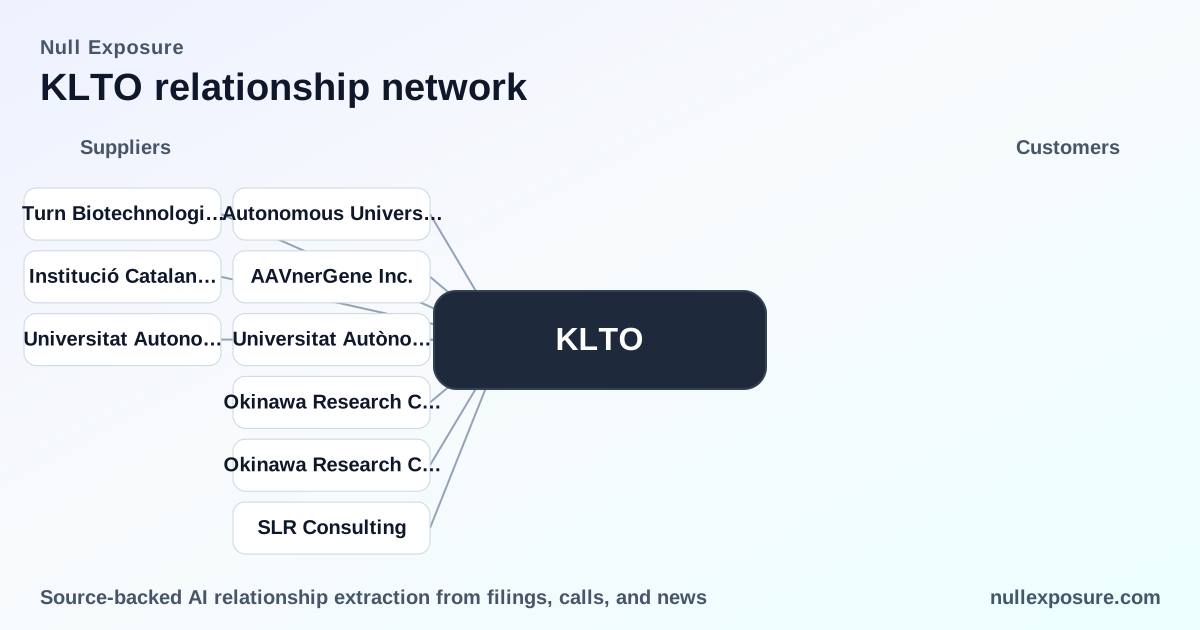
Autonomous University of Barcelona — KLTO licensed a unique RNA splice variant of the human alpha-Klotho gene, including patents, know‑how and related IP for gene and gene‑engineered cell therapies, positioning the university as a primary IP source for KLTO’s core platform. (PR Newswire, March 2026)
-
AAVnerGene Inc. — KLTO has a manufacturing partnership with AAVnerGene to produce several gene therapy candidates that use tissue‑specific promoters to raise Klotho protein levels in targeted tissues, reflecting a CDMO manufacturing relationship for vector production. (PR Newswire, March 2026)
-
Universitat Autònoma de Barcelona (UAB) — KLTO secured an exclusive worldwide license for the secreted Klotho isoform (s‑Kl) from UAB, confirming UAB as a principal licensor for KLTO’s therapeutic program. (Yahoo Finance summary of company release, March 2026)
-
Okinawa Research Center for Longevity Science (ORCLS) — ORCLS will supply and/or coordinate analysis of centenarian blood samples in a research partnership to study tissue and blood Klotho levels and their relationship to longevity and neurodegenerative disease risk. (Yahoo Finance & BioSpace coverage, March 2026)
-
Okinawa Research Center for Longevity Science — a second report reiterated the ORCLS collaboration focusing on centenarian sample analysis to establish Klotho’s role in longevity and disease risk reduction. (BioSpace press release, March 2026)
-
SLR Consulting — SLR Consulting prepared Mineral Resource Estimates that KLTO referenced in a press release about acquiring Greenland Mines Corp, indicating external technical consultation for non-biotech mineral assets the company has announced. (PR Newswire, March 2026)
-
Turn Biotechnologies, Inc. — KLTO signed a Letter of Intent to acquire select assets from Turn, which develops iPSC and cellular reprogramming technologies, signaling an inorganic expansion into cell‑based capabilities. (PR Newswire and Yahoo Finance, March 2026)
-
Institució Catalana de Recerca i Estudis Avançats (ICREA) — KLTO secured an exclusive worldwide license for s‑Kl that includes rights from ICREA alongside UAB, positioning ICREA as a co‑licensor for the company’s foundational IP. (Yahoo Finance, March 2026)
-
Turn Biotechnologies, Inc. — a second mention in a separate outlet confirmed the LOI to acquire Turn assets, reinforcing the strategic intent to integrate iPSC and reprogramming technology into KLTO’s pipeline. (Yahoo Finance, March 2026)
-
Universitat Autonoma de Barcelona — an Australian patent grant notice confirmed that IP Australia will grant certain claims to KLTO and the licensor Universitat Autonoma de Barcelona, strengthening KLTO’s patent estate in Australia. (PR Newswire and Yahoo Finance Canada coverage, March 2026)
-
Universitat Autonoma de Barcelona — duplicate coverage of the Australian patent claim grant appears across outlets and confirms the same IP milestone. (Yahoo Finance Canada, March 2026)
Each relationship entry above is taken from company press releases and public reporting in March 2026; these form the supplier and IP map investors should track.
What the relationships imply about concentration and criticality
- Concentration of key IP with academic licensors (UAB/ICREA) makes KLTO’s core product economics highly dependent on the scope and enforceability of those licenses — IP is the primary value driver.
- Manufacturing reliance on third parties (AAVnerGene and unnamed CDMOs/CROs) creates a single‑point execution risk: delays or quality issues at a CDMO translate directly into clinical and commercial setbacks.
- Strategic diversification through the Turn LOI and the Greenland Mines reference (SLR Consulting) signals management pursuing both vertical capability (iPSC) and non-core asset acquisition; both moves produce opportunity but raise complexity and capital allocation risk.
- Contracting posture is mixed: evidence shows long-term license commitments with auto-extension features alongside at least one short-term debt maturity, indicating both multi-year IP lock‑in and near-term financing cadence.
Key takeaways and risk checklist
- IP control is decisive: exclusive worldwide licenses for s‑Kl and granted patent claims in Australia are positive de‑risking events for potential monopoly economics.
- Execution depends on partners: manufacturing and trial delivery are outsourced; investors must watch counterparty performance and supply agreements.
- Licensing fees and royalties are explicit: disclosures reference upfront fees, milestone payments and a 2% royalty, which defines a quantifiable downstream royalty burden.
- Balance sheet timing matters: a note maturing December 4, 2025 requires monitoring of liquidity or refinancing actions.
If you evaluate counterparties or need a supplier risk scorecard tied to these relationships, see actionable profiles at https://nullexposure.com/.
Actionable next steps for investors
- Review the full license terms and patent filings for scope and field‑of‑use limitations; exclusivity breadth is central to valuation.
- Monitor AAVnerGene and any named CDMOs for manufacturing timelines and quality signals that would affect clinical milestones.
- Track Turn Biotechnologies transaction progress to understand whether KLTO is acquiring capabilities or merely assets; integration risk affects near‑term cash needs.
For a tailored supplier diligence brief or to map KLTO’s counterparty dependencies across filings, visit https://nullexposure.com/.
Klotho’s strategy is IP-first with outsourced execution, and the recent relationship map reinforces that thesis — investors should value patents and licenses as primary assets while treating CDMO/CRO performance and near-term financing events as the main operational risks.