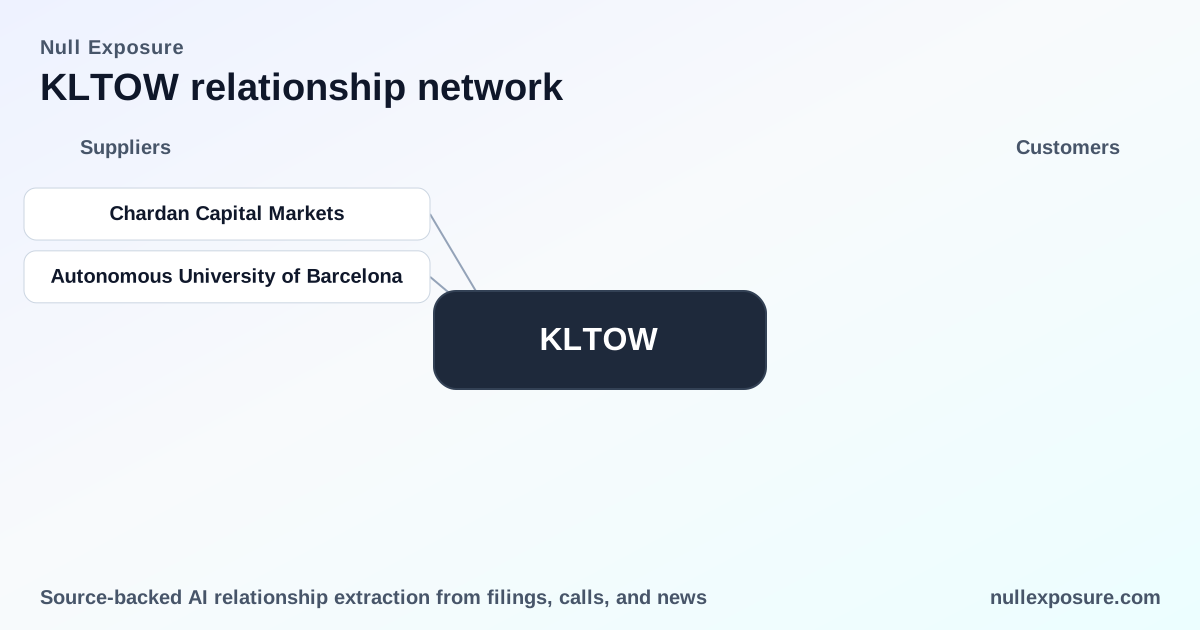
KLTOW supplier landscape: licensing, capital advising and third‑party manufacturing that determine execution risk
Klotho Neurosciences operates as an early‑stage biotech that monetizes through licensing its neuroscience assets, executing targeted financing events, and partnering with third‑party manufacturers and service providers to advance clinical programs. The company’s cash and capitalization strategy is executed through financial advisors and public warrant mechanics, while its product pipeline is built on academic licenses and long‑dated manufacturing agreements that lock in supply but concentrate operational risk.
For a concise, investor‑facing directory of counterparties and supplier signals visit NullExposure.
Relationship snapshots
Chardan Capital Markets — Klotho engaged Chardan as a financial advisor in connection with public warrant exercises, a role that signals institutional underwriting and active capital management during FY2025 (reported March 2026). According to a BioSpace press release, Chardan served as the exclusive financial advisor to facilitate the warrant exercises that funded the company’s recent equity recapitalization (https://www.biospace.com/press-releases/klotho-neurosciences-raises-over-11-million-retires-all-debt-and-exceeds-nasdaq-stockholders-equity-requirement, Mar 10, 2026). SmallCapExclusive also noted Chardan’s involvement as consistent with a disciplined capital strategy (SmallCapExclusive, Jul 7, 2025; https://smallcapexclusive.com/2025/07/07/klotho-neurosciences-nasdaq-klto-11-million-raised-als-gene-therapy-manufacturing-underway-a-disruptor-on-the-nasdaq/).
Autonomous University of Barcelona — Klotho’s s‑KL gene variant program is licensed from the Autonomous University of Barcelona, with the intellectual property concentrated in neuronal tissues relevant to ALS and spinal cord targets. SmallCapExclusive documented that the s‑KL variant underpins the company’s lead translational work (SmallCapExclusive, Jul 7, 2025; https://smallcapexclusive.com/2025/07/07/klotho-neurosciences-nasdaq-klto-11-million-raised-als-gene-therapy-manufacturing-underway-a-disruptor-on-the-nasdaq/).
What these relationships reveal about the business model
- Capital strategy is active and advisor‑led. The Chardan engagement shows Klotho uses specialist investment banks to structure equity and warrant transactions that directly fund operations and address balance sheet issues. That is a deliberate monetization approach: execute financing events rather than rely solely on milestone partnerships.
- IP is university‑anchored and license heavy. The Autonomous University of Barcelona licensing indicates the company’s R&D is primarily built on academic IP transfers, not internal discovery commercialization.
- Execution depends on third‑party manufacturing and service providers. Public disclosures and licensing language show Klotho relies on CROs and CDMOs for manufacturing, quality control, and trial execution—creating a vendor‑centric operating model where product release and regulatory timelines are contingent on external partners.
For deeper supplier profiling and counterparty risk analytics, see NullExposure.
Operating model constraints and what they mean for investors
The company’s public materials and license excerpts surface several durable constraints that shape valuation and operational risk:
- Long‑term licensing posture. Klotho’s licenses include terms that extend up to 10 years post‑market authorization and automatically renew unless notice is given 180 days prior to expiry. This structure secures long‑dated commercialization rights but increases lock‑in risk and exposure to partner performance over multiple regulatory cycles.
- Multiple licensing arrangements. The company has executed non‑exclusive and exclusive license agreements (for example, with Heidelberg University and other academic institutions), indicating a portfolio approach to IP acquisition rather than single‑origin ownership.
- EMEA operational footprint. Asset acquisitions and approvals in Germany point to geographic concentration in EMEA for some licensed products, which has implications for regulatory pathway alignment and market access strategy.
- Outsourced manufacturing and clinical execution. Klotho explicitly relies on CROs and CDMOs for manufacturing, quality control, logistics, and trial conduct; this is a company‑level signal that manufacturing execution and vendor quality are critical single points of failure.
- Active supplier relationships. Licensing and manufacturing agreements are described as active, exclusive, and royalty‑bearing in places (e.g., a 2014 exclusive license tied to API supply), which signals ongoing contractual commitments that carry both revenue upside and operational dependency.
These constraints are company‑level signals drawn from licensing and operational language in filings and press materials. They collectively indicate a business model that is partner‑dependent, licensing‑driven, and capital‑sensitive.
Detailed supplier and partner implications
- Capital advisor (Chardan Capital Markets): The exclusive advisory role for warrant exercises indicates Klotho prioritizes structured equity solutions to shore up liquidity and retire debt, which reduces immediate dilution risk for management but increases execution reliance on capital markets timing (BioSpace, Mar 10, 2026; SmallCapExclusive, Jul 7, 2025).
- Academic licensors (Autonomous University of Barcelona and others): Academic licenses supply core IP that is central to clinical programs; favorable license terms accelerate development rights, while non‑exclusive structures can dilute competitive barriers (SmallCapExclusive, Jul 7, 2025).
- Manufacturing suppliers / CDMOs / RLS (implied in license language): Exclusive API supply agreements and long‑dated manufacturing contracts prioritize supply certainty but impose concentration risk if a supplier underperforms or fails regulatory audits (license excerpts and company disclosures).
Concentration, criticality and maturity — one‑line investor signals
- Concentration: IP and approved assets show EMEA concentration for certain products; manufacturing may be concentrated to a small number of CDMOs.
- Criticality: Manufacturing and CRO execution is mission‑critical; failures create immediate clinical and regulatory setbacks.
- Maturity: Relationships span early translational licensing to active commercial supply agreements, indicating a mix of embryonic and contractually mature arrangements.
Mid‑article action point: for regular monitoring and supplier stress testing, visit NullExposure.
Key risks and what to monitor next
- Execution risk at CDMOs/CROs — track audit outcomes, regulatory inspection results and quality control holds for any named manufacturing partners.
- Financing cadence — monitor warrant exercise notices, advisory filings and any future Chardan communications for dilution and capital runway indicators.
- License renewal and exclusivity triggers — watch contractual notice windows and royalty mechanics tied to long‑term license extensions.
- Geographic concentration — follow regulatory filings in Germany and broader EMEA to assess market access and reimbursement timelines.
Final takeaways and investor actions
Klotho’s supplier ecosystem is a classic small biotech design: academic IP, advisor‑led financing, and outsourced execution. That structure creates upside through focused science and partnerships but concentrates downside on the performance of a few counterparties and the company’s ability to execute financing events. Investors should treat supplier disclosures as leading indicators: capital advisor engagements precede liquidity events; license terms reveal lock‑in and revenue pathways; and manufacturing contracts define the path to clinical and commercial supply.
For a consolidated view of Klotho’s counterparties and to track evolving supplier signals, consult NullExposure.