Kimberly‑Clark (KMB) — supplier relationships, procurement posture, and investor implications
Thesis: Kimberly‑Clark is a mature consumer‑products manufacturer that monetizes entrenched brand equity (Kleenex, Huggies, Kotex) through global retail distribution and steady volume sales; its margins and cash returns are anchored by scale purchasing of pulp and absorbent materials and by disciplined capital allocation to dividends and buybacks. For investors and operators evaluating supplier relationships, the critical signals are long‑term raw‑materials contracting, supplier concentration for specific inputs, and use of large financial counterparties for hedging—all of which shape cost volatility and regulatory exposure. For a concise commercial map and supplier intelligence, visit https://nullexposure.com/.
How Kimberly‑Clark makes money and why suppliers matter
Kimberly‑Clark manufactures largely paper‑based consumer products and sells through retail and institutional channels worldwide. Revenue is driven by branded consumer purchases—tissue, diapers, feminine care and wipes—with steady cash generation (Revenue TTM $16.45B, EBITDA $3.199B, Profit Margin 12.3%) that supports a material dividend (Dividend Yield ~5.1%). The business model depends on predictable access to commodity inputs—pulp, superabsorbent polymers and utilities—so procurement contracts directly influence gross margin stability.
Key corporate signals of maturity: large market capitalization (~$33.3B), low beta (0.23), high institutional ownership (~89%) and a history of dividend payouts, all consistent with a low‑beta, income‑oriented industrial retail franchise. These characteristics reduce growth optionality but emphasize operational and procurement execution as the main drivers of investor returns.
Supply posture in plain language: long contracts, concentrated sources, financial counterparties
Kimberly‑Clark’s public disclosures show a clear procurement strategy and risk posture:
- Long‑term purchasing commitments are used for critical inputs: “We have entered into long‑term contracts for the purchase of raw materials, primarily superabsorbent materials, pulp and certain utilities.” That contracting posture favors price stability and supply continuity but creates exposure if contract terms become unfavourable relative to spot markets.
- Counterparty selection leans to large financial institutions for hedging and derivative needs: the company states derivatives are “primarily entered into with major financial institutions,” which signals counterparty credit discipline and conventional treasury management.
- Supplier concentration for particular inputs is material and, in places, critical: Kimberly‑Clark acknowledges a network that includes “sole‑source and single‑source suppliers for certain commodities and raw material inputs,” which increases operational risk for those product lines if disruptions occur.
These are company‑level signals drawn from Kimberly‑Clark disclosures and should be read as structural operating constraints: long contracts reduce short‑term margin volatility but can lock in adverse pricing; concentrated suppliers create high single‑point risks for specific materials; and reliance on major banks for hedging reduces counterparty credit risk but centralizes financial relationships.
Regulatory and competitive overlap — the Kenvue interaction
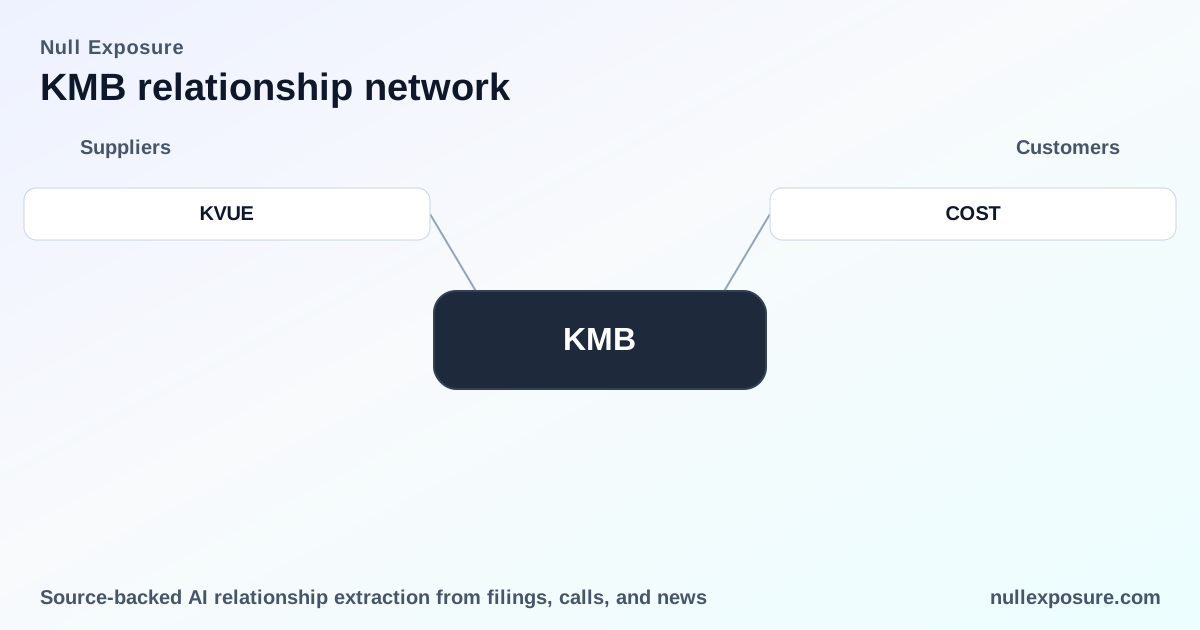
Kenvue (KVUE) is the one counterparty flagged in our supplier‑scope review. The relationship is best understood through recent regulatory scrutiny:
- Kimberly‑Clark and Kenvue both supply feminine‑hygiene products in New Zealand, which was cited by the Commerce Commission during clearance review activity connected to a transaction. An MLex report on March 10, 2026 noted the Commerce Commission said both companies supply tampons, sanitary pads and panty liners in New Zealand. This regulatory overlap implies product category competition and potential antitrust review in concentrated local markets. (Source: MLex article, March 10, 2026.)
The practical implication for investors and operators: when products and channels overlap at a local level, regulatory clearance processes can highlight where supplier/customer roles intermix with competition policy, and those processes can reveal sensitive market shares and substitution patterns that affect route‑to‑market strategy.
Relationship map: every counterparty flagged in the review
- Kenvue — Both Kimberly‑Clark and Kenvue are suppliers of feminine hygiene products in New Zealand, a point the Commerce Commission raised in the context of an acquisition filing; this underlines competitive overlap in selected geographies and potential regulatory scrutiny. (MLex, March 10, 2026.)
What these signals mean for investors and operating teams
Operational and investment consequences flow directly from the procurement and supplier posture described above:
- Cost and margin management: Long‑term contracts smooth input cost volatility but can underperform the market when commodity deflation occurs. Investors should watch contract renewal windows and indexed pricing terms.
- Single‑source risk: For product lines reliant on sole or single suppliers of specific polymers or pulp grades, downtime or supplier failure can produce outsized operational disruption. Operators must prioritize supplier diversification for those inputs or secure redundancy through inventory and alternative sourcing.
- Regulatory friction where competitors overlap: The Kenvue overlap in New Zealand demonstrates how supplier and competitor roles can trigger transactional review and local channel shifts; commercial teams should map market shares at jurisdictional level to anticipate clearance risk.
- Financial‑market counterparty stability: Hedging with major financial institutions keeps credit exposure predictable but creates dependence on a small set of banks under systemic stress; treasury teams should maintain contingency plans for counterparty stress events.
Practical monitoring checklist for investors/operators:
- Watch contract expiries for pulp and superabsorbent materials and any change in indexing clauses.
- Track supplier concentration metrics for named single‑source inputs and mitigation plans.
- Monitor regulatory filings where Kimberly‑Clark is acquiring assets or where competitors overlap (local market share disclosures are revealing).
- Review treasury counterparty lists and collateral practices ahead of rate or liquidity shocks.
For a detailed supplier intelligence view and to monitor these signals in real time, visit https://nullexposure.com/.
Final assessment and actions for market participants
Kimberly‑Clark is a cash‑generative, mature consumer staple operator whose competitive defensibility rests on brands and stable retail demand. However, procurement structure and supplier concentration are active levers that determine margin resilience. Competitive overlap—illustrated by the Kenvue reference in New Zealand—introduces localized regulatory and market‑share risk rather than enterprise‑level existential risk.
Calls to action:
- If you are underweight commodity‑exposed consumer names, evaluate Kimberly‑Clark’s contract renewal schedule and supplier concentration as part of a risk‑adjusted income strategy; more context is available at https://nullexposure.com/.
- Operators should prioritize supplier redundancy and transparent contracting language on indexation and pass‑through clauses; for supplier mapping tools and deeper relationship analytics, see https://nullexposure.com/.
Bottom line: Kimberly‑Clark’s stable cash flow and dividend profile make it a classic defensive holding, but active due diligence on contract terms and single‑source dependencies is essential for both investors and supply‑chain operators to assess downside risk and operational resilience.