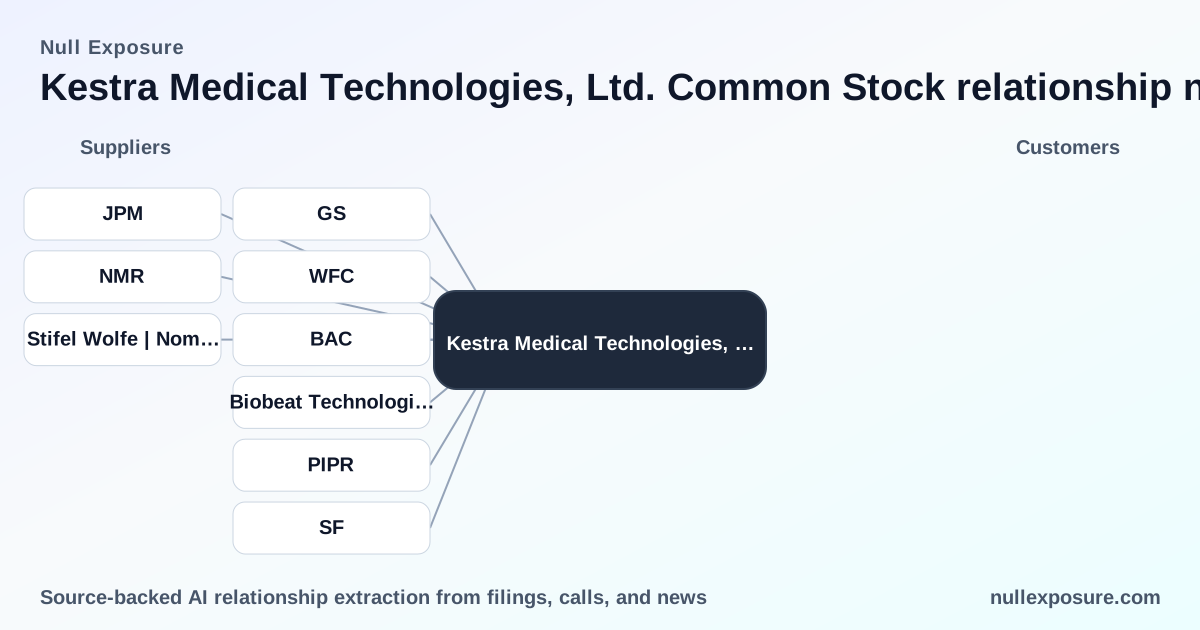
KMTS Supplier Map: Who Kestra Medical Works With and Why it Matters to Investors
Kestra Medical Technologies builds and commercializes the ASSURE wearable cardioverter defibrillator and monetizes through device sales, rental and reconditioning services, and an expanding digital-care platform powered by integrated biosensing partners. The company finances growth through equity markets and underwritten offerings, while outsourcing most hardware manufacture and field services—creating a supplier footprint that is strategically critical to revenue delivery and clinical performance. For a deeper look at counterparties and how they affect KMTS risk and upside, visit https://nullexposure.com/.
Big-picture operating model: outsourced hardware, partnered clinical data, and capital markets access
Kestra runs a capital-light manufacturing posture: it designs the ASSURE system but outsources the manufacturing and reconditioning of garments, monitors, batteries and accessories to third parties. Field execution is also outsourced—Kestra’s commercial model relies on a contracted network of over 300 patient support specialists (APSs) to fit and train patients, while third-party partners recondition devices for redeployment. These relationships are not optional extras; they are material and in some cases critical to continuity of product supply and patient care.
- Kestra’s lease disclosures show multi-year, long-term real estate commitments for R&D and headquarters through April 30, 2029, signaling stable operational footholds and predictable fixed overhead (company lease disclosure as of April 30, 2025).
- The company states it relies on a small number of vendors for manufacturing and reconditioning, which creates concentration risk if a supplier interruption occurs.
- Kestra also holds and receives licensed IP/technology, indicating part of its product stack depends on third-party licenses as well as internal development.
Those structural points shape supplier priorities: quality and regulatory compliance from contract manufacturers, uptime and logistics from reconditioning providers, and interoperability from digital health partners.
Every named partner and what they do for Kestra
Below are every relationship referenced in the results set, each with a plain-English summary and its source.
- BofA Securities — Served as a lead underwriter/bookrunner on Kestra’s public offering activity in FY2025; listed with other banks in the company’s offering announcements. According to GlobeNewswire press material released December 1 and December 3, 2025, BofA was among the bookrunners for the upsized primary offering.
- Goldman Sachs — Named as a lead bookrunner and underwriter for Kestra’s offering activities during the FY2025 financing process. A cardiovascular industry report and GlobeNewswire releases (Dec 2025; March 2026 reporting) list Goldman Sachs among the underwriting syndicate.
- Goldman Sachs & Co. LLC — The corporate entity appears on Kestra’s underwriting roster for the public offering; GlobeNewswire’s December 2025 release identifies Goldman Sachs & Co. LLC in the underwriting group.
- Wells Fargo Securities — Acted as a bookrunner on Kestra’s public offering in FY2025, named alongside other major bulge-bracket firms in the company’s December 2025 press releases. (GlobeNewswire, Dec 2025; cardiovascularbusiness reporting).
- Piper Sandler — Identified repeatedly as a lead/bookrunner for Kestra’s offering and as part of the underwriting syndicate for the upsized December 2025 deal. (GlobeNewswire, Dec 2025; tradingcalendar summary).
- J.P. Morgan — Listed as a bookrunner on Kestra’s public offering materials in December 2025; included in the underwriting group in company press releases. (GlobeNewswire, Dec 2025).
- Stifel — Cited as a bookrunner in Kestra’s offering syndicate and mentioned in industry press about the IPO process in FY2025. (cardiovascularbusiness and GlobeNewswire releases, Dec 2025 / Mar 2026).
- Wolfe | Nomura Alliance — Served as co-manager/co-managerial participant for Kestra’s proposed offering, referenced in coverage of the IPO process. (cardiovascularbusiness reporting, March 2026).
- Stifel Wolfe | Nomura Alliance — Appears as a combined listing in coverage and offering summaries for Kestra’s IPO/offerings during FY2025; referenced in tradingcalendar and related summaries. (tradingcalendar summary, Mar 2026).
- Biobeat Technologies, Ltd. — Entered a strategic collaboration with Kestra to integrate Biobeat’s FDA‑cleared blood pressure and ambulatory BP monitoring (ABPM) technology into the ASSURE WCD platform, expanding remote diagnostic capabilities for cardiac recovery patients; announced in a GlobeNewswire release dated January 13, 2026 and covered by TradingView on March 10, 2026.
Each relationship above is documented in Kestra’s market communications and industry coverage; underwriting partners are consistently named across December 2025 press releases and March 2026 trade reporting, while the Biobeat collaboration is detailed in January 2026 disclosures and subsequent press pickup.
What these relationships imply for investors: concentration, capability, and liquidity
Kestra’s supplier and partner map creates three clear investment implications:
- Concentration risk is real and measurable. The company explicitly relies on a small number of contract manufacturers and reconditioning partners; any significant interruption could affect shipments and revenue recognition. The company’s own risk disclosures identify vendor concentration as a material vulnerability (company risk disclosures, FY2025).
- Clinical capability is expanding via strategic tech partners. The Biobeat collaboration is a substantive product-level upgrade: integrating FDA-cleared ABPM into ASSURE WCD increases the device’s clinical signal and value to providers, which supports adoption and reimbursement discussions (GlobeNewswire Jan 13, 2026; TradingView Mar 10, 2026). This is a positive demand-side lever.
- Capital markets relationships show strong financing access. The presence of major underwriters—BofA, Goldman Sachs, J.P. Morgan, Wells Fargo, Piper Sandler, Stifel and co-managers—indicates Kestra has market access when it needs equity financing, which reduces near-term liquidity concerns tied to growth capital (GlobeNewswire Dec 2025; cardiovascularbusiness Mar 2026).
Explore how supplier relationships affect valuation and risk modeling in more detail at https://nullexposure.com/.
Operational constraints that shape supplier risk and negotiating posture
Interpreting Kestra’s public disclosures yields practical constraints investors should weight into models:
- Contracting posture: Kestra’s long-term facility leases through April 30, 2029 suggest fixed-cost commitments that favor suppliers capable of reliable volume forecasting and stable lead times; the company’s outsourcing strategy reduces capital expenditure but increases dependency on contract terms.
- Concentration and criticality: Multiple disclosures describe reliance on a small number of vendors for manufacturing and reconditioning; those relationships are material and in some instances critical to the product lifecycle.
- Geographic exposure: Kestra warns of global supply-chain dynamics and trade protection measures as a potential cost/input risk, signaling that component sourcing is international and sensitive to tariff and trade actions.
- Relationship roles: Public text identifies suppliers across three roles—manufacturer, licensee, and service provider—so counterparty risk is protocol-diverse: manufacturing disruptions, IP license term risk, or field‑service capacity shortfalls each carry different mitigation levers.
These are company-level signals—use them to stress-test scenario models for production continuity, margin pressure, and clinical uptime.
What to watch next (and a final action)
Key near-term catalysts that will reprice KMTS counterparty risk: device shipment cadence and reconditioning throughput metrics, commercialization progress of ABPM-enabled ASSURE units with Biobeat technology, and any follow‑on capital markets activity that reallocates underwriting exposure. Monitor company disclosures and the underwriting syndicate’s role in future financings as a liquidity barometer.
For a structured supplier risk review and ongoing monitoring of KMTS counterparties, return to https://nullexposure.com/ for updated analyses and alerting. If you want the full supplier roster mapped to operational risk scenarios, start here: https://nullexposure.com/.
Bold takeaways: Kestra’s business is capital‑market enabled, clinically differentiated by partnerships like Biobeat, and operationally dependent on a concentrated set of manufacturing and service suppliers—each a potential value lever or fault line for investors.