CarMax (KMX) — supplier relationships that move inventory, capital, and customer experience
CarMax is a national used-vehicle retailer that monetizes a tight two-sided model: it buys vehicles at scale from consumers and auctions, refurbishes and retails them through its store and digital channels, and finances sales through CarMax Auto Finance. Revenue derives from vehicle sales, financing margins, and ancillary services; the supplier ecosystem therefore spans capital providers, digital partners, and marketplace vendors whose contracts and costs feed directly into margins and working capital. For investors and operators, the supplier footprint matters because supply inputs (vehicle purchases), funding arrangements, and digital distribution partners each influence liquidity, gross margin pressure, and the pace of digital customer acquisition. Learn more about structured supplier intelligence at https://nullexposure.com/.
Why supplier relationships are a strategic lever for CarMax
CarMax’s operating model concentrates risk and opportunity in three areas: (1) the sourcing of inventory from individual sellers and dealers; (2) the funding stack that underpins its auto loan receivables; and (3) digital partnerships that influence lead generation and online conversion. This is not a distribution business where suppliers are interchangeable — inventory counterparty mix and funding tenor are core determinants of working capital volatility and financing cost. The recent reporting and press items in early 2026 illustrate active management of that stack: cost control in SG&A, new digital channels, and the use of third-party capital markets relationships.
What the public record shows about CarMax’s supplier relationships
Below I cover every relationship found in the sourced material and summarize the practical implication for investors and operators.
Snowflake (SNOW): cloud/AI data partner for automotive solutions
CarMax is cited as a customer for Snowflake’s new automotive AI data-cloud solutions, indicating the company is investing in advanced data and AI tooling to drive operational efficiency and potentially improve pricing and inventory decisions. According to Snow’s 2026 Q1 earnings call (March 2026), Snowflake introduced automotive solutions that “empower companies like CarMax and Nissan with advanced data and AI solutions.” Source: Snow Q1 2026 earnings call.
RBC Capital Markets: investment banking/advisory relationship
RBC Capital Markets is positioned as an investment banking counterparty that expects to receive or seek compensation for services from CarMax within a short timeframe, signaling an active capital markets advisory relationship or potential financing transaction. A Streetwise Reports article (April 16, 2026) notes that a member of RBC Capital Markets expects to receive or intends to seek compensation for investment banking services from CarMax in the next three months. Source: Streetwise Reports, April 2026.
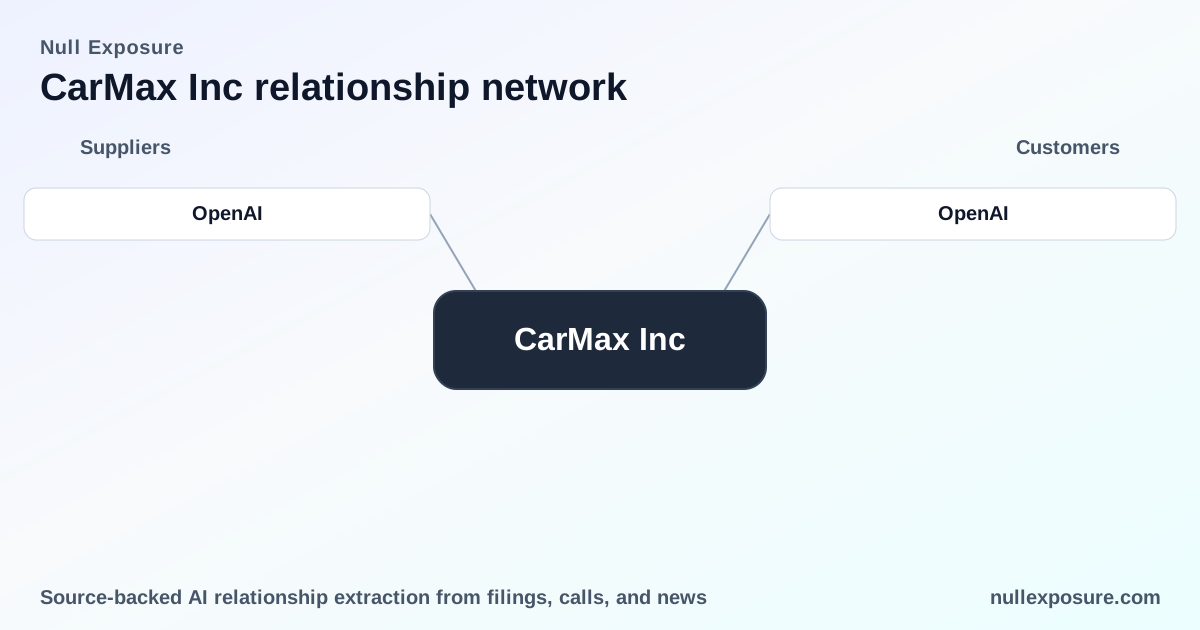
OpenAI / ChatGPT App Store: distribution and customer-facing AI channel
CarMax launched a CarMax app in the ChatGPT App Store to surface nationwide inventory and online offer capabilities, establishing OpenAI as a distribution channel for vehicle discovery and trade-in offers and exposing CarMax to conversational commerce. A GlobeNewswire press release (Feb 27, 2026) announced the CarMax App in ChatGPT, and industry commentary (Sahm Capital, Feb 28, 2026) flagged this as a strategic bet on AI-driven digital growth and suggested watching competitor responses. Sources: GlobeNewswire Feb 27, 2026; Sahm Capital commentary Feb 28, 2026.
Edmunds: occupancy/lease termination impact on SG&A
CarMax recorded higher occupancy costs partly driven by a $21 million Edmunds lease exit charge, linking Edmunds to a material one-off occupancy and expense item that affected reported SG&A in FY2026. The Q4 FY2026 earnings transcript reported the $21 million Edmunds lease exit charge contributing to higher occupancy costs. Source: Q4 FY2026 earnings transcript as published on The Globe and Mail (May 2026).
Operating-model constraints that shape supplier risk and priority
CarMax’s filings and commentary reveal company-level structural constraints that determine how supplier relationships function in practice:
- Long-term funding posture for receivables. CarMax typically uses term securitizations to provide long-term funding for auto loans receivable, which institutionalizes reliance on capital markets and structured finance partners rather than solely short-term credit lines.
- High proportion of individual counterparties for inventory. The company acquires a significant percentage of retail used vehicles directly from consumers via in-store and online appraisals, making individual sellers a high-volume, operationally important counterparty class.
- Bank counterparties for credit mitigation. CarMax mitigates credit risk by transacting with highly rated bank counterparties, reflecting a conservative credit counterparty posture for financing and deposit relationships.
- Geographic concentration in the U.S. Operations are national but domestic — as of Feb. 28, 2025 CarMax operated 250 used-car stores across 109 U.S. television markets — underscoring that suppliers are predominantly U.S.-based and subject to domestic market cycles.
- Material spend and purchase obligations. The company reported purchase obligations and commitments around $371.9 million (with $163.9 million due in fiscal 2026), and it bought approximately 1.2 million vehicles in fiscal 2025, indicating material, recurring procurement spend that shapes supplier negotiation leverage and working capital needs.
- Buyer role with scale concentration. CarMax’s role as a large buyer of consumer vehicles makes supplier relationships strategic rather than ancillary; supply interruptions or pricing shifts directly flow into inventory cost and turnover.
These characteristics explain why CarMax actively pursues technology partnerships to improve pricing efficiency (Snowflake, OpenAI), preserves capital access through banking and investment banking relationships (RBC), and manages real estate and occupancy costs (Edmunds-related lease exits).
Investment and operational implications
- Digital partnerships are now part of competitive moat construction. The OpenAI app and Snowflake engagement indicate management is deploying data and conversational channels to restore digital growth and improve procurement/pricing decisions; investors should treat these as strategic investments in customer acquisition efficiency.
- Capital markets relationships are a governance lever on liquidity. RBC’s expected advisory role suggests potential refinancing, securitization, or other capital actions that will influence leverage and liquidity; monitor filings for bank/advisor fees and transaction terms.
- SG&A and occupancy actions can produce volatile line-item swings. The Edmunds lease exit charge is a reminder that real-estate decisions can generate material one-offs; separate core SG&A trends from discrete restructuring/lease actions in any model.
- Procurement scale introduces working-capital sensitivity. High volumes of consumer-sourced vehicles and substantial purchase obligations mean inventory turns and pricing environment are primary drivers of near-term cash flow; stress scenarios should model negative price drift and securitization funding cost widening.
Key takeaways: CarMax’s supplier relationships are not ancillary vendors — they are operational levers that affect inventory flow, customer reach, and balance-sheet funding. Investors should watch continued rollout and adoption of AI/digital channels, any capital markets transactions, and the cadence of non-recurring occupancy costs.
For a deeper look at supplier relationships across public companies and to map counterparty exposure into financial stress tests, visit https://nullexposure.com/.
Concluding, the early-2026 record shows CarMax actively investing in AI-driven distribution (OpenAI), expanding enterprise data tooling (Snowflake), engaging capital markets advisors (RBC), and executing real-estate rationalization that produced an Edmunds-related charge — all movements that directly influence margins, liquidity, and strategic optionality.