Knowles (KN): Supplier relationships, strategic moves, and what investors should price in
Knowles operates and monetizes as a component and precision-devices manufacturer that sells engineered acoustic and electromechanical products into medtech, defense, and industrial electrification end markets; growth and margin expansion are driven by product sales, higher-value precision devices, and strategic M&A to add complementary capabilities. In FY2025 Knowles executed a targeted acquisition program—paying $259.8 million to buy Kaplan Electronics and certain assets of Cornell Dubilier—to accelerate its Precision Devices segment and capture adjacencies in medtech and industrial electrification. Investors should view Knowles as a product-oriented OEM that leverages inorganic dealmaking to reshape its end-market exposure and move up the value chain.
Explore deeper supplier intelligence and relationship mapping at https://nullexposure.com/.
The corporate signal: what the filings say about supplier risk and sourcing posture
Knowles’ disclosures provide clear, actionable signals about its supplier strategy and vulnerability. The company states that historically "the loss of any single supplier has not had a material impact on operating profits," but also warns that if a supplier or foundry cannot deliver materials or components in a timely manner, Knowles could experience a material adverse impact on results of operations. Separately, the company admits it relies on highly specialized suppliers or foundries for critical materials that are sometimes sole sourced or that also serve competitors.
From these excerpts we derive firm-level characteristics important for investors evaluating counterparty and operational risk:
- Contracting posture: Knowles contracts with specialized suppliers and foundries that supply critical inputs; this is not a purely transactional buyer — supplier relationships are strategic and enduring.
- Concentration: The language on sole-sourcing and strategic suppliers signals concentration risk in the supply base rather than broad commoditized purchasing.
- Criticality: Inputs from certain suppliers are mission-critical; disruptions translate directly to production and revenue loss rather than indirect margin pressure.
- Maturity and replaceability: The company admits substitute qualification timelines can be long, which makes supplier replacement operationally and commercially expensive.
These company-level constraints shape how investors should value Knowles’ acquisition strategy and its supplier relationships: M&A that internalizes critical components or secures alternate manufacturing capability materially alters risk-adjusted cash flow profiles.
Supplier relationships disclosed in the record
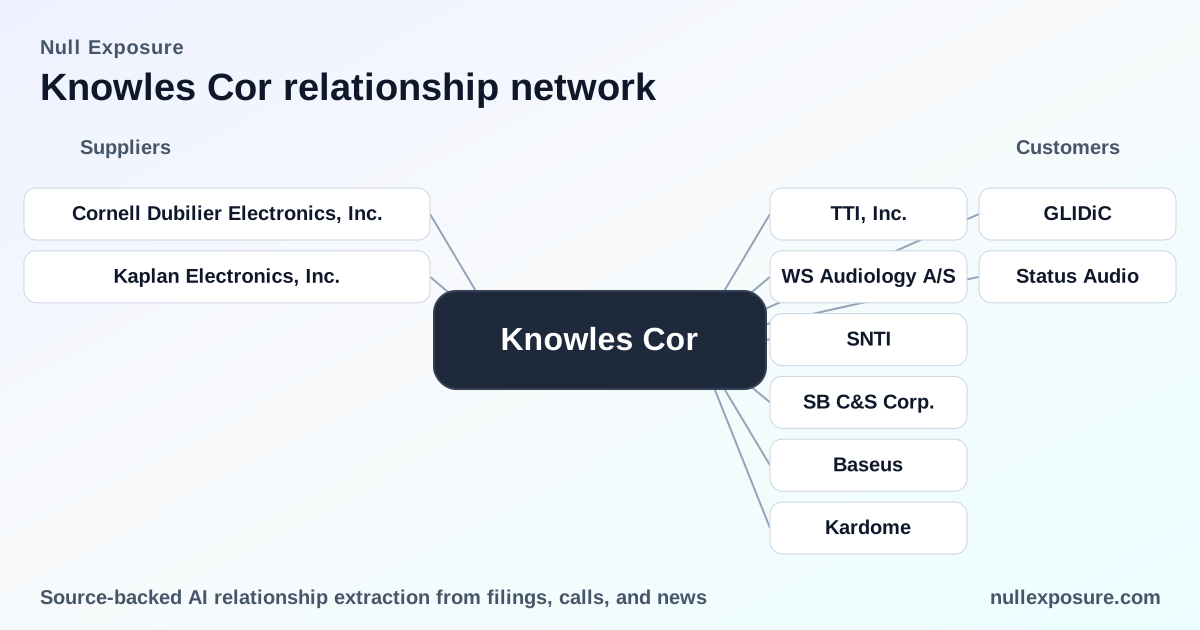
Kaplan Electronics, Inc.
Knowles acquired Kaplan Electronics, Inc. as part of a $259.8 million transaction intended to bolster its Precision Devices segment and accelerate access to medtech, defense, and industrial electrification applications. TradingView’s coverage of Knowles’ SEC 10‑K (FY2025) reported the acquisition and described the strategic intent behind the purchase. (Source: TradingView reporting on Knowles’ FY2025 10‑K).
Takeaway: The Kaplan purchase is a deliberate vertical/adjacency move to internalize design and manufacturing capability for higher-margin precision products.
Cornell Dubilier Electronics, Inc. (certain assets)
Knowles purchased certain assets of Cornell Dubilier Electronics, Inc. within the same $259.8 million transaction package, positioning those assets to strengthen its Precision Devices offerings for targeted industrial and defense end markets. TradingView’s summary of Knowles’ FY2025 10‑K describes the asset purchase as complementary to the Kaplan acquisition and focused on applications in medtech, defense, and industrial electrification. (Source: TradingView reporting on Knowles’ FY2025 10‑K).
Takeaway: Acquisition of Cornell Dubilier assets is a capability grab that reduces reliance on external suppliers for discrete components used in precision applications.
Operational implications for investors and operators
Knowles’ transaction set and supplier disclosures combine to form a coherent strategy and an identifiable set of operational risks:
- Strategic de-risking through M&A. By acquiring Kaplan and assets from Cornell Dubilier, Knowles is converting external supplier capability into in-house capacity—reducing single-supplier exposure and shortening qualification cycles for critical components.
- Integration and execution risk. The value of these deals depends on successful integration of engineering, manufacturing, and quality systems into Knowles’ Precision Devices segment; execution failure would reintroduce supply fragility and depress expected synergies.
- Revenue mix and margin trajectory. Shifting revenue toward medtech and defense via precision devices typically increases ASPs and margin potential, but it also raises program qualification and warranty obligations that require disciplined engineering and quality management.
- Supply continuity remains a material risk. Despite these acquisitions, Knowles explicitly recognizes that supply disruptions can have a material impact—a disclosure investors must price into scenario analysis for the next 12–24 months.
For a practical assessment of how these supplier moves impact downside scenarios, run a sensitivity on margin and lost production days tied to a single critical supplier event and compare to the projected synergies of the Kaplan/Cornell asset purchases.
Learn more about how supplier relationships change valuation risk at https://nullexposure.com/.
What to watch next (operational milestones and investor cues)
Investors should track the following near-term indicators to confirm the strategic thesis:
- Integration milestones (customer migrations, internal qualification of components formerly bought from external suppliers).
- Program wins in medtech, defense, and industrial electrification that are supported by Kaplan or Cornell Dubilier capabilities.
- Supplier concentration metrics disclosed in quarterly filings—changes in single-supplier dependency will directly affect the company’s risk profile.
- Any reported manufacturing or qualification delays that could signal integration friction.
If Knowles achieves clean integration and converts a meaningful share of Precision Devices revenue to higher-margin programs, the acquisition will be accretive to free cash flow and reduce supplier-driven downside. Conversely, missed milestones or persistent single-source dependencies will keep the company exposed to material operational shocks.
Bottom line and investor action items
Knowles is executing a targeted strategy to internalize critical capabilities in its Precision Devices segment through M&A, a move that reduces supplier concentration risk and accelerates its entrance into higher‑value end markets. The company’s own disclosures keep supplier risk front-and-center: while past supplier losses were not material, a future supplier disruption could have a material adverse impact on operations. Investors should value Knowles using scenario-based stress tests that incorporate supplier disruption probabilities and integration success rates for the Kaplan/Cornell transactions.
For detailed supplier mapping and to see how these relationships interact with contract exposure, visit NullExposure and request a supplier-risk briefing: https://nullexposure.com/.
If you are evaluating a position in KN or managing counterparty exposure, prioritize diligence on integration cadence, qualification timelines, and any remaining single-source components—these factors will determine whether the $259.8 million deployment generates durable upside or simply shifts timing of supply-chain risk. For help modeling these scenarios and building an operational risk view tailored to your portfolio, start with a briefing at https://nullexposure.com/.