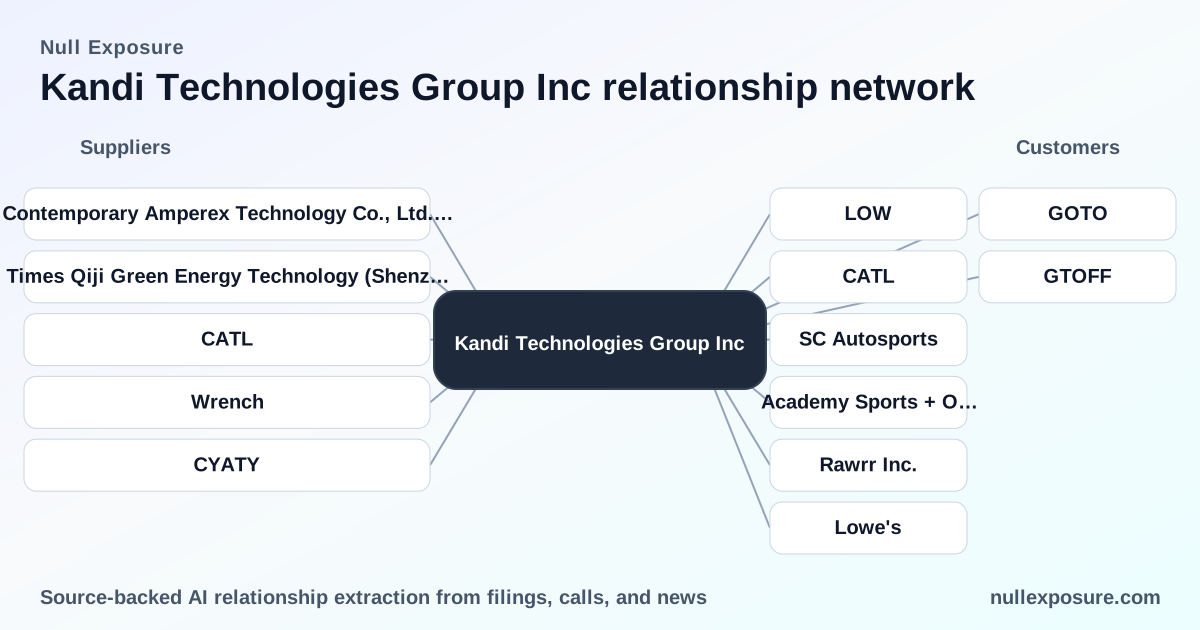
Kandi Technologies (KNDI): supplier relationships that reshape the battery-swap playbook
Kandi Technologies designs, manufactures and distributes low-speed electric vehicles and components in China and internationally, and it monetizes through vehicle and parts sales, equipment contracts via its subsidiary China Battery Exchange (battery-swap station hardware), and services/aftermarket partnerships in export markets. The commercial pivot for investors is clear: Kandi is transitioning from pure vehicle sales to recurring-equipment contracts tied to battery-swap rollouts, which generate project revenue streams with different margin and risk profiles than vehicle OEM sales.
Explore KNDI supplier risk at NullExposure
What the public record shows about Kandi’s supplier relationships
Below are every supplier-related item surfaced in the public feed for KNDI. Each entry is a concise, plain-English summary with the cited source.
-
Contemporary Amperex Technology Co., Ltd. (CATL) — A Finviz news item (March 10, 2026) notes that China Battery Exchange successfully entered CATL’s global supplier ecosystem, signaling acceptance by a global battery leader. According to that coverage, the relationship positions China Battery Exchange to supply equipment into CATL-linked programs (Finviz, 2026-03-10).
-
Times Qiji Green Energy Technology (Shenzhen) Co., Ltd. (Qiji Energy) — The same Finviz report (March 10, 2026) states China Battery Exchange signed an agreement to serve as a strategic supplier to Qiji Energy, which is a CATL subsidiary focused on battery-swap and energy services, creating a channel into CATL’s swap infrastructure (Finviz, 2026-03-10).
-
CATL (repeat coverage) — Separate news coverage records that China Battery Exchange signed an agreement to become a battery-swap station equipment supplier to CATL, underlining a formal supplier role rather than a pilot or advisory arrangement (Finviz, 2026-03-10).
-
Wrench — Kandi America announced a partnership with Wrench for mobile vehicle maintenance and repair (press release summarized by Wccftech), establishing an electric-fleet service agreement for onsite warranty repairs in the U.S., which diversifies Kandi’s service footprint outside China (Wccftech, reporting an August 13 announcement).
-
Contemporary Amperex Technology Co. Ltd. (CYATY) — Sahm Capital and market write-ups referenced a framework procurement deal between China Battery Exchange (Zhejiang) Technology and CATL (August 2025), indicating a procurement pipeline and prior contracting history with CATL ahead of the 2026 agreements (Sahm Capital, coverage citing August 2025 framework deal).
-
CATL (earnings call disclosure, 2025 Q2) — Kandi’s Q2 2025 earnings call confirms China Battery Exchange became a supplier of heavy-truck battery-swapping station equipment to CATL and reported a first order to support CATL’s rollout plan for 10,000 stations, converting the relationship into an executable, order-backed engagement (KNDI 2025 Q2 earnings call).
Why these relationships matter for investors and operators
The CATL/Qiji pipeline transforms Kandi’s balance between one-time vehicle revenue and recurring project-level equipment contracts. CATL is a large, creditworthy counterparty and its decision to onboard China Battery Exchange as a supplier elevates Kandi from small OEM to component/equipment contractor in a high-capex network rollout. The earnings call disclosure of an initial order tied to an ambition of 10,000 stations is a commercial proof point of scale intent (KNDI Q2 2025 earnings call).
At the same time, the Wrench partnership demonstrates geographic diversification of service capability, exposing Kandi to U.S. fleet-service economics and warranty management, which are recurring-revenue adjacent and reduce reliance on Chinese retail vehicle sales (Wccftech, 2020 press release).
Explore KNDI supplier risk at NullExposure
Operational constraints and company-level signals investors should weigh
There are no explicit external constraints listed in the supplier feed; that absence is itself a signal. From company data and relationship context, derive the following operational characteristics:
-
Contracting posture: Project and PO-driven — supplier work is delivered as station-equipment contracts tied to multi-station rollouts rather than continuous commodity supply, implying milestone-based invoicing and revenue lumpyness. The earnings-call order for CATL supports this posture.
-
Concentration: High counterparty concentration — multiple entries reference CATL and its subsidiaries (Qiji), indicating revenue and execution risk concentrated with one dominant battery player.
-
Criticality: Strategically high but commercially asymmetric — supplying CATL’s swap stations is commercially important and enhances Kandi’s strategic standing, but CATL’s relative size and leverage give the buyer negotiating power over price and delivery terms.
-
Maturity: Emergent supplier profile — China Battery Exchange is operating at the junction between prototype and scale: documented framework agreements and initial orders exist, but Kandi’s corporate financials show the firm is still rebuilding profitability (Revenue TTM ~ $104M, EBITDA negative ~$30.3M, EPS -$0.61), so supplier delivery hinges on Kandi’s operational execution while it remains financially constrained.
These signals combine to define a supplier relationship mix that is strategic, concentrated, milestone-dependent, and sensitive to Kandi’s balance sheet.
Risk and upside implications for procurement and investor diligence
-
Upside: Access to CATL’s rollout unlocks meaningful equipment demand and a path to recurring installation/project revenue if Kandi converts capacity into repeatable deliveries across the 10,000-station target (KNDI Q2 2025 earnings call; Finviz, March 2026).
-
Risks: Single-buyer exposure, execution cadence, and working-capital strain. Kandi’s negative EBITDA and limited institutional ownership (≈1.26%) increase the importance of contract terms that include upfront payments, performance milestones, and protective termination/penalty clauses.
-
Diversification: The Wrench partnership is a functional counterweight—aftermarket and service agreements reduce overall program concentration risk by creating revenue outside of Chinese station equipment projects (Wccftech, 2020).
Practical next steps for investors and partners
- For investors: review contract economics and payment schedules in any filings or supplier agreements; prioritize verification of order backlog and payment milestones tied to the CATL engagement.
- For procurement teams and operators: insist on firm minimums, progress payments and acceptance tests for large-station orders, and require financial covenants or escrow mechanics when working with a supplier exhibiting negative EBITDA and limited institutional support.
- Conduct site-level validation of early deployments tied to CATL’s program to validate unit economics before scaling purchasing commitments.
Evaluate supplier exposure further at NullExposure
Bottom line
Kandi’s supplier relationships, led by a confirmed supplier role into CATL’s battery-swap program and complemented by U.S. service partnerships like Wrench, redefine the company as both an OEM and an equipment contractor. That strategic pivot introduces meaningful upside if Kandi executes on orders, but it simultaneously concentrates risk around a single dominant buyer and strains the company’s already fragile profitability profile. Investors and sourcing teams must focus diligence on contract structure, backlog verification and working-capital protections to convert strategic relationships into durable shareholder value.