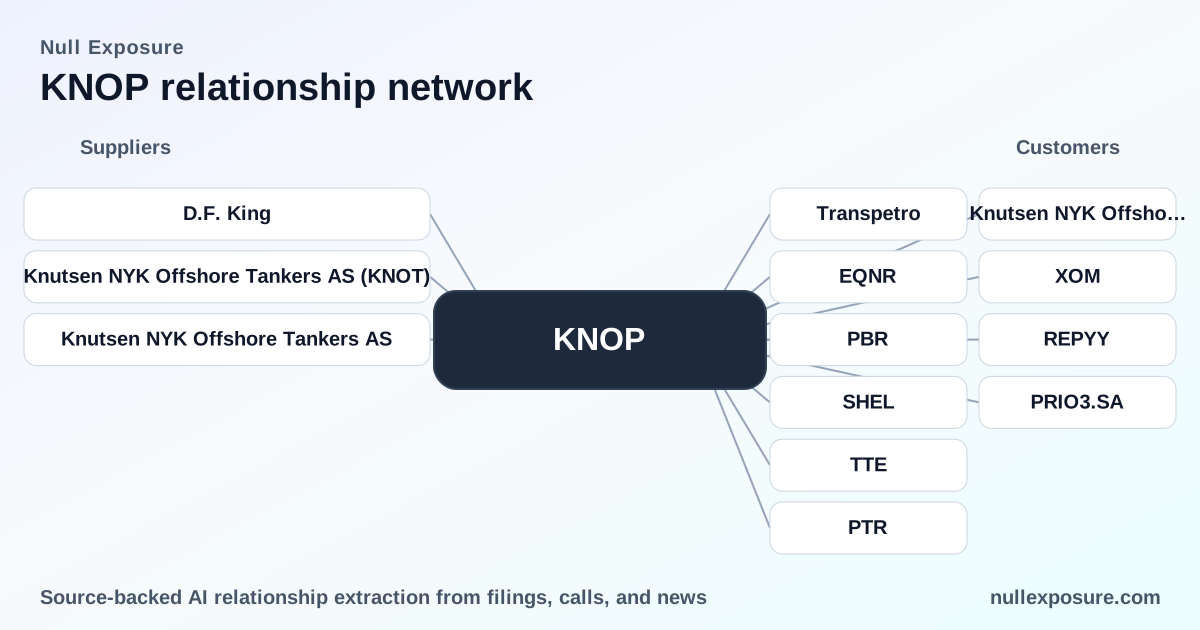
KNOP Supplier Map: How Knot Offshore Partners Monetizes its Fleet and Who Supplies Key Services
Knot Offshore Partners (KNOP) operates as a shipping company that monetizes through ownership and commercial deployment of shuttle tankers and related vessel assets, generating cash flow from long-term charters, spot employment and opportunistic asset swaps that optimize fleet configuration. Revenue is asset-driven and partner-dependent: KNOP extracts value by placing specialized DP2 shuttle tankers into service while relying on a small set of third-party counterparties for vessel transactions and corporate services.
For investors and operators assessing supplier risk, the recent record shows tight operational relationships with Knutsen NYK Offshore Tankers (KNOT) for vessel purchases and swaps, and standard corporate governance support from a proxy solicitor. Review the relationship summaries below, then read the implications for counterparty concentration, contracting posture, and near-term operational risk. For a complete supplier-provider profile visit https://nullexposure.com/.
Quick take: what these supplier ties signal for investors
KNOP’s supplier interactions emphasize an asset-centric operating model with high counterparty concentration in vessel origination/transfer, predictable transactional behavior (swaps and purchases), and standard corporate support services. These patterns translate into clear liquidity and asset deployment levers, but also concentration risk if the KNOT relationship shifts. For deeper supplier risk monitoring and continuous updates, see https://nullexposure.com/.
D.F. King — proxy solicitation and shareholder meeting services
KNOP engaged D.F. King as its proxy solicitor in connection with its annual meeting process; investors are directed to contact D.F. King for voting assistance. According to a March 2026 notice referenced by AIJourn, KNOP listed D.F. King as the designated contact for unit-holder voting and related proxy services in FY2025. Corporate governance services are outsourced to a professional solicitation firm, which is typical for mid-cap partnership structures and reduces internal administrative burden.
Source: AIJourn reporting on KNOP’s FY2025 annual meeting adjournment, March 2026.
Knutsen NYK Offshore Tankers AS (KNOT) — shuttle tanker swap: Tuva Knutsen for Dan Cisne (reported FY2024)
KNOP’s subsidiary KNOT Shuttle Tankers AS executed a vessel swap with Knutsen NYK Offshore Tankers AS that involved acquiring the shuttle tanker Tuva Knutsen while selling the Dan Cisne. Multiple industry outlets documented the transaction in FY2024, confirming it as a simultaneous swap rather than a simple sale or purchase. The swap demonstrates an active fleet-optimization posture: KNOP trades vessels with a major industry counterparty to match asset specifications to commercial needs.
Source: Chemical Analyst coverage of the swap (FY2024) and public reporting on the transaction.
Source: ShippingTelegraph coverage of the Dan Cisne/Tuva Knutsen swap (FY2024).
Knutsen NYK Offshore Tankers AS (KNOT) — acquisition of Daqing Knutsen (reported FY2025)
KNOP reported an acquisition of the 2022-built DP2 shuttle tanker Daqing Knutsen from Knutsen NYK Offshore Tankers AS, reflecting a targeted purchase to refresh or expand the fleet in FY2025. ShippingTelegraph documented the July 2 FY2025 notice, highlighting KNOP’s willingness to buy relatively young, specialized assets to capture productive charter opportunities. Purchases of recent-build DP2 vessels indicate a capital allocation bias toward high-specification, revenue-generating tonnage.
Source: ShippingTelegraph report on KNOP’s acquisition of the 2022-built Daqing Knutsen (FY2025).
What these supplier relationships collectively reveal about KNOP’s operating model
No formal external constraints were reported in this supplier review; instead, the relationship activity itself reveals company-level operational characteristics investors should weigh:
-
Contracting posture: KNOP operates an opportunistic but structured contracting approach—using swaps and targeted purchases with a single major counterparty to optimize fleet composition rather than relying solely on newbuilds or broad market acquisitions. This indicates negotiated, bilateral contracting with counterparties capable of executing simultaneous asset exchanges.
-
Counterparty concentration: The volume and materiality of vessel transactions with Knutsen NYK Offshore Tankers AS show concentration risk. Dependence on a dominant supplier for fleet changes increases exposure to that counterparty’s strategic decisions and market position.
-
Criticality: Vessel transactions with KNOT are operationally critical because shuttle tankers are core revenue assets; disruption or deterioration in the relationship would directly affect cash flow and deployment flexibility.
-
Maturity and predictability: The mix of swaps and acquisitions of recent-build tonnage signals a mature operating playbook: KNOP actively manages fleet age and capabilities to sustain charter earnings rather than pursuing speculative expansion.
Investment implications and risk checklist
-
Concentration premium versus concentration risk: The strategic relationship with KNOT enables efficient fleet management and likely better execution on asset exchanges; however, it creates single-counterparty exposure that can amplify counterparty or market shocks.
-
Governance hygiene: Outsourcing proxy solicitation to D.F. King aligns with market practice and limits governance execution risk on shareholder actions; investors should consider whether governance outsourcing is accompanied by transparent meeting disclosures.
-
Asset quality focus: Purchases of modern DP2 shuttle tankers (for example, the 2022-built Daqing Knutsen) suggest capital allocation toward higher-spec assets that command premium charters, which supports long-term cash generation if utilization remains strong.
If you evaluate counterparties or need ongoing monitoring tools for supplier concentration and transaction flow, start with our supplier intelligence hub at https://nullexposure.com/.
Final recommendation
KNOP’s supplier footprint is compact and asset-centric: a concentrated but predictable set of relationships focused on acquiring and exchanging specialized shuttle tankers, complemented by standard corporate service providers. For portfolio managers and operators, the primary diligence lines are counterparty resilience at KNOT, the terms of vessel swaps/purchases, and how governance services are organized. For continuous supplier updates and deeper counterparty risk scoring, visit https://nullexposure.com/.
Bold takeaway: KNOP’s business is driven by asset stewardship through strategic swaps and selective acquisitions; this model delivers stable, asset-backed cash flow but concentrates execution risk in a small set of counterparties.