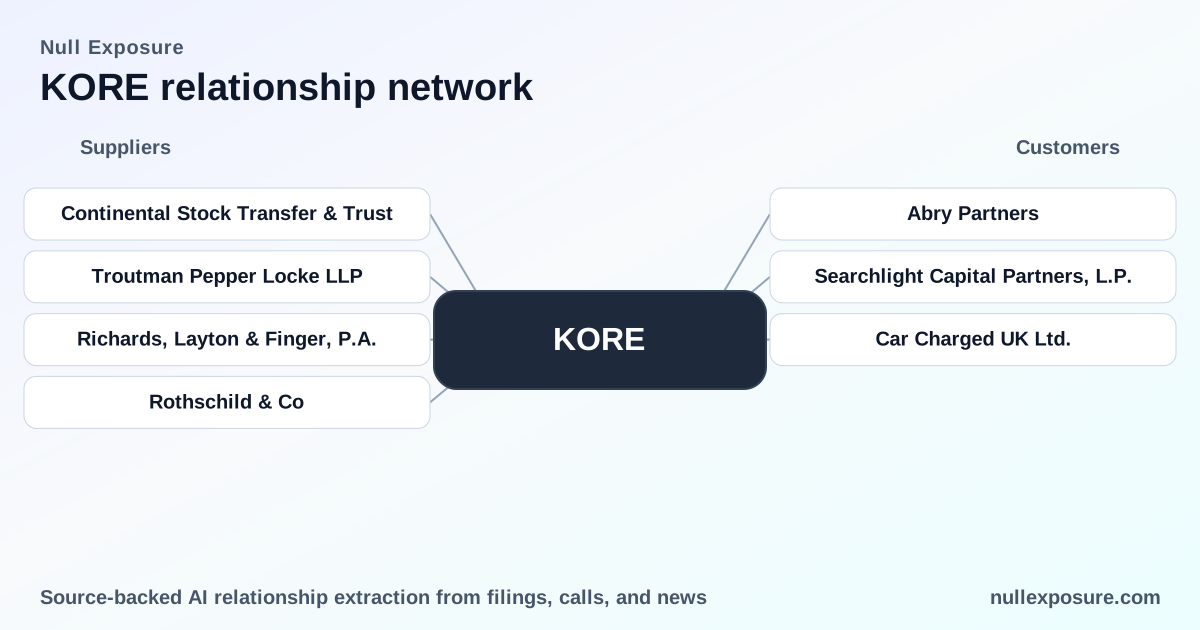
KORE Supplier Relationships: Who KORE Uses and Why It Matters to Investors
KORE Technologies sells IoT connectivity, hardware and managed services and monetizes through recurring connectivity fees, device and hardware sales, and associated service revenue. Recent corporate actions — including a reverse stock split and an announced acquisition by Searchlight Capital Partners and Abry Partners — have produced a set of visible supplier and advisor relationships that illuminate both the company's operating dependencies and its corporate-finance posture. Investors should treat KORE as an IoT operator with concentrated supplier exposures, mid-range committed procurement, and active transaction-level advisory engagement.
Learn more about these signals at https://nullexposure.com/.
Why the supplier list matters now: a short investor thesis
KORE’s core economics depend on delivering connectivity and device solutions at scale; that model translates operationally into reliance on hardware manufacturers, carriers and a small set of service partners for fulfillment. The company-level signals available in filings and press releases show concentration in suppliers, meaningful committed purchase exposure (roughly in the $10–100M band), and active capital-markets advisory engagement that accompanies significant corporate events. These factors combine to affect both operational risk and transaction execution value for equity and debt investors.
What the public record shows: every named relationship
Below I list each relationship surfaced in the available disclosures, with a plain-English description and the issuing source.
Continental Stock Transfer & Trust
Continental is acting as the transfer agent and specifically served as the exchange agent for KORE’s reverse stock split. According to a PR Newswire release dated March 10, 2026, Continental executed the split-related exchange agent duties tied to that corporate action. (PR Newswire, March 10, 2026)
Troutman Pepper Locke LLP
Troutman Pepper is serving as legal advisor to KORE in connection with the announced transaction. The company named Troutman Pepper Locke LLP as its outside legal advisor in a PR Newswire announcement of the acquisition agreement. (PR Newswire, March 10, 2026)
Richards, Layton & Finger, P.A.
Richards, Layton & Finger, P.A. is counsel to KORE’s Special Committee, providing independent legal advice to the committee overseeing the transaction process. That role was disclosed in the same PR Newswire release announcing the acquisition agreement. (PR Newswire, March 10, 2026)
Rothschild & Co
Rothschild & Co is acting as the financial advisor to KORE’s Special Committee, providing valuation and deal advisory services during the acquisition process. This engagement is documented in the PR Newswire announcement of KORE’s agreement to be acquired by Searchlight Capital Partners and Abry Partners. (PR Newswire, March 10, 2026)
Corporate and operational constraints investors should read into
The vendor and advisory roster is only half the story; the company-level constraints embedded in KORE’s disclosures are the other half. From those excerpts, extractable operating-model implications are:
-
Concentrated supplier exposure is a material operational risk. KORE discloses reliance on a limited group of suppliers for components needed to deliver IoT Solutions, and the company explicitly warns that supply disruption could reduce revenue and impair results. Treat this as a corporate-level concentration signal rather than a single-vendor problem.
-
KORE outsources manufacturing for critical components. The filings state reliance on third parties to manufacture parts of the solutions, indicating that supply-chain continuity and contract terms with manufacturers are critical to delivery and margins.
-
KORE acts both as a buyer of service and hardware provider. Cost-of-revenue includes connectivity costs with carriers, hardware products, freight and direct labor; that reflects a blended operational posture—part platform/recurring revenue and part physical hardware logistics and fulfillment.
-
Purchase commitments are meaningful and sit in the mid-sized spend band. The company reported $58.0 million of purchase commitments not recorded as liabilities at year-end, consistent with a spend band in the $10M–$100M range and implying multi-year procurement exposure and potential take-or-pay risk.
-
Contracting posture is transactional and concentrated. The mix of manufacturer reliance and mid-range committed spend suggests KORE negotiates significant, concentrated contracts rather than a highly fragmented supplier base; that contracting posture increases vendor leverage and elevates supplier risk during tight markets.
-
Governance and transaction maturity are elevated. The presence of independent Special Committee counsel and an adviser to that committee, plus company counsel for the buyer-side transaction and a transfer agent handling a reverse split, signal a company executing formal, market-standard transaction processes consistent with mature M&A activity.
How these items change the risk-reward calculation
The advisor roster and the transfer-agent engagement are standard for companies preparing for a controlled liquidity event. Combine that procedural maturity with the operational constraints and you get a clearer risk map:
-
Operational risk is concentrated and credit-relevant. A supplier disruption that affects connectivity modules or device manufacturing would have direct revenue implications because hardware and connectivity are embedded in the cost of revenue.
-
Procurement commitments create real cash and execution exposure. The reported $58.0M of purchase commitments compresses flexibility and can become a lever in renegotiations or in a sale process if suppliers assert claims.
-
Transaction signaling affects optionality and valuation. The Special Committee’s use of Rothschild & Co and independent counsel demonstrates a rigorous sale process; that increases the probability of a controlled outcome that preserves downside protections for shareholders and creditors.
For a deeper vendor-risk breakdown and to monitor changes in these relationships, visit https://nullexposure.com/.
Investor action checklist
- Confirm counterparty concentration in procurement contracts and ask management for supplier-level spend and term summaries.
- Review the $58.0M purchase commitments for concentration, termination rights, and timing of cash outflows.
- Factor supplier disruption scenarios into downside stress cases for revenue and EBITDA given the critical supplier classification disclosed by the company.
- Monitor the acquisition process and Special Committee disclosures: advisor appointments and transfer-agent actions often precede binding transaction milestones that change governance and capital structure.
Bottom line
KORE’s visible relationships — transfer agent, company counsel, Special Committee counsel and financial adviser — paint a picture of a company executing a formal transaction while operating with concentrated supplier exposure, outsourced manufacturing dependencies, and material purchase commitments. From an investor perspective, the combination of operational concentration and active M&A processes requires focused due diligence on supplier contracts and committed spend to properly size downside exposure and valuation assumptions. Learn more about tracking these supplier signals at https://nullexposure.com/.