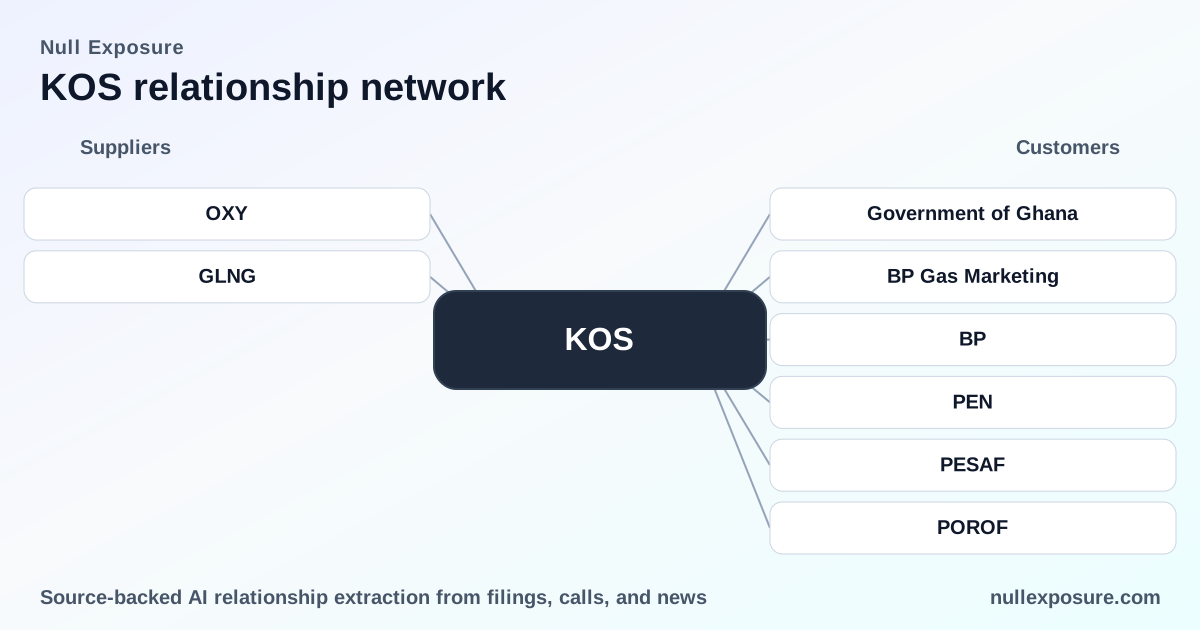
Kosmos Energy (KOS) — supplier relationships, operating posture, and commercial implications
Kosmos Energy operates as an upstream E&P group that commercializes offshore hydrocarbon resources through operated developments and equity partnerships, and it monetizes by bringing fields online (operator and non-operator positions), leveraging host-facility arrangements and FLNG initiatives with third-party partners. For investors and supplier counterparties, the practical takeaway is simple: Kosmos runs capital-intensive, multi-year projects where supplier selection, long-term contracting and financing structure drive execution risk and margin capture. Learn more about how we map these relationships at https://nullexposure.com/.
How Kosmos’s supplier posture translates into risk and opportunity
Kosmos’s operating model combines project-level operator control with a habitual use of third-party contractors for drilling, subsea and FLNG services. Company disclosures describe contracting with third parties to conduct drilling and related services on both development projects and exploration prospects, which positions supplier arrangements as mission critical to on-time, on-budget delivery. At the same time, the firm’s balance-sheet posture — documented amendments to a revolving credit facility with extended tenor and increased capacity — shows medium-term financing commitment that supports multi-year capex plans.
Important structural signals for suppliers and investors:
- Long-term contracting mentality: A formal amendment extended the facility maturity to December 31, 2029 and increased the facility size to $1.35 billion, indicating planning for multi-year capital deployment and liquidity runway. This is a company-level signal about contract tenor expectations rather than a single-project clause.
- Outsourced execution: Kosmos explicitly contracts third parties to perform drilling and related services, reflecting a service-provider relationship model and the expectation that suppliers will deliver field execution under operator oversight.
- Material spend scale: Borrowing levels and undrawn capacity reported as of year‑end indicate capital availability consistent with >$100 million project and program spending, so suppliers should price for scale and duration rather than short-term spot work.
These company-level constraints shape procurement posture: suppliers should expect multi-year scopes, formal contracting and performance accountability tied to project schedules and host-facility integration. Visit https://nullexposure.com/ for a consolidated view of these commercial signals and how they influence counterparty selection.
What Kosmos’s public relationships look like (what we found)
Below are the relationships surfaced in the public record that are relevant for suppliers and investors evaluating Kosmos’s commercial ecosystem. Each entry includes a concise summary and a source reference.
Oxy (OXY)
Kosmos is the project operator on the Tiberias development in the outboard Wilcox, while Oxy holds a 50/50 partnership interest and owns and operates the Lucius host facility that will support the development. This arrangement makes Oxy both a strategic partner on development risk and a host-infrastructure counterparty for production handling. According to an earnings-call transcript covering Q4 2025 published March 10, 2026 on InsiderMonkey, the parties described their alignment on the low-cost Tiberias plan and the shared operational responsibilities. (InsiderMonkey Q4 2025 earnings call transcript, Mar 10, 2026 — https://www.insidermonkey.com/blog/kosmos-energy-ltd-nysekos-q4-2025-earnings-call-transcript-1708159/)
Golar (GLNG)
Golar is engaged with the partnership on initiatives to enhance FLNG operational efficiency and to debottleneck LNG production capacity, signaling a focus on increasing delivered gas volumes and lowering per-unit operating cost through host-operator collaboration. The company noted this collaboration in the same Q4 2025 discussion, highlighting joint workstreams to extract incremental value from the FLNG arrangement. (InsiderMonkey Q4 2025 earnings call transcript, Mar 10, 2026 — https://www.insidermonkey.com/blog/kosmos-energy-ltd-nysekos-q4-2025-earnings-call-transcript-1708159/)
What these relationships imply for suppliers and counterparties
- Operational criticality and coordination: With Kosmos operating projects and relying on partners like Oxy for host facilities and Golar for FLNG services, suppliers must be prepared for complex interface management across operator, host, and FLNG contractor roles. Suppliers that demonstrate integrated logistics, offshore compatibility, and strict HSE track records will win priority.
- Contract length and payment expectations: Company disclosures around the amended revolving facility — larger capacity, extended tenor and a revised interest margin — indicate finance programs built around multi-year execution. Suppliers should anticipate longer-term master service agreements or multi-year scopes rather than single-lift engagements, and should price credit terms accordingly.
- Scale and capital intensity: Reported borrowing and available capacity point to program-level spend capacity above $100 million, so procurement cycles will favor suppliers that can scale, provide performance guarantees and offer competitive financing or staged delivery models.
- Counterparty stability and partner risk transfer: Partnerships with established players like Oxy and Golar materially reduce execution risk for certain interfaces (host operations and FLNG), but they also create points of counterparty dependency — suppliers should structure contracts to reflect which party is accountable for host-facility constraints or FLNG bottlenecks.
Key takeaway: Kosmos runs a capital-intensive, partnership-centric model that rewards suppliers capable of long-term execution, cross-party coordination, and capital-backed performance.
Practical guidance for investors evaluating supplier risk
Investors should treat Kosmos’s supplier relationships as an operational lever: good supplier execution preserves project IRR; poor execution increases cost and schedule slippage risk. Evaluate counterparties on three axes — contractual tenor and protections, operational interface capability (offshore, FLNG, host tie‑ins), and financial resilience to support warranty and performance obligations.
For a concise, actionable map of Kosmos’s supplier posture and partner network, see our synthesis at https://nullexposure.com/.
Conclusion and investor action points
Kosmos’s public disclosures and partner discussions point to a deliberate trade-off: operator control of value capture coupled with heavy reliance on third-party service providers and host/FLNG partners to execute. Suppliers and investors should underwrite multi-year engagement economics, operational interface complexity and counterparty concentration when modeling returns or pricing bids.
If you evaluate energy supplier networks or underwrite project execution risk, use our platform to benchmark Kosmos relationships and contract signals in depth: https://nullexposure.com/.