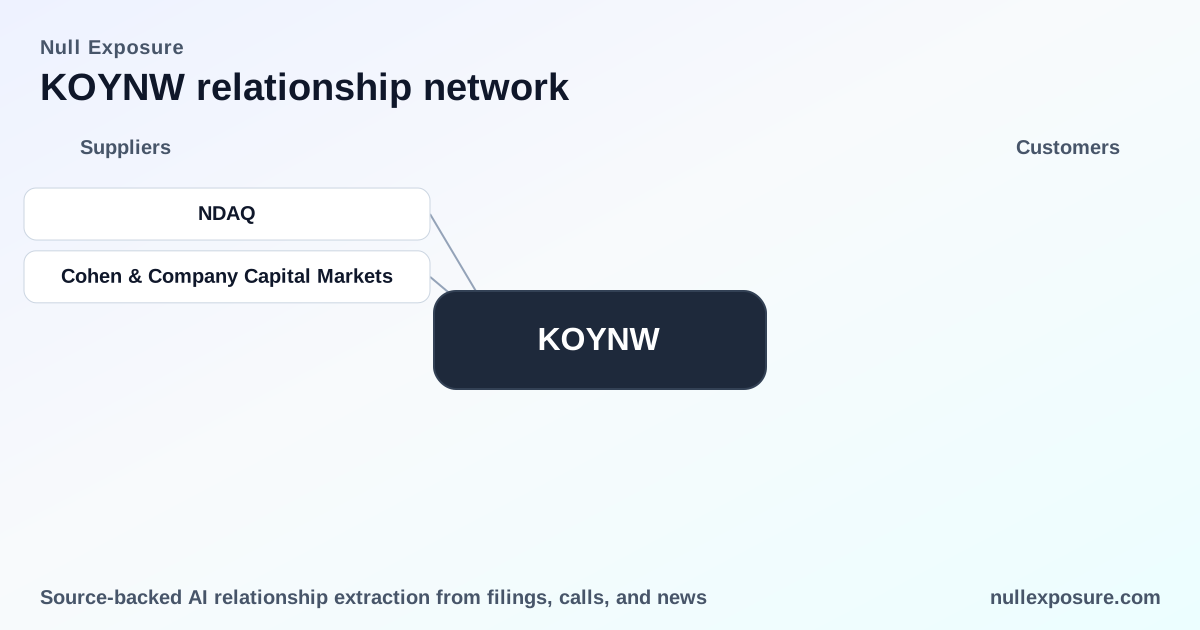
What KOYNW’s supplier footprint tells investors about capital-market access and underwriting concentration
KOYNW is tied to securities issued by CSLM Digital Asset Acquisition Corp III and monetizes through public-market issuance: the vehicle raised cash via a units offering that listed on Nasdaq, with underwriting and book-running managed by a single capital-markets shop. Revenue and investor outcomes for KOYNW holders are driven directly by market liquidity, listing venue integrity, and the underwriting partner’s execution. For deeper supplier relationship intelligence and continuous monitoring, visit https://nullexposure.com/.
Quick read: how this supplier map turns into investor value
KOYNW’s economic pathway is straightforward: issuance proceeds from the IPO provide the trust assets and working capital; secondary-market trading on the Nasdaq establishes liquidity and pricing; and underwriting leadership shapes the primary-sale economics and market reception. Control points for valuation are listing venue access and the sole book-runner’s distribution capability, which makes these supplier relationships disproportionately important to early returns.
Why the Nasdaq relationship matters more than it looks
Nasdaq provides the trading venue and the visible market for KOYNW-class securities. The listing created immediate price discovery and the ability for sponsors and investors to transact post-IPO, which is central to realizing any sponsor-led business combination value or unwind.
- The company’s units began trading on The Nasdaq Global Market under ticker KOYNU on August 27, 2025, establishing the liquidity channel that underpins KOYNW valuations (Quiver Quant news, first seen March 10, 2026).
Key takeaway: Nasdaq is the primary conduit for valuation and secondary liquidity; any disruption to that relationship would be immediately material to holders.
Why a single book-runner concentrates execution risk
A sole book-running manager concentrates both distribution capability and reputational accountability. That concentration reduces friction in decision-making during the IPO but also centralizes execution risk in one firm’s origination and placement capacity.
- Cohen & Company Capital Markets acted as sole book-running manager for the offering that raised $230 million, giving it a decisive role in price formation and allocation (Quiver Quant news, first seen March 10, 2026).
Key takeaway: Reliance on one underwriter amplifies single-point-of-failure risk in primary-market outcomes and makes due diligence on that advisor’s balance sheet, distribution footprints, and sector expertise essential.
All supplier relationships in the public record (concise, sourced)
Nasdaq Global Market (Nasdaq) — The units related to this filing began trading on Nasdaq under the ticker KOYNU on August 27, 2025, creating the liquidity venue that underpins KOYNW pricing and secondary trading behavior (Quiver Quant news, March 2026).
Cohen & Company Capital Markets — Cohen & Company Capital Markets acted as the sole book-running manager for the IPO that raised $230 million, placing it at the center of primary-market allocation and underwriting economics for KOYNW-related securities (Quiver Quant news, March 2026).
Operating-model signals investors should read into these supplier ties
Several firm-level characteristics emerge from the supplier map that influence risk-return.
- Contracting posture: Market-facing and transactional. KOYNW’s issuance and listing posture underscore a reliance on capital-market counterparties rather than long-term vendor contracts.
- Concentration: High. A single exchange listing and a sole book-runner imply concentrated operational and counterparty risk that accelerates contagion if one supplier underperforms.
- Criticality: Core. The Nasdaq listing and underwriting relationship are mission-critical; they directly enable liquidity, capital formation, and distribution.
- Maturity: Nascent. The listing date in August 2025 signals a recent market debut; governance, sponsor incentives, and secondary-market dynamics are still settling.
These are company-level signals derived from the public record of the offering and listing; they are not attributed to any single relationship beyond the explicit disclosures above.
For ongoing tracking of supplier concentration and to convert these signals into portfolio action, visit https://nullexposure.com/.
What this means for risk management and portfolio decisioning
Investors should treat supplier relationships as operational levers that are just as material as cash and sponsor alignment. Specifically:
- Liquidity risk is concentrated in a single exchange venue; evaluate bid-offer dynamics on Nasdaq and watch for unusual delisting or compliance notices.
- Underwriting and distribution risk is concentrated with Cohen & Company Capital Markets; review the underwriter’s recent deal flow and aftermarket stabilization behavior.
- Event risk around a potential business combination or redemption window will be executed through these players; monitor transactional announcements and book-runner commentary for directional bias.
Active risk managers will overlay these supplier signals with market microstructure data and sponsor disclosures rather than treating them as ancillary notes.
Next steps for investors and operators
- Conduct counterparty diligence on Cohen & Company Capital Markets: recent underwriting performance, institutional placement capability, and conduct history.
- Track Nasdaq trading metrics for KOYNU/KOYNW: volume, spreads, and order-book depth ahead of material corporate events.
- Monitor sponsor communications and trust-account statements that will determine downstream capital deployment options.
If you want a structured supplier-risk brief or continuous watchlists built from these disclosures, explore our tools and research offerings at https://nullexposure.com/.
Bottom line
KOYNW’s public trail identifies two critical, high-leverage supplier relationships: Nasdaq for market access and Cohen & Company Capital Markets for underwriting execution. Those links define where investor value will be created or destroyed in the near term. Concentration in venue and underwriter is the dominant operational risk, and proactive monitoring of both is mandatory for any investor allocating to KOYNW-linked securities.