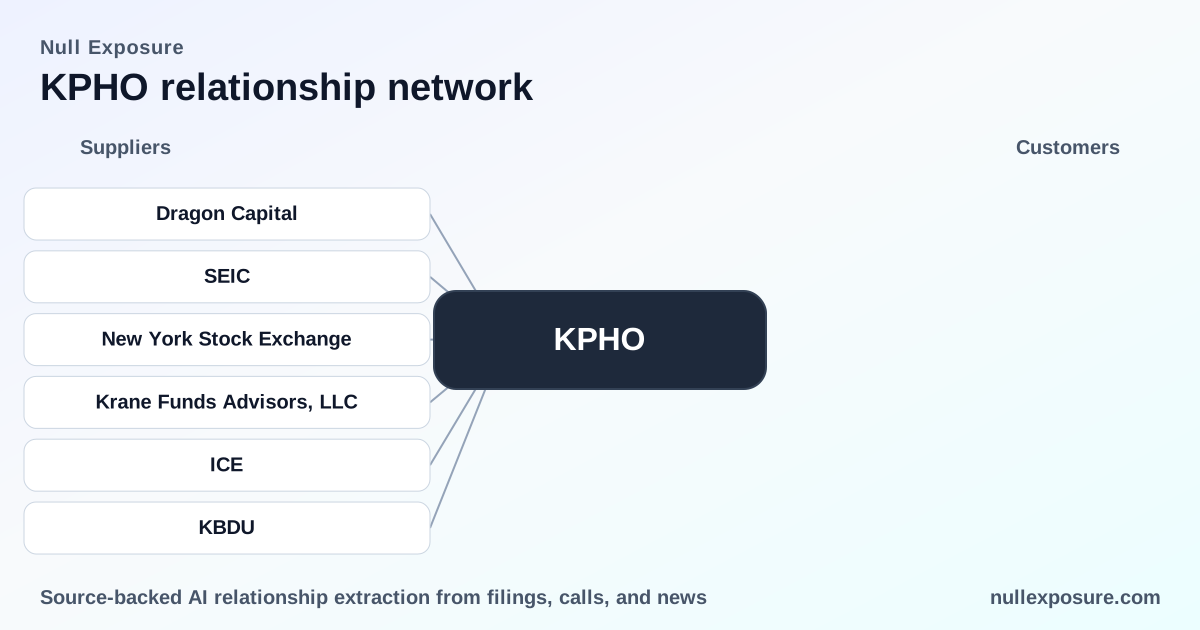
KPHO: How the KraneShares Dragon Capital Vietnam Growth ETF monetizes through partnerships
The KraneShares Dragon Capital Vietnam Growth Index ETF (Ticker: KPHO) packages exposure to Vietnamese equities that are at or near foreign ownership limits by leaning on a multi-party operating model. KPHO monetizes through asset gathering and management/distribution fees, while outsourcing local market access, sub-advisory expertise, and distribution to established partners — a structure that concentrates execution risk in a handful of suppliers but accelerates market entry and capacity to access constrained names. For more depth on counterparty exposure and how it affects portfolio-level operational risk, visit the Null Exposure homepage.
Why the supplier map matters to investors
When an ETF’s value proposition is access rather than alpha generation alone, counterparty relationships become a primary driver of product performance and durability. For KPHO, the right sub‑advisor unlocks access to FOL‑constrained stocks; the distributor determines U.S. market placement and investor reach; and the listing venue sets the liquidity and regulatory framework for trading. Those dependencies translate into concentrated operational risk that investors should price alongside traditional market and country risks.
Company-level operating signals and constraints
Treat these as firm-level signals for KPHO’s operating model rather than claims about any individual partner:
- Contracting posture: Multi‑counterparty outsourcing — KPHO relies on a sub‑advisor, a distributor, and an exchange listing rather than vertical integration. That reduces capital intensity but increases contractual and counterparty due diligence needs.
- Concentration: A small number of suppliers control critical functions (local market access, distribution, and listing), creating single‑point‑of‑failure exposure if a partner changes terms or availability.
- Criticality: Access to foreign‑ownership‑limited names is the ETF’s differentiator; therefore, partners who control that access are operationally critical to the fund’s proposition.
- Maturity: The ETF is a recently launched product (listing activity concentrated in FY2025 and FY2026), so contractual terms, distribution traction, and AUM dynamics are still evolving and will determine near‑term fee capture and scale.
For ongoing monitoring of KPHO’s supplier relationships and how they affect fund durability, see the Null Exposure homepage.
Who KPHO works with — relationship summaries and sources
Dragon Capital
Dragon Capital is the local sub‑advisor that gives KPHO on‑the‑ground access to Vietnamese stocks, including those at or near Foreign Ownership Limits (FOL); KraneShares uses Dragon Capital’s locally‑listed ETF to reach constrained names. This relationship is documented in KraneShares’ product materials and industry coverage in FY2025–FY2026. According to KraneShares and ETFGI coverage in FY2025, Dragon Capital serves as the fund’s sub‑advisor and brings decades of local experience (KraneShares webinar, ETFGI and GlobeNewswire, FY2025).
SEI Investments Distribution Company (SIDCO)
SEI Investments Distribution Company acts as the U.S. distributor for the KraneShares ETFs, including KPHO, which positions the product for broker/dealer networks and custodial channels in the U.S. KraneShares notes that SIDCO distributes KraneShares and KFA Funds ETFs and is not affiliated with Krane Funds Advisors, LLC (KraneShares webinar and ETFGI/GlobeNewswire references, FY2025–FY2026).
New York Stock Exchange (NYSE / ICE)
KPHO is listed on the New York Stock Exchange, giving the ETF U.S. exchange liquidity and regulatory visibility; KraneShares announced the listing in December 2025. Coverage of the listing appears in press releases and financial news outlets in FY2025, which confirms the product’s primary trading venue and the public distribution channel for U.S. investors (GlobeNewswire and TheInvestor, FY2025).
KraneShares (sponsor/operator)
KraneShares is the ETF sponsor and global asset manager that launched KPHO, responsible for product design, marketing, and sponsor responsibilities. ETFGI and KraneShares’ own communications in FY2025 describe KraneShares as the lead manager and promoter of the KraneShares Dragon Capital Vietnam Growth Index ETF (ETFGI and GlobeNewswire, FY2025).
Krane Funds Advisors, LLC
Krane Funds Advisors, LLC is identified in fund materials as the Investment Adviser for KraneShares’ funds; public statements clarify that the distributor (SIDCO) is not affiliated with Krane Funds Advisors, LLC. This delineation of roles is noted in KraneShares’ investor materials and distribution disclosures in FY2026 (KraneShares webinar and website materials, FY2026).
What investors should focus on right now
- Access is the product. KPHO’s performance differential versus broad Vietnam exposure will track how reliably Dragon Capital can route allocations into FOL‑constrained names; that makes sub‑advisor continuity and access terms material.
- Distribution equals scale. SIDCO’s effectiveness in placing the ETF with U.S. intermediaries will determine how much AUM the sponsor captures and therefore how much fee revenue KraneShares realizes.
- Listing venue provides liquidity and credibility. The NYSE listing (announced in FY2025) reduces market‑structure risk for U.S. investors but does not eliminate underlying country liquidity constraints for the basket of Vietnamese names.
- Concentration risk is real. A handful of counterparties perform mission‑critical roles — any change in contract terms, regulatory treatment, or inter‑party disputes could affect the ETF’s strategy execution and cost base.
Tactical investor takeaways
- For exposure to FOL‑constrained Vietnamese equities, KPHO offers a differentiated access pathway enabled by Dragon Capital’s local presence and KraneShares’ U.S. distribution footprint (KraneShares and ETFGI, FY2025–FY2026).
- Monitor announcements from Dragon Capital about its local ETF composition and foreign‑ownership handling, along with distribution metrics from KraneShares and SIDCO, as early indicators of scalability and fee capture (KraneShares webinar and GlobeNewswire, FY2025–FY2026).
- For operational diligence and counterparty risk scoring, use sponsors’ press releases and distribution notices as primary inputs; KPHO’s narrative is still forming given the product’s recent NYSE listing (GlobeNewswire, TheInvestor, FY2025).
For a concise counterparty risk brief and ongoing monitoring tools for KPHO and similar funds, visit the Null Exposure homepage.
Conclusion: KPHO is an access‑oriented ETF whose investment case is inseparable from its supplier relationships. Investors should underwrite those counterparties as vigorously as they underwrite market and country risks, because the ability to reach FOL‑constrained Vietnamese equities is the ETF’s core economic asset. For further research and tailored supplier reports, see the Null Exposure homepage.