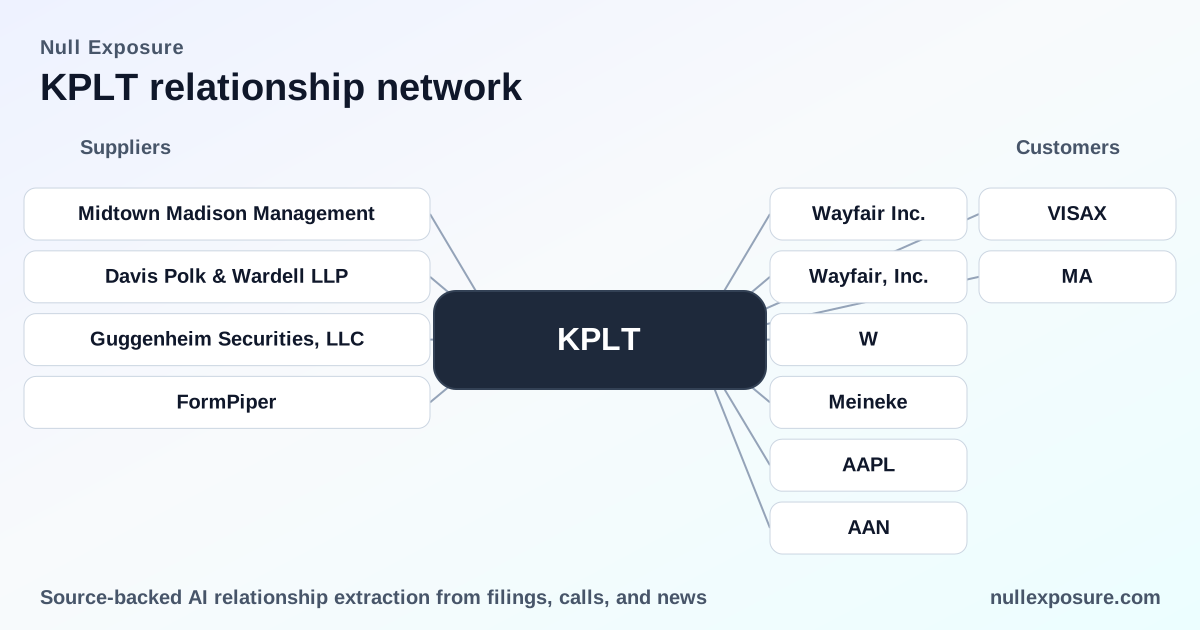
KPLT supplier relationships: what investors and operators need to know
Katapult (ticker KPLT) operates a merchant-focused lease-to-own platform that monetizes through merchant fees, interest/lease revenue, and ancillary servicing while leveraging third‑party capital and strategic partnerships to scale originations. Investors should value the business as a hybrid payments/financing operator whose near-term performance tracks merchant integration velocity, capital provider appetite, and transaction-level credit performance.
If you want a concise supplier map and ongoing monitoring for KPLT, visit https://nullexposure.com/ for continuous coverage and alerts.
How Katapult runs the business — revenue levers and contracting posture
Katapult’s commercial model is fundamentally merchant-first: the company supplies a point-of-sale lease-to-own product that retailers integrate to convert customers who cannot pay upfront. Revenue flows from merchant fees and consumer lease payments; capital for receivables and growth comes from third‑party lenders and funding partners rather than pure balance-sheet expansion.
- Contracting posture: Katapult relies on external financiers, legal counsel, and strategic advisors to enable growth and execute transactions, which makes supplier relationships operationally critical rather than purely tactical.
- Concentration and criticality: A handful of large merchants and funding partners can materially influence throughput and covenant health; supplier continuity and funding stability are therefore central to operating risk.
- Maturity and strategic posture: The company is in a phase of consolidation and strategic repositioning—evidenced by advisor engagements and transactional activity—so supplier relationships shift between growth enablement and risk mitigation.
These characteristics are company-level signals: they describe how Katapult organizes its suppliers and capital providers rather than tying a constraint to any single partner.
Supplier and partner map — plain-English summaries
Below are concise, source-backed summaries for every supplier relationship identified in the dataset.
Midtown Madison Management — lender waiver removed a default
Midtown Madison Management, together with other lenders, granted Katapult a waiver that permanently cleared a default tied to minimum trailing three‑month net originations as of January 31, 2026, resolving a covenant trigger that had been in force. This was reported by TradingView on March 10, 2026, summarizing lender action and covenant remediation. (TradingView, March 10, 2026)
Davis Polk & Wardell LLP — legal counsel on strategic combination
Davis Polk & Wardell LLP is serving as legal counsel to Katapult in connection with a planned combination involving Katapult, The Aaron’s Company, and CCF Holdings, signaling significant corporate‑transaction activity and the need for top‑tier transactional law support. This engagement was described in CityBiz and in a GlobeNewswire release tied to the December 2025 announcement. (CityBiz, March 10, 2026; GlobeNewswire, December 12, 2025)
Guggenheim Securities, LLC — financial advisor for the combination
Guggenheim Securities is serving as Katapult’s financial advisor for the proposed all‑stock combination with The Aaron’s Company and CCF Holdings, indicating that management is pursuing a strategic consolidation strategy supported by an investment bank. The advisory role was disclosed in the same CityBiz and GlobeNewswire materials covering the transaction. (CityBiz, March 10, 2026; GlobeNewswire, December 12, 2025)
FormPiper — merchant onboarding and application workflow partner
FormPiper has partnered with Katapult to provide merchants with streamlined consumer application processing and to surface Katapult’s lease-to-own options at the point of sale; FormPiper’s CEO framed the relationship as adding a “best‑in‑class LTO” capability that improves merchant conversion for customers who need alternative payment options. This partnership was covered in a Yahoo Finance article about a Meineke deployment. (Yahoo Finance, item covering Meineke and Katapult)
What these relationships imply for investors and operators
- Funding and covenant sensitivity are material. The lender waiver with Midtown Madison Management is concrete evidence that Katapult’s growth and covenant compliance are monitored closely by its capital providers; covenant flexibility or additional liquidity are material drivers of short-term viability.
- Strategic M&A is active and resourced. Engagement of Guggenheim and Davis Polk indicates management is executing a deliberate, high‑stakes corporate strategy—M&A can reshape revenue concentration, funding structure, and regulatory posture.
- Merchant experience and integration remain core growth levers. The FormPiper partnership demonstrates continued emphasis on smoother merchant onboarding and higher conversion rates at checkout, directly influencing originations and the top line.
If you need a deeper supplier risk scan or ongoing alerts about covenant events and advisor appointments, check the coverage at https://nullexposure.com/ for subscription options and bespoke reporting.
Risks embedded in supplier dynamics
- Funding fragility: Dependence on external lenders creates a direct transmission path from covenant triggers or lender sentiment to originations and liquidity. A lender posture change could compress growth immediately.
- Execution risk in integrations: Merchant-facing partners like FormPiper are growth multipliers only if integrations scale; poor execution reduces originations and stresses covenant testing.
- Transaction execution risk: M&A activity can divert management attention and introduce integration costs or execution shortfalls; advisor hires reduce execution risk but do not eliminate it.
These are the operational realities investors should price into models: supplier relationships are not peripheral—they are operational levers that determine how quickly originations expand and how resilient cash flows are under stress.
Actionable takeaways for investors and operators
- For investors: focus on covenant timelines, funding partner composition, and merchant originations trendlines—those three items will determine short‑term downside and upside capture.
- For operators and procurement teams: prioritize redundancy for critical funding and integration partners and codify contingency plans that preserve originations if a single funding source tightens.
- For due diligence teams evaluating M&A or repricing risk: request contract-level detail on lender covenants, notice/waiver mechanics, and merchant‑integration SLAs.
For ongoing alerts and a supplier-level view tied to covenant events and advisor activity, visit https://nullexposure.com/ and sign up for tailored monitoring.
Bottom line
Katapult’s supplier map shows a company whose growth engine is tightly coupled to merchant integrations and external capital providers, while strategic advisors are actively reshaping capital and corporate structure. Investors should treat supplier relationships as leading indicators—monitor lender sentiment, originations metrics, and the progress of announced combinations to anticipate changes in valuation and liquidity. For operators, the priority is ensuring continuity of funding and flawless merchant integration execution to sustain revenue momentum.
If you want continuous monitoring of these supplier ties and real‑time alerts about covenant waivers or advisor engagements, start here: https://nullexposure.com/.