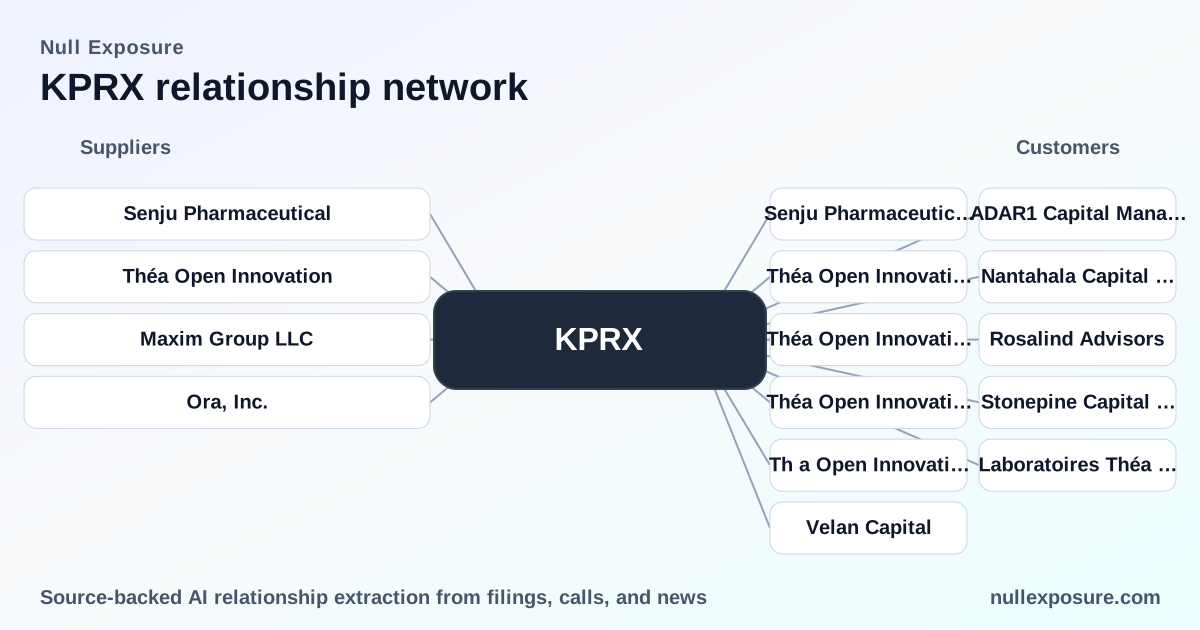
KPRX Supplier Map: How Kiora Pharmaceuticals Sources Funding, Clinical Tools and Market Access
Kiora Pharmaceuticals (KPRX) operates as a clinical-stage ophthalmology developer that monetizes through partnerships, licensing of development and regional commercialization rights, and capital markets transactions. The company advances candidate therapies (notably KIO-301) through external funding and collaboration, outsourcing manufacturing and clinical validation work while using placement agents and grants to finance programs. For investors and operators, the supplier set is less about raw materials today and more about funding, clinical services, commercialization options, and placement support.
Explore deeper supplier intelligence at NullExposure.
Why counterparties matter for KPRX's value chain
KPRX’s operating model is defined by outsourcing and capital partnerships rather than integrated manufacturing or commercial distribution. Two company-level signals clarify the contracting posture:
- Company disclosure states: “We do not have an in‑house manufacturing capability for our products and as a result, we will depend heavily on third‑party contract manufacturers to source raw materials, produce and package our products.” This is a direct admission of an outsourced manufacturing strategy.
- The company also reports: “We currently do not have any contractual relationships with third‑party manufacturers. We intend to rely on third‑party suppliers that we have used in the past for the manufacturing of various components that comprise our KIO‑104, KIO‑301 and other contemplated clinical trials.”
These excerpts are company-level signals about concentration and maturity: KPRX is pre‑commercial, highly dependent on external manufacturing and service suppliers, and currently in a prospecting stage for formal manufacturing contracts. That posture creates critical supplier risk (manufacturing and clinical tools are pivotal for trials and regulatory timelines) and execution dependency—partners and placement agents are central to near-term value realization. Review supplier exposure and contractual status at NullExposure.
The counterparties you need to track
Below are every supplier/partner relationship surfaced in the public results, summarized plainly with source context.
Théa Open Innovation — development funding for KIO‑301
Kiora secured a major partnership with Théa Open Innovation to fund development of KIO‑301, insulating Kiora’s balance sheet from interest‑rate pressure and shifting development cost and execution responsibilities to the partner. This arrangement was described in a MarketMinute on FinancialContent covering Kiora’s 2025 strategic moves (MarketMinute, Dec 18, 2025). Source: FinancialContent MarketMinute (Dec 18, 2025) — https://markets.financialcontent.com/wral/article/marketminute-2025-12-18-the-biotech-tug-of-war-is-kiora-pharmaceuticals-positioned-to-ride-the-2025-commodity-wave
Senju Pharmaceutical — option agreement for Asian rights
Kiora has an option agreement with Senju Pharmaceutical for Asian market rights, establishing a regional commercialization pathway for at least one program and creating potential near‑term licensing revenue and royalties if exercised. This was reported in the same MarketMinute article describing Kiora’s partnership strategy (Dec 18, 2025). Source: FinancialContent MarketMinute (Dec 18, 2025) — https://markets.financialcontent.com/wral/article/marketminute-2025-12-18-the-biotech-tug-of-war-is-kiora-pharmaceuticals-positioned-to-ride-the-2025-commodity-wave
Maxim Group LLC — sole placement agent for a private placement
Kiora announced a private placement for which Maxim Group LLC is acting as the sole placement agent, providing capital markets distribution and placement support for financing needs tied to development programs. The company’s Newsfile press release details the placement announcement (private placement of up to approximately $45 million). Source: Newsfile press release (FY2024) — https://www.newsfilecorp.com/release/196432/Kiora-Pharmaceuticals-Announces-Private-Placement-of-up-to-Approximately-45-Million
Ora, Inc. — clinical-test partnership on MLOM
Kiora is validating the Multiluminence Orientation Mobility (MLOM™) suite of tests developed in partnership with Ora, Inc., and grant funding will support clinical validation for use as endpoints in ABACUS‑2 (KIO‑301 Phase 2). This partnership supplies the standardized clinical assessment tools that feed trial endpoints and regulatory dossiers. Source: Newsfile press release on grant (FY2025) — https://www.newsfilecorp.com/release/204982/Kiora-Pharmaceuticals-Receives-Grant-from-Choroideremia-Research-Foundation-to-Fund-Novel-Clinical-Trial-Endpoints-for-Inherited-Retinal-Diseases-Approval-Granted-to-Initiate-Clinical-Validation-Study?lang=fr
What the relationship mix implies for investors and operators
- Funding-first operating model: KPRX uses external capital (private placements, grants) and development partnerships to underwrite clinical programs rather than internal R&D funding. That reduces near-term burn pressure but transfers execution risk to partners.
- Commercial optionality via licensing: Option agreements like the Senju deal create non‑dilutive paths to regional commercialization and potential milestone/royalty revenue streams before full-scale commercialization.
- Clinical validation reliance: Ora’s role indicates outsourced clinical endpoint development, which is a critical operational input for trial success and regulatory approval.
- Capital markets dependence: Use of a sole placement agent (Maxim) shows reliance on capital markets intermediaries to finance programs, concentrating financing execution risk in a single arranger.
Key operational constraint: KPRX is explicit that it lacks in‑house manufacturing and currently does not hold contractual relationships with third‑party manufacturers; this is a company-level signal indicating the firm is in a supplier prospecting stage for manufacturing and will depend on third parties for production, packaging, and raw materials. That configuration raises timeline and qualification risk for any product commercialization.
Middle-level diligence action: review counterparty agreements, milestone schedules, and manufacturing contingency plans at NullExposure.
Risks that matter to supplier relationships
- Manufacturing criticality: Without an in‑house manufacturer and with no current manufacturing contracts, qualification delays, lead‑time variability, and single‑source concentration represent the most direct operational risk to timelines and cost.
- Partner execution risk: Partnerships that fund development shift operational control away from KPRX; partner delays, reprioritization, or termination will directly affect the company’s clinical calendar and valuation.
- Financing dependency: Reliance on private placements creates market‑access risk—if capital markets conditions deteriorate, the company’s ability to fund non‑partnered programs will tighten quickly.
Tactical conclusions and next steps
For investors: prioritize counterparty due diligence on manufacturing partners (contracts, capacity, lead times) and on the explicit commercial economics of option agreements (milestones, royalties). For operators: secure backup manufacturing arrangements and clear qualification milestones in partner contracts to protect timelines.
If you want a deeper counterparty risk score or contract‑level parsing for KPRX’s suppliers, start here: NullExposure homepage.
Final note: KPRX’s supplier mix reflects a capital‑light, partnership‑dependent strategy—it reduces internal burn but concentrates execution risk in external suppliers and financiers. Monitor partnership deliverables and manufacturing contracting as the primary drivers of near‑term value. For ongoing monitoring and to benchmark these suppliers against peers, visit NullExposure.