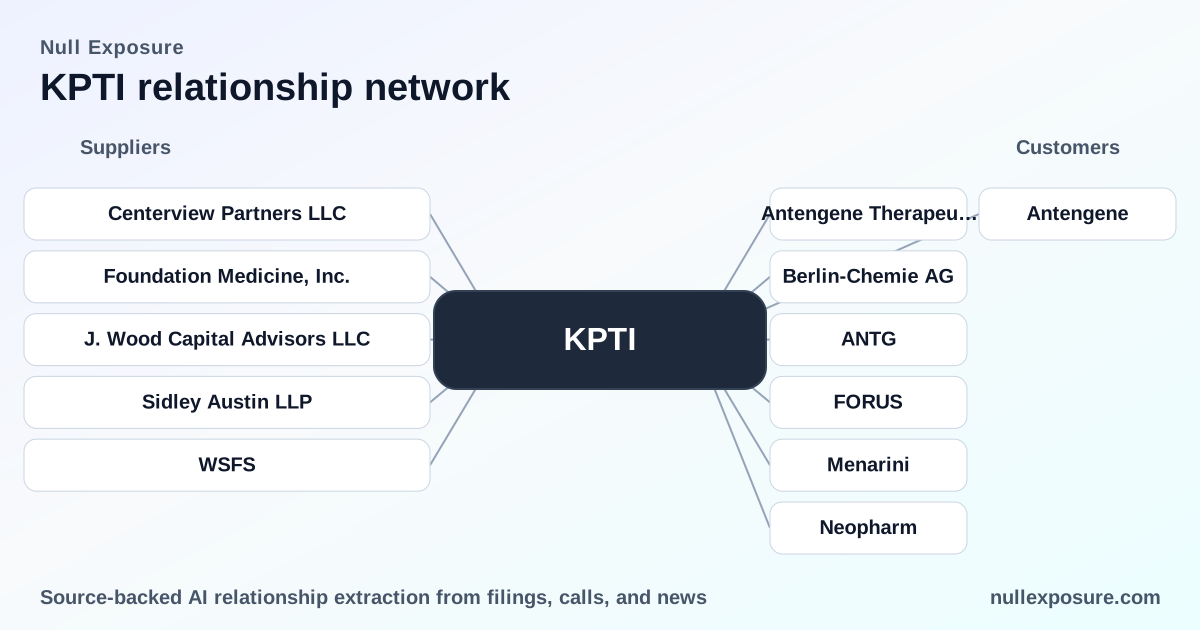
Karyopharm (KPTI) — Supplier and counterparty map for investors and operators
Karyopharm operates as a clinical-stage and commercial oncology company that monetizes primarily through the commercialization of its approved therapeutic (XPOVIO) and through strategic collaborations and capital markets transactions that extend runway for clinical readouts. The company outsources manufacturing, distribution, and many clinical services to third parties and secures financing and legal support through advisory and lending relationships — a model that concentrates operational risk in a small set of external providers while retaining commercial upside through product sales and milestone-driven partnerships. For a systematic view of counterparties and supplier risk, visit the NullExposure homepage: https://nullexposure.com/.
The advisor and counsel backbone: capital markets support
Centerview Partners LLC — Centerview acted as a financial advisor to Karyopharm in connection with October 2025 strategic financing transactions that extended the company's cash runway into 2026, supporting near-term development priorities. According to Karyopharm’s October 8, 2025 press release, Centerview was engaged alongside another boutique advisor on the capital plan.
J. Wood Capital Advisors LLC — J. Wood served as a co-financial advisor on the same October 2025 transactions, providing additional capital markets advisory resources for the financing package. The company press release lists J. Wood as a named advisor in FY2025.
Sidley Austin LLP — Sidley Austin acted as legal counsel to Karyopharm for the October 2025 financing transactions, handling the legal documentation and regulatory support for the capital raise. The October 8, 2025 investor announcement identifies Sidley Austin as counsel.
Takeaway: Karyopharm relies on experienced boutique and national advisors for financing and legal work, signaling a transactional approach to capital planning rather than an in-house investment banking function.
Diagnostic collaboration that underpins clinical enrollment
Foundation Medicine, Inc. — Karyopharm entered a global collaboration with Foundation Medicine to develop a tissue-based comprehensive genomic test (FoundationOne CDx) to identify TP53 wild-type tumors for enrollment in the EC-042 trial, linking diagnostic capability to trial recruitment and potential label strategy. This collaboration is documented in company press materials spanning FY2025 and reiterated in FY2026 filings and releases.
Takeaway: The Foundation Medicine relationship is clinically strategic and directly tied to trial patient identification, supporting enrollment efficiency and regulatory positioning for EC-042.
Credit counterparties and liquidity mechanics
Wilmington Savings Fund Society — Wilmington Savings Fund Society is identified as Administrative Agent and representative of lenders in an amended credit agreement tied to Karyopharm’s 2026 payment deferral structure, referenced in reporting on the company’s financing and credit amendments in FY2026. A public report on the credit amendment cites Wilmington as the administrative agent.
Takeaway: The Wilmington-led lending group functions as a liquidity backstop and has influence over covenant mechanics and timing of cash flow relief through structured amendments.
For a consolidated supplier and counterparty view that supports due diligence and operational planning, see https://nullexposure.com/.
What Karyopharm’s supplier constraints reveal about operating posture
Karyopharm’s supplier constraints present a clear operating profile:
-
Contracting posture: The company runs a mix of long-term supply agreements and as-needed purchase orders for drug product, indicating strategic long-term commitments for core drug supply while retaining flexibility for ancillary services. According to company disclosures, clinical and commercial supplies are supplied under a combination of long-term and purchase order arrangements (FY2025).
-
Service cadence: Many service providers invoice monthly in arrears or on milestone completion, which produces short-term payment cycles for CROs and other service vendors and concentrates working capital needs on vendors that invoice after delivery.
-
Geographic concentration: Manufacturing and clinical supply chains span North America and Europe — the API for XPOVIO is manufactured in France while finished drug product is produced in the U.S.; CROs and CMOs are located in Canada, the U.K., and continental Europe. These facts create dual-region exposure (NA and EMEA) and associated FX and regulatory complexity (FY2025 disclosures).
-
Role concentration and criticality: Karyopharm does not operate its own manufacturing facilities and depends on third-party contract manufacturers and specialty distributors to get product to patients; distribution is handled through a limited network of specialty pharmacies and distributors. This structure increases the operational criticality of a few suppliers and raises single-source risk for key inputs.
-
Relationship maturity and activity: The company maintains active development programs and ongoing commercial efforts supported by external CROs, CMOs, and specialty pharmacy partners, suggesting relationships that are operationally mature but reliant on external execution.
Investor implication: These constraints translate into high supplier concentration risk for manufacturing and distribution, predictable short-term payment patterns for service vendors, and operational exposure to EMEA and NA regulatory environments.
How that profile changes counterparty risk and deal structuring
-
Concentration risk demands contractual protections. Long-term supply agreements for core drug product reduce interruption risk but require careful review of termination clauses, change-of-control protections, and quality-assurance obligations. Operators should prioritize counterparties with demonstrated multi-site redundancy.
-
Clinical enrollment depends on diagnostic partnerships. The Foundation Medicine collaboration is not optional for EC-042 enrollment strategy; diagnostic accuracy and turnaround drive trial timelines and downstream launch economics.
-
Financing dependency affects runway and strategic flexibility. Reliance on external financial advisors and bank-led credit facility amendments implies that capital markets execution is central to the company’s near-term plans, increasing sensitivity to market access costs and covenant negotiation outcomes.
For more granular mapping of counterparties and to track changes over time, explore NullExposure’s supplier intelligence at https://nullexposure.com/.
Practical takeaways for investors and operators
- Monitor single-source manufacturing locations in France and U.S. production sites for API and finished goods; supply disruptions there have immediate commercial impact.
- Evaluate the Foundation Medicine relationship as a driver of trial enrollment velocity and potential label precision — diagnostic capability is operational leverage.
- Scrutinize credit terms and covenant flexibility with Wilmington-led lenders and understand financing tranches stemming from the 2025–2026 financing package.
- Prioritize contingency plans for specialty distribution since the company uses a limited network of specialty pharmacies and distributors to reach patients.
Conclusion — the succinct verdict
Karyopharm’s external supplier network is strategically concentrated and operationally critical: a small number of manufacturing, diagnostic, distribution, and financing counterparties underpin both near-term runway and future commercial execution. Investors should treat counterparties as first-class risk factors when modeling cash runway, enrollment timelines, and launch-readiness. For a structured supplier-risk view and ongoing monitoring, visit https://nullexposure.com/.
Sources: Karyopharm investor press release dated October 8, 2025 and related PR Newswire releases for FY2025–FY2026 describing advisor roles and the Foundation Medicine collaboration; public reporting including a TradingView note in FY2026 identifying Wilmington Savings Fund Society as Administrative Agent.