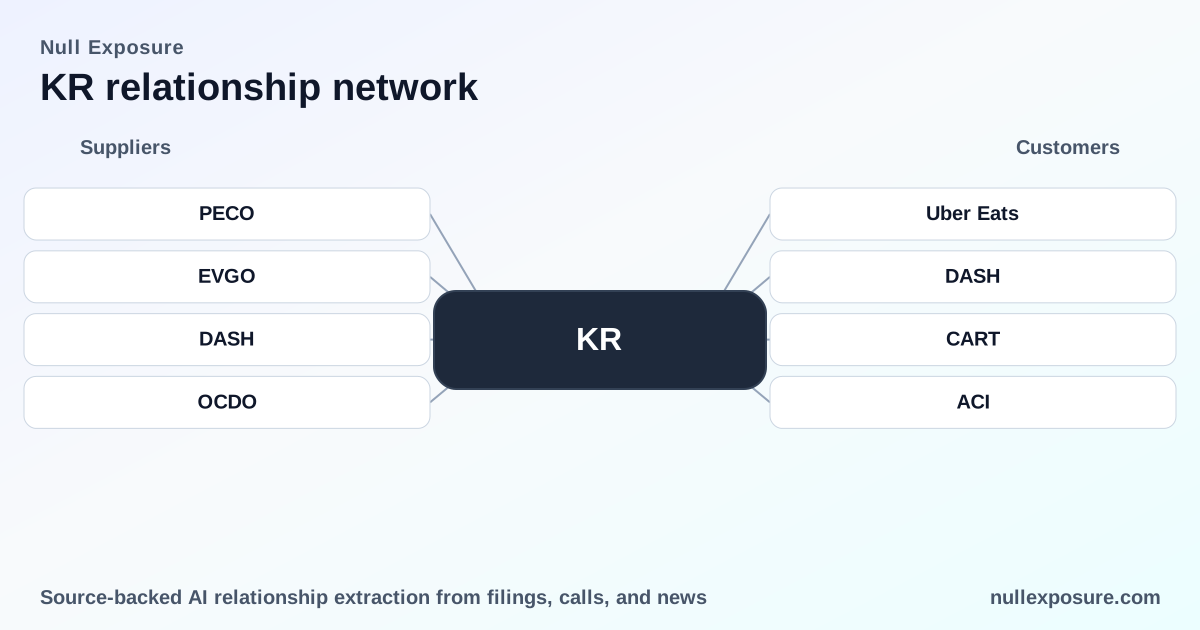
Kroger (KR) supplier footprint: who matters, how Kroger pays, and what investors should watch
Kroger operates as a scale grocery retailer and integrated consumer goods platform, monetizing through in-store and online grocery sales, private-label manufacturing, fuel and pharmacy services, and strategic delivery and retail partnerships that extend its customer reach. Its supplier posture combines centralized buying for retail assortments, in-house food production for a meaningful share of private-label items, and short-term procurement commitments for inputs such as raw materials and energy — a mix that drives gross-margin control while exposing Kroger to supply-chain volatility.
If you want a quick view of Kroger’s supplier relationships and operating constraints for portfolio due diligence, visit the Kroger supplier map on NullExposure: https://nullexposure.com/.
Why the supplier map matters: concentrated functions and active sourcing
Kroger’s commercial model blends wholesaling scale with manufacturing control. The company buys the majority of merchandise through centralized procurement while producing roughly a third of its Our Brands items in company-owned food plants. That hybrid posture delivers margin leverage and product differentiation, but it also concentrates operational risk: disruption in suppliers, raw materials, or energy has direct sales and margin implications.
- Short-term contracting posture: Kroger uses many short-term commitments for raw materials and energy that are intended to be cycled in normal operations, which enables procurement flexibility but increases exposure to price volatility and supplier tightening.
- Global sourcing: Products come from domestic and international vendors, making the company sensitive to cross-border logistics, regulatory interruptions, and supplier quality issues.
- Material supply-chain exposure: Supply continuity is a business-critical input; interruptions would negatively affect store inventory and private-label production.
- Dual role in the value chain: Kroger functions both as a manufacturer (internal production of Our Brands) and a buyer (centralized purchasing of broader assortment), creating operational complexity but also control over private-label margins.
- Active relationships: Supplier relationships are operational and ongoing rather than legacy or dormant, indicating continuous procurement activity and partner engagement.
These are company-level operating characteristics derived from Kroger’s disclosures and are useful when evaluating counterparties or stress-testing supplier scenarios. Learn more and map specific partner exposures at NullExposure: https://nullexposure.com/.
Relationship snapshots: the partners in the current news set
Phillips Edison & Company (PECO)
PECO identified Kroger as one of its top grocery anchors, alongside Publix, Albertsons and Ahold Delhaize, reinforcing Kroger’s role as a major tenant/anchor for grocery-centric retail real estate. According to a Bitget news item dated March 10, 2026, PECO lists Kroger among its leading grocery anchors (https://www.bitget.com/amp/news/detail/12560605214763).
EVgo Inc.
EVgo plans to expand DC fast charging into local retail settings and the company flagged Kroger as a target retail partner in 2026, positioning Kroger locations as potential charging sites that extend foot traffic and convenience services. This was reported in EVgo’s FY2025 results release carried by GlobeNewswire / The Globe and Mail on March 10, 2026 (https://www.theglobeandmail.com/investing/markets/markets-news/GlobeNewswire/530127/evgo-inc-reports-record-fourth-quarter-and-full-year-2025-results/).
DoorDash
Kroger and DoorDash expanded their partnership to provide nationwide grocery delivery from nearly 2,700 Kroger stores, enabling full-assortment delivery tied to Kroger’s loyalty and pricing programs and materially scaling the company’s e‑commerce reach. TradingView’s company overview and associated coverage noted the March 2026 announcement of this nationwide expansion (https://www.tradingview.com/symbols/NYSE-KR/).
Ocado
Kroger’s disclosures include an adjustment for payments related to the Ocado exit liability, indicating a finalization of a past strategic partnership unwind and a cash settlement line item recorded in FY2025/FY2026 reporting. This payment adjustment appears in Kroger’s FY2025 results and the related press release on March 10, 2026 (PR Newswire and Kroger investor relations: https://www.prnewswire.com/news-releases/kroger-reports-fourth-quarter-and-full-year-2025-results-and-announces-guidance-for-2026-302705235.html; https://ir.kroger.com/news/news-details/2026/Kroger-Reports-Fourth-Quarter-and-Full-Year-2025-Results-andAnnounces-Guidance-for-2026/default.aspx).
What these relationships say about strategic direction and risk
Kroger’s partner set reflects a deliberate strategy to combine core retail strength with service expansion and physical network leverage. The DoorDash relationship is focused on scale and consumer convenience, EVgo ties Kroger into new service economics via on-site EV charging that can increase store visits, and the PECO mention underscores Kroger’s importance to retail real estate economics. The Ocado payment adjustment is a reminder that legacy strategic experiments can create residual liabilities.
Key investor takeaways:
- Execution risk is front-of-mind: Rolling out nationwide delivery and retail EV charging requires operational coordination across merchandising, logistics, and real estate teams. Delivery scale will stress order fulfillment systems and last-mile economics.
- Supply exposure is material: The combination of global sourcing and many short-term procurements creates meaningful sensitivity to commodity and freight price swings, which translates to margin volatility under stress.
- Manufacturing control is a double-edged sword: Owning 31% of Our Brands production enables margin capture and private-label agility, but it also concentrates capex and operational risk in in-house plants.
- Legacy liabilities persist: The Ocado exit payment shows strategic unwinds can incur cash impacts after the partnership ends; investors should track any further contingent items.
For a comprehensive view of Kroger’s supplier exposures and to overlay counterparty risk with market data, see the full supplier analysis at NullExposure: https://nullexposure.com/.
What investors should monitor next quarter
- DoorDash rollout progress and unit economics for delivered full-assortment orders; track incremental sales lift versus rising delivery costs.
- EVgo installations at Kroger locations and any leasing/utility arrangements that affect store economics.
- Procurement cost trends for key commodities and energy contracts, given Kroger’s short-term contract posture.
- Any further adjustments or disclosures related to the Ocado exit liability that would affect cash flow or reported liabilities.
- Real-estate anchor tenancy shifts that reflect Kroger’s draw power in shopping centers and mixed-use assets.
If you are modeling Kroger’s margin sensitivity or counterparty concentration, factor in procurement flexibility as a volatility amplifier and private-label manufacturing as a margin stabilizer with operational risk. For tailored exposure reports and supplier scoring for investment committees, visit NullExposure and request a demo: https://nullexposure.com/.
Kroger’s supplier map shows a retailer executing across distribution, services, and owned manufacturing; the mix delivers strategic optionality but requires disciplined execution and supply-chain risk management to protect margins and cash flow. For ongoing monitoring and deep-dive supplier intelligence, return to the Kroger supplier hub at NullExposure: https://nullexposure.com/.