KKR Real Estate Finance Trust (KREF): The KKR-managed mortgage REIT investors should underwrite for concentrated, financed exposure
KKR Real Estate Finance Trust Inc. originates and acquires senior commercial real estate loans and finances those positions through a mix of secured term debt, repurchase agreements, and short-term facilities; it monetizes by earning net interest income on loan spreads while outsourcing management to an affiliate of KKR. The company is externally managed by a KKR subsidiary and leverages KKR’s financing and capital markets capabilities to source loans and structure funding, producing a business model that is capital-intense, highly finance-dependent, and operationally integrated with its sponsor. For a concise vendor and counterparty exposure view, visit https://nullexposure.com/ to compare supplier relationships across REITs and asset managers.
How KREF’s operating model drives returns — and risk
KKR Real Estate Finance Trust operates as an externally-managed mortgage REIT: investment decisions, origination and portfolio management are performed by a KKR affiliate under a Management Agreement, while KREF provides the capital and balance-sheet wrapper. The business relies on both long-term secured facilities (a refinanced term loan running into 2032) and substantial short-term liquidity sources (revolvers, repo lines) to fund origination and hold positions. Those financing relationships are material and critical to KREF’s ability to execute its strategy: management discloses that 74% of financing is non-mark-to-market, which reduces earnings volatility but simultaneously concentrates exposure in a limited set of financing arrangements and counterparties.
- Contracting posture: a mix of long-term secured term debt (maturing 2032) and actively used short-term facilities and repo lines.
- Counterparty profile: primary counterparties are very large and large financial institutions, with global reach.
- Materiality: financing sources are explicitly material and, in aggregate, critical to the business.
- Spend and liquidity scale: available revolver capacity and sizable secured borrowing capacity indicate eight-figure to nine-figure financing reliance.
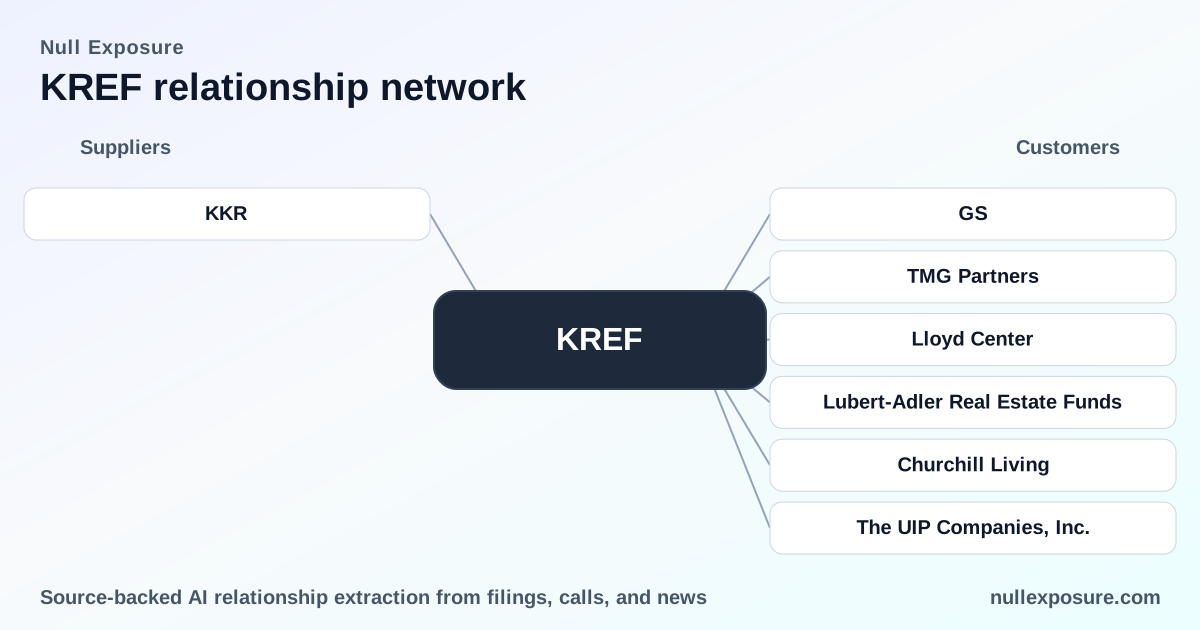
The sponsor and related entities: every supplier relationship found
Below are the supplier/counterparty relationships surfaced in public coverage and filings. Each entry includes a plain-English summary and the original reporting citation.
KKR & Co. Inc. — external manager and sponsor (news report, FY2025)
KKR & Co. Inc. is the sponsor: an affiliate externally manages and advises KREF under a Management Agreement, supplying the investment team and platform access. According to a Yahoo Finance article referencing FY2025 disclosures, KREF is externally managed and advised by an affiliate of KKR & Co. Inc. (https://finance.yahoo.com/news/kkr-real-estate-finance-trust-205200011.html).
KKR & Co. Inc. — external manager and sponsor (news report, FY2026)
KKR’s role as external manager continues into FY2026, reaffirming ongoing management and advisory duties that align KREF’s origination and financing strategy with KKR’s global platform. The FY2026 Yahoo Finance note repeated that KREF is externally managed and advised by a KKR affiliate (https://finance.yahoo.com/news/kkr-real-estate-finance-trust-211500746.html).
KKR — integration with global platform to source and manage investments (analysis, FY2025)
KKR’s global platform is used to enhance sourcing, risk assessment and expected risk-adjusted returns, with management highlighting integration benefits that reduce earnings volatility. A Simply Wall St article discussing FY2025 cited this expected enhancement from KKR platform integration (https://simplywall.st/stocks/us/diversified-financials/nyse-kref/kkr-real-estate-finance-trust/news/kkr-real-estate-finance-trust-kref-extended-losses-highlight).
KKR Capital Markets — financing execution and non-mark-to-market capacity (earnings call, FY2026)
KKR Capital Markets provided financing support during the quarter and helped expand KREF’s non-mark-to-market financing capacity; management reported that 74% of financing remains non-mark-to-market, a figure cited on the Q4 2025 earnings call transcript. The transcript (InsiderMonkey) explains how internal capital markets capabilities were leveraged (https://www.insidermonkey.com/blog/kkr-real-estate-finance-trust-inc-nysekref-q4-2025-earnings-call-transcript-1689402/).
KKR & Co Inc — sponsor identification in brokerage coverage (market commentary, FY2026)
Brokerage coverage and consensus ratings explicitly identify KKR & Co. Inc. as KREF’s sponsor, which reinforces the market’s recognition of the sponsor–REIT relationship. MarketBeat noted the sponsor status while reporting on broker consensus for FY2026 (https://www.marketbeat.com/instant-alerts/kkr-real-estate-finance-trust-nysekref-receives-consensus-rating-of-hold-from-brokerages-2026-02-28/).
KKR — access to information and market data via global network (SEC recap/reporting, FY2026)
KREF leverages KKR’s global network for information and market data, providing a sourcing advantage and centralized market insight for origination and portfolio decisions. TradingView coverage of the company’s SEC filings summarized KKR’s role in supplying market access and data during FY2026 (https://www.tradingview.com/news/tradingview:21d96cf6c7708:0-kkr-real-estate-finance-trust-inc-sec-10-k-report/).
KKR — platform integration noted in analyst commentary (independent bulletin, FY2025)
Analyst and independent commentary highlighted the platform integration expectation—using KKR’s scale to reduce volatility and improve risk-adjusted results—which functions as a qualitative supplier relationship signal. Sahm Capital’s analysis reiterated platform benefits for FY2025 (https://www.sahmcapital.com/news/content/kkr-real-estate-finance-trust-kref-extended-losses-highlight-persistent-valuation-concerns-vs-recovery-narratives-2025-10-23).
Constraints and operating characteristics that matter for counterparties and investors
KREF’s public disclosures reveal several company-level constraints that define the supplier and counterparty posture investors must model when assessing exposure:
- Contract maturity mix: The firm refinanced a term loan into a secured facility due March 2032, signaling long-term secured funding capacity, while continuing active use of short-term revolvers and repo lines for origination liquidity. This mixed maturity profile creates both funding longevity and short-term refinancing sensitivity (company filings, March 2025).
- Concentration and counterparty scale: Counterparties are large and very large financial institutions, and KREF maintains cash and financing relationships with major banks and repo counterparties; this produces concentrated, systemic-tier counterparty exposure rather than a distributed vendor base.
- Criticality of financing: Financing sources are material and critical—management explicitly calls out reliance on repo, warehouse, credit facilities and securitizations—so loss of access or adverse terms would have material impact on operations.
- Service provider posture: KREF is externally managed by a KKR subsidiary and operates through a Management Agreement; that contract places day-to-day investment and financing execution in the sponsor’s control, making the manager a critical service provider rather than an arms-length vendor.
- Scale of spend/liquidity: Reported liquidity metrics (cash, revolver capacity, borrowing availability) and the company’s use of master repurchase agreements indicate nine-figure financing scale and routine reliance on facility draw and repo markets.
For a comparative view of how sponsor-managed REITs structure supplier exposures, see https://nullexposure.com/ which indexes sponsor relationships across REITs and finance firms.
Investment implications and what operators should underwrite
The KKR relationship is a double-edged driver: sponsor integration delivers sourcing, capital markets access and non-mark-to-market financing that stabilizes earnings, while dependence on a handful of large financing counterparties and an externally-managed governance structure concentrates operational and counterparty risk. Underwrite the following when evaluating KREF:
- Stress test short-term liquidity and repo access in a marked market dislocation.
- Quantify counterparty concentration limits and replacement cost for large secured facilities.
- Price the value of management alignment—assess fee terms in the Management Agreement relative to realized spread capture.
- Model covenant terms on the $550 million secured term loan (matures 2032) and revolver availability under adverse scenarios.
If you want a side-by-side supplier exposure map comparing KREF to peers, consult our comparative tools at https://nullexposure.com/.
Bottom line: sponsor strength matters, financing concentration dominates
KKR Real Estate Finance Trust offers investors exposure to CRE senior loans with the clear benefit of KKR’s origination and capital markets engine; the primary investment trade is between enhanced access and concentrated financing risk. For investors and operating partners, due diligence must focus on counterparty concentration, covenant structure, and the operational terms of the Management Agreement, because those factors determine whether sponsor integration is an alpha source or a tail risk.
For further proprietary supplier intelligence and peer comparisons, visit https://nullexposure.com/ to request coverage and relationship analytics.