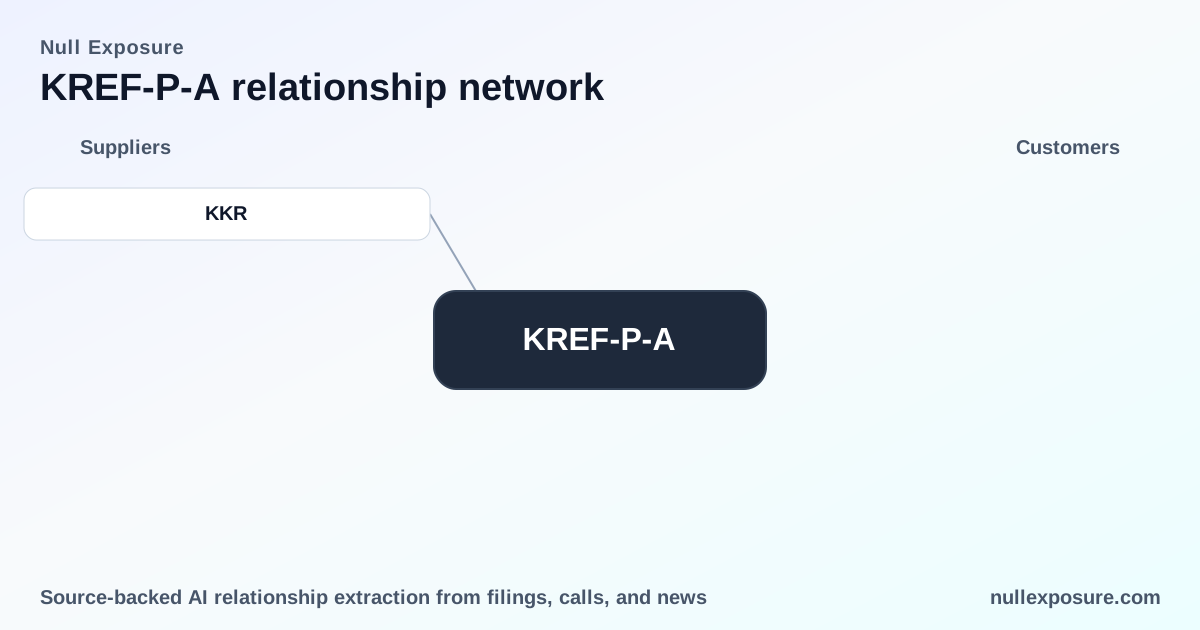
KREF-P-A: What investors should know about the supplier relationship with KKR
KREF-P-A is a preferred equity instrument tied to a REIT focused on commercial real estate and mortgage-related assets; the firm generates cash flow through investment income and management of property and debt positions, while monetizing expertise via external management agreements. For investors and operators, the central operational fact is simple and strategic: KREF outsources portfolio management to an affiliate of KKR & Co. Inc., creating a concentrated operating dependency that underpins both upside (scale, execution) and supplier risk (single-manager exposure).
Learn more about supplier risk signals and supplier profiles at https://nullexposure.com/.
The single most important supplier fact: external management by KKR
KREF’s operating model is structured around an external manager relationship. That relationship makes the manager the de facto operator of asset selection, capital allocation and many day-to-day decisions. External management concentrates operational control, aligns KREF with the KKR platform, and simultaneously creates counterparty concentration and operational criticality.
- Contracting posture: KREF operates with an outsourced posture — a formal management/advisory contract governs services, fees and decision rights.
- Concentration: Reliance on an affiliate of KKR produces single-supplier concentration that investors must underwrite for governance and continuity risk.
- Criticality: The manager is operationally critical — investor returns and dividend continuity are tied to the manager’s execution and capital markets access.
- Maturity: Affiliation with KKR brings institutional processes, capital markets relationships and scale, which increases operational maturity versus a standalone manager.
Detailed read: every relationship noted in the record
Below are every supplier-relationship mention captured in the results feed. Each entry is presented with a plain-English summary and a concise source reference.
-
KKR & Co. Inc. — press release (Business Wire via FinancialContent), Oct 18, 2024. The item states that KREF is externally managed and advised by an affiliate of KKR & Co. Inc., confirming the formal outsourcing of management functions to KKR’s platform. Source: Business Wire press release distributed on Oct 18, 2024 via FinancialContent.
-
KKR & Co. Inc. — StreetInsider article, Oct 16, 2025. A market-minute report reiterates that the company is externally managed by an affiliate of the global investment firm KKR and has a history of honoring preferred dividends, signaling both governance continuity and dividend-priority communications. Source: StreetInsider market-minute, Oct 16, 2025.
-
KKR & Co. Inc. — WRAL syndication of the same market-minute piece, Oct 16, 2025. The WRAL-distributed note echoes StreetInsider’s summary on management and dividend history, reinforcing that public communications consistently link KREF’s management to KKR’s affiliate. Source: WRAL market-minute syndication, Oct 16, 2025.
-
KKR & Co. Inc. — SSB Crack news report, date listed in feed as FY2025. The article declares that KREF is externally managed and advised by an affiliate of KKR, underscoring repeated public disclosures about the management relationship. Source: news.ssbcrack.com release (FY2025).
-
KKR & Co. Inc. — The Globe and Mail press release pick-up, FY2025. The Globe and Mail’s distribution of the press release again records that an affiliate of KKR manages and advises KREF, aligning mainstream financial press with the company’s vendor disclosures. Source: The Globe and Mail press release page (FY2025).
Each of these items converges on the same operating fact: KKR’s affiliate is the formal manager and advisor to KREF, and KREF’s public communications tie dividend and operational messaging to that relationship.
What this means for investors and operators
The KREF–KKR arrangement is straightforward and consequential. External management confers benefits and risks in equal measure:
- Benefits: Access to KKR’s deal flow, balance-sheet capacity, structured finance capabilities and institutional risk-management frameworks enhances KREF’s ability to acquire and manage scale assets efficiently.
- Risks: Counterparty concentration is the primary corporate risk — a single-manager structure concentrates operational, reputational and governance exposure. If the manager changes incentives, exits, or is impaired, KREF’s execution and distributions could be disrupted.
- Governance: Investors need to scrutinize the management agreement, fee arrangements, change-of-control protections and board composition to understand how aligned the external manager’s incentives are with preferred holders.
- Liquidity and signaling: Public statements about preferred dividends — repeated in the press — are important signaling tools; investors should treat those communications as part of the firm’s investor-relations rhythm and monitor for any divergence in operating performance or capital allocation.
Absence of documented constraints in the feed — what that signals
The records provided do not include explicit contractual constraints or supplier-specific limitations beyond the external-management disclosure. That absence should be treated as a company-level signal: no additional supplier constraints were captured in the reviewed sources, not that none exist in filings or contracts. Investors must still obtain the underlying management agreement and SEC filings for definitive terms, because absence of evidence in news coverage is not evidence of absence in legal agreements.
Explore supplier intelligence and primary-document sourcing at https://nullexposure.com/.
Actionable takeaways for investors evaluating KREF-P-A
- Primary exposure is managerial: KREF’s performance for preferred holders is materially dependent on KKR’s affiliate executing portfolio strategy and preserving dividend flow.
- Concentration is the chief risk: Any change to the external manager relationship or a material shift in KKR’s priorities would be dispositive for KREF holders.
- Due diligence focus: Review the management agreement, fee schedule, termination provisions, and board oversight provisions; track public communications for changes in dividend language and manager commentary.
- Operational upside: The KKR affiliation is a net positive for sourcing and execution, provided contractual alignment and governance protections are robust.
For a deeper supplier-risk briefing and access to primary press and filing extracts, visit https://nullexposure.com/.
Final assessment
KREF-P-A’s investment thesis is straightforward: investors are buying a preferred interest in a REIT that leverages an external management relationship with a large, sophisticated platform. That relationship is the company’s operational fulcrum — it delivers scale and capability while introducing concentration and counterparty dependence. Investors should treat KKR’s affiliate as the central supplier to be underwritten, and use the management contract and public filings as the decisive documents for assessing alignment, fee economics and termination risk.
For more supplier profiles and supplier-risk analysis designed for institutional due diligence, go to https://nullexposure.com/.