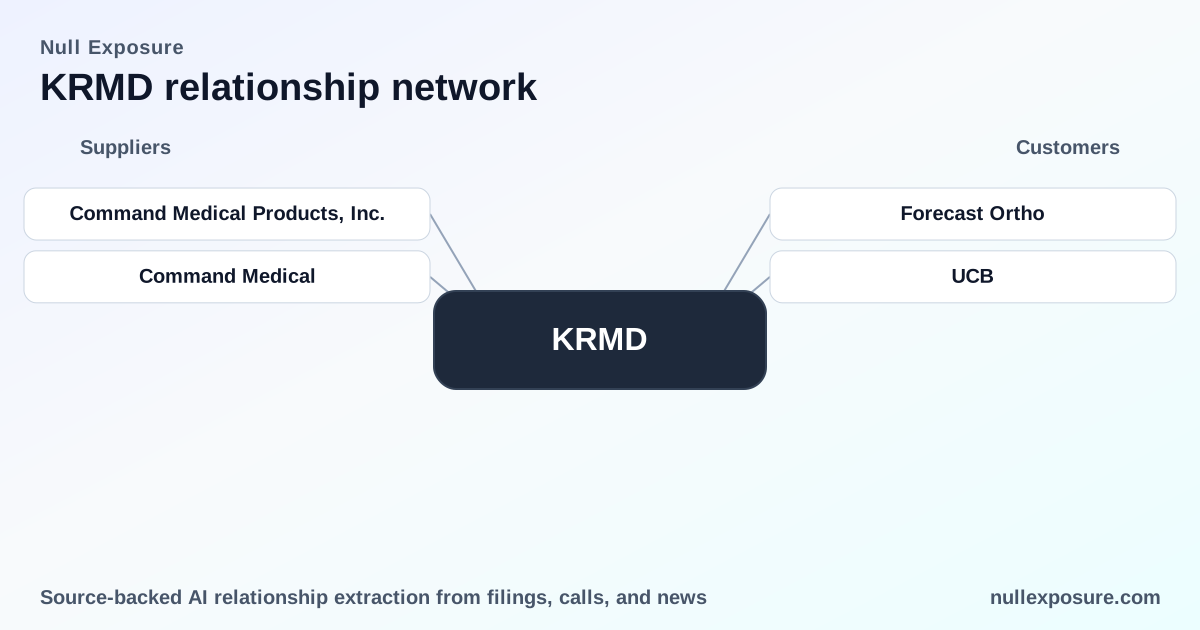
KORU Medical Systems (KRMD) — Supplier Concentration and Operational Leverage from Command Medical
Repro Med Systems, trading as KORU Medical Systems (KRMD), designs and sells portable ambulatory infusion devices and associated consumables. The company monetizes through device sales and recurring consumable revenue tied to infusion sets and tubing; it retains device assembly in New Jersey while outsourcing the large majority of consumables manufacturing to a single contract manufacturer. For investors, KRMD is a play on recurring consumable economics but one with clear supplier concentration and operational dependency that materially affects risk and scalability.
Discover more supplier intelligence at https://nullexposure.com/.
How the company makes money and why supplier relationships matter
KORU sells pumps and consumables into the ambulatory infusion market. Device sales drive upfront revenue and product adoption while consumables create higher-margin, repeat revenue. The latest trailing revenue sits around $41.1 million with gross profit of about $25.6 million, but the company is unprofitable on the bottom line (negative net margins and negative EBITDA). Profitability improvement depends on scaling sales of consumables and controlling cost of goods — which in KORU’s case is tightly linked to its supplier posture.
Operationally, KORU manufactures all pump volume at Mahwah, NJ, and sources the lion’s share of consumables from an external contract manufacturer. That supplier relationship therefore controls both cost exposure (pricing and geography) and production continuity (fulfillment and inventory risk). Given the company’s small absolute revenue base, supplier terms translate directly into margin and production resilience.
Primary supplier: Command Medical Products, Inc. — the economics and the documents
Hurricane-level supplier concentration centers on Command Medical Products.
Manufacturing and Supply Agreement disclosed in FY2024 (10‑K)
According to KORU’s FY2024 Form 10‑K filing, the company entered a Manufacturing and Supply Agreement with Command Medical Products, Inc. on November 11, 2020, under which Command manufactures and supplies subassemblies, needle sets and tubing to KORU per KORU’s specifications and purchase orders. This contract underpins 85% of consumable sourcing while KORU retains pump production domestically. (Source: KORU Medical Systems FY2024 Form 10‑K).
Amended Supply Agreement reported in FY2025 (market report)
A MarketScreener report noted that KORU entered an amended Supply Agreement with Command Medical on or around November 19, with the SEC filing referenced November 17, indicating continued contractual engagement and likely operational updates to the original arrangement. This public amendment signals ongoing reliance on Command and active contract management rather than imminent supplier replacement. (Source: MarketScreener news report referencing SEC filing, FY2025).
What the documented constraints tell investors about KORU’s operating model
The structured constraint excerpts in filings and reports provide specific operational signals that map directly to investor-relevant characteristics:
- Long-term contracting posture: Company-level disclosure states the Manufacturing and Supply Agreement provides a five‑year term from the Effective Date, reflecting a deliberate, multi-year outsourcing commitment that stabilizes supply planning and cost expectations. This is a company-level signal about KORU’s preferred contracting horizon rather than a single transactional detail.
- Geographic and cost posture — LATAM manufacturing: The disclosures identify Command’s operations in Nicaragua and that 85% of consumables are produced there, indicating KORU deliberately leverages lower-cost LATAM manufacturing for consumables, which supports margin on recurring revenue but introduces geopolitical, logistic, and quality control vectors.
- Manufacturer role and criticality: Command is explicitly described as KORU’s contract manufacturer for subassemblies, needle sets and tubing, meaning Command is a critical manufacturing partner rather than a peripheral supplier. The operation is not interchangeable without meaningful requalification and supply chain transition costs.
Together these constraints create a clear operational profile: KORU relies on a long‑dated, concentrated outsourcing relationship in LATAM for the majority of its consumables, while retaining device assembly domestically to protect intellectual property and device control.
Risks and upside from the supplier configuration
The supplier structure produces asymmetric outcomes:
- Upside: Lower unit cost and scalable gross margin on recurring consumables, supporting higher lifetime value per customer as adhesive consumables are consumed over time. Long-term contracts reduce short-term spot-price volatility.
- Risks: High supplier concentration (85%) concentrates production, quality and geopolitical risk. Any disruption at Command’s Nicaragua operations, regulatory changes, or termination/amendment disputes would directly impair KORU’s ability to supply consumables and could compress revenue and margins quickly. Contract duration reduces the flexibility to rebalance suppliers in the near term.
Key investor checklist:
- Monitor Command’s operational health and any subsequent SEC filings for further amendments.
- Track KORU’s gross margin trends and any changes in the percentage of consumables produced internally vs. outsourced.
- Watch for supplier diversification initiatives or strategic inventory buffers disclosed in earnings commentary.
If you want deeper supplier-level signals and contract analytics, see the full supplier intelligence hub at https://nullexposure.com/.
Actionable takeaways for investors and operators
- Supplier concentration is material: Command supplies approximately 85% of consumables and is contracted as the manufacturer of subassemblies and tubing; this is the dominant counterparty risk for operational continuity.
- Contracted, long-term relationship reduces short-term repricing risk but increases strategic dependency. The five‑year term provides predictability for cost planning but raises transition costs if relocation becomes necessary.
- LATAM manufacturing is a deliberate margin lever with attendant geopolitical and logistic risk. Investors must weigh lower production cost against potential supply interruptions and regulatory exposures.
For market participants focused on operational due diligence or supplier risk quantification, detailed contract monitoring and on-the-ground supplier assessments are required; start with the company filings and the public reporting trail at https://nullexposure.com/.
Closing assessment
KORU’s business model captures recurring consumable economics, but the profit and growth story is tethered to a single, LATAM-based contract manufacturer — Command Medical. This relationship is the primary operational lever for margin improvement and the primary single point of failure for supply continuity. Investors should treat Command as a de facto strategic partner when modeling downside scenarios and upside margin capture. For forensic-grade supplier tracking and to monitor amendments or new filings as they arrive, use the resources at https://nullexposure.com/.