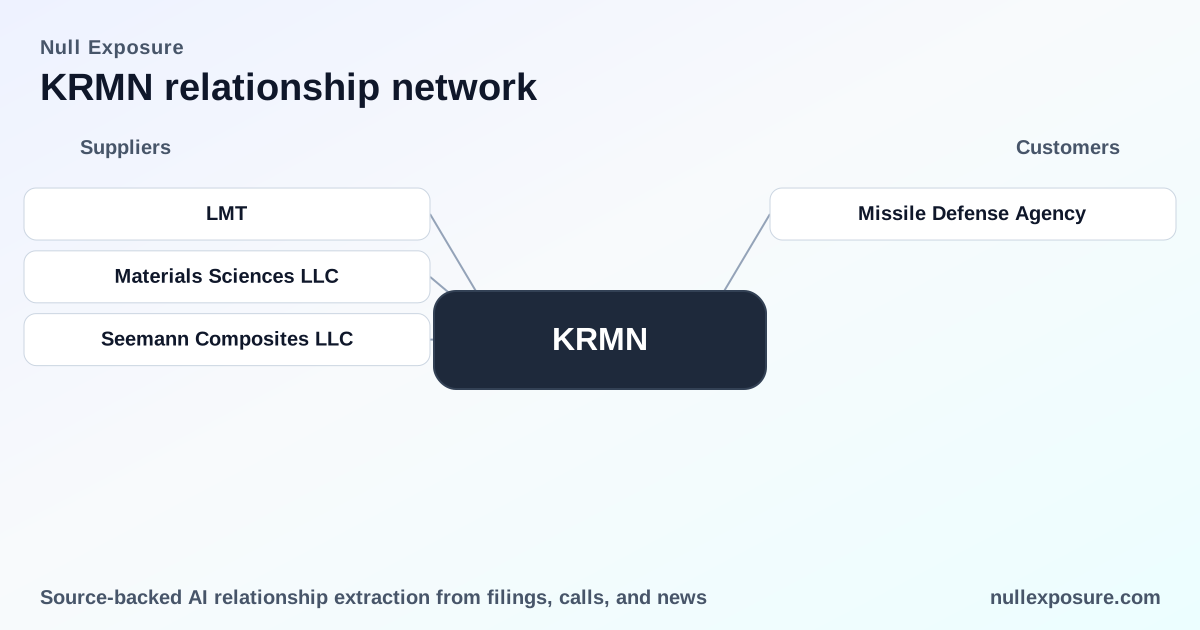
Karman Holdings (KRMN): supplier relationships that shape scale and risk
Karman Holdings operates as a designer, tester and manufacturer of mission‑critical systems for missile/defense, space and hypersonic markets, monetizing through direct sales and program contracts with prime contractors and government customers. Revenue is concentrated in large defense programs and supplier and customer relationships are consequential to execution and working capital, so investors should evaluate counterparties for concentration, service continuity and strategic fit when assessing Karman’s growth trajectory and margin durability. For deeper, structured supplier intelligence visit https://nullexposure.com/.
How Karman’s commercial model drives supplier dynamics
Karman sells engineered subsystems and integrated hardware to defense and space primes and government programs, which produces a classic supplier posture: long lead components, program-tied contracts and service relationships for recurring test, integration and audit work. That commercial shape creates a mix of high revenue per program and concentrated counterparty interdependence—good for margin upside on award capture, but directly increasing execution and payables risk if a critical supplier is disrupted.
Karman’s public metrics underline the stakes: market capitalization of roughly $13.8 billion against TTM revenue of $428.2 million, a high valuation multiple structure (price/sales ~32x, EV/EBITDA >130x) that presumes continued execution on large programs and acquisitions to scale revenue. This corporate posture amplifies the importance of supplier relationships to maintain program schedules and sustain expected growth.
Visit https://nullexposure.com/ for supplier-level reports and tracking if you are modeling Karman’s operating leverage into price targets.
Supplier relationships investors need on the radar
Below I summarize every named supplier/partner mentioned in the available reporting and what each relationship signals for operators and investors.
-
ULA — Karman was named Enterprise Operations Supplier of the Year for 2025 by ULA, a recognition that signals meaningful operational integration and preferred-supplier status on launch and space programs; the acknowledgment was mentioned on Karman’s 2025 Q3 earnings call. (Source: 2025 Q3 earnings call commentary, March 2026.)
-
Seemann Composites LLC — Karman agreed to acquire Seemann Composites as part of a broader transaction valued at about $220 million in total consideration, placing Karman directly into naval defense and composite manufacturing capability. The acquisition was disclosed in a filing and reported in March 2026. (Source: news report covering the company filing, March 2026.)
-
Materials Sciences LLC — Included in the same deal as Seemann, Materials Sciences LLC was acquired for the combined consideration described above (approximately $210 million cash plus $10 million in stock per the filing), representing an inorganic expansion into materials and naval defense supply capability. (Source: news report covering the company filing, March 2026.)
Each of these relationships has strategic implications: the ULA award is an earned preferential supplier status on launch programs, while the two acquisitions materially expand Karman’s vertical footprint into composites and materials—capabilities that shorten supply chains and increase control over critical inputs.
What the company-level constraints tell investors about contracting posture and risk
Karman’s public disclosures and filing excerpts reveal company-level signals that shape supplier risk and negotiating leverage:
-
Concentration: The three largest customers accounted for approximately 50.7% of revenue for the year ended December 31, 2024, indicating high customer concentration and program dependency. The same filing shows one supplier comprised about 19.6% of accounts payable as of that date, highlighting supplier concentration on the liability side.
-
Service-provider relationships and spend scale: Audit and other professional fees billed by Moss Adams LLP are recorded in the filing; the line item for professional fees totaled $1,813,528, which situates certain service engagements in the $1–10 million spend band and reflects established third‑party service relationships and external controls costs.
-
Contracting posture and criticality: The mix of high-revenue programs, supplier concentration and recent acquisitions points to a contracting posture that is program-driven and increasingly vertically integrated — Karman is acquiring upstream capabilities to reduce external dependency for critical composite and materials inputs.
Together, these signals describe a supplier ecosystem where specific partners are critical, the company leverages service providers for compliance and auditing, and management is pursuing inorganic moves that shorten critical supplier chains.
What this means for valuation and operational risk
Karman’s valuation assumes growth and margin expansion. From a supplier-risk lens:
-
Operational continuity is critical. The ULA supplier recognition reduces schedule risk on launch work but does not eliminate the company-level dependency on large customers and concentrated suppliers.
-
Acquisitions de‑risk some supplier concentration long term. Buying Seemann and Materials Sciences brings manufacturing and materials in-house, improving control over lead times and specialized capability—but introduces integration execution risk and near-term cash outflow ($210M cash + ~$10M stock disclosed).
-
Cost and audit discipline are visible but modest in scale. Professional fees in the mid‑six figure range indicate robust external control processes but are not large relative to program budgets; this is consistent with a company scaling quickly while maintaining external assurance.
Key investor takeaways are summarized below:
- Positive: Preferred supplier recognition from a program prime (ULA) and strategic M&A to internalize critical capabilities.
- Negative: Revenue and payable concentration create single-counterparty execution and working capital risk that can affect program delivery and margins.
- Valuation sensitivity: High multiples reflect expectations for continued acceleration; supplier disruptions or integration delays would have outsized P&L impacts.
Tactical recommendations for investors and operators
- Monitor integration milestones and synergy realization for Seemann and Materials Sciences in quarterly filings and earnings calls; delays will stress cash flow assumptions.
- Track accounts payable concentration and any public identification of the large supplier representing ~19.6% of payables—this is a key operational risk indicator.
- Use supplier awards (like the ULA recognition) as a leading indicator of program pipeline visibility and potential incremental backlog.
If you need structured supplier intelligence, vendor exposure analytics, or ongoing monitoring, start your investigation at https://nullexposure.com/ — our platform consolidates filings, call transcripts and news signals for decision-ready insight.
Closing: what to watch next quarter
Karman’s supplier posture is moving from external dependence toward vertical control through targeted acquisitions while preserving premium prime-contractor relationships. Investors should watch integration execution, any shifts in accounts payable concentration, and commentary on program backlog or supplier disruptions in upcoming quarterly reports. For continuous tracking of supplier events and their financial implications, explore https://nullexposure.com/ for tailored reports and alerts.