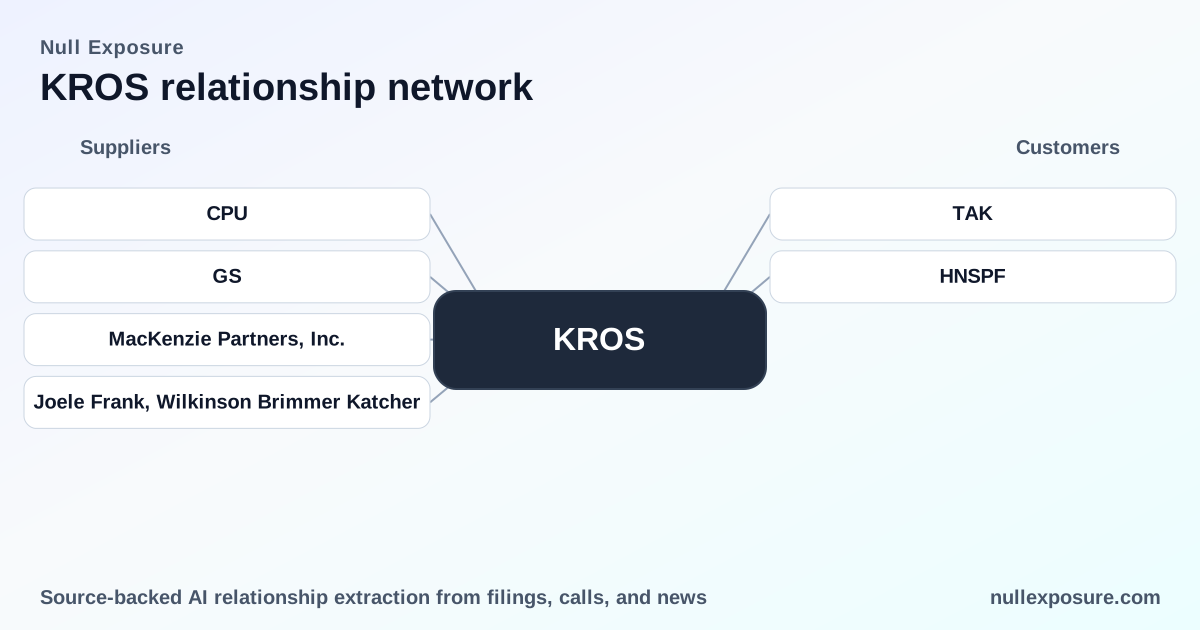
Keros Therapeutics (KROS) — Supplier Relationships and Operational Signals for Investors
Keros Therapeutics is a clinical-stage biopharmaceutical company focused on developing and commercializing therapies for hematological and musculoskeletal disorders. The company monetizes through the clinical advancement of its pipeline toward market approval and through commercial sales or licensing/partnering arrangements once products are approved; today its operations are execution- and supply-chain‑driven rather than commercialization-driven. Keros runs a highly outsourced manufacturing and clinical execution model, which creates clear operational leverage and concentrated supplier risk that investors must price into valuation and near-term liquidity planning. For a deeper view of supplier exposures, visit https://nullexposure.com/.
Why supplier relationships matter for a clinical-stage biotech like KROS
Keros’ operating model is built on external partners for both manufacturing and trial execution. The constraints drawn from company disclosures present a coherent picture:
- Contracting posture: short-term purchase orders. Keros states that it obtains supplies from CMOs on a purchase order basis and does not maintain long-term supply agreements, signaling transactional procurement and limited supply-side commitments.
- Concentration: critical single-source dependencies. The company explicitly highlights single-source reliance for the manufacture of its lead candidates (cibotercept, KER-065 and elritercept), which creates acute delivery and regulatory risk if a supplier disruption occurs.
- Relationship roles and maturity: active manufacturer and service-provider model. Keros relies on third-party CMOs for manufacturing and on CROs, contracted labs and independent investigators for clinical operations; these relationships are active and central to ongoing trials and potential commercial scale-up.
Together, these signals define an operational profile where manufacturing and supplier continuity are material to clinical timelines, cost structure and ultimately value realization. Investors should treat supplier resilience as a first-order variable in modeling time-to-revenue and upside capture.
How supplier structure translates to valuation risk and execution risk
Keros reports revenue TTM of $244.1 million and a market capitalization of roughly $336.0 million, yielding a low trailing P/E of 4.8 but a stretched forward P/E of 48.8—a split that reflects recent earnings dynamics and future growth expectations. Supplier concentration and short-term contracting increase both the timing risk and potential cost volatility that justify a discount to headline multiple: delays in manufacturing translate directly into trial extensions, additional capital needs, and push-outs of commercialization.
Operationally, short-term purchase orders give Keros negotiating flexibility but reduce supplier commitment to capacity allocation, increasing the probability of supply bottlenecks during peak clinical demand. Single-source manufacturing for multiple candidates is a critical vulnerability that amplifies regulatory and production execution risk. Investors should incorporate the probability of supply interruptions and contingency costs into cash runway and scenario models.
For investors looking to quantify exposure, perform targeted diligence on long-lead materials, secondary sourcing options, and historical supply interruptions; for a curated supplier-intelligence view see https://nullexposure.com/.
Who Keros engaged in the reported tender offer—and what that implies
Keros disclosed a tender offer with supporting service providers in a public press release. The following relationships were named in that disclosure; each is summarized concisely with source context.
-
Computershare Trust Company, N.A. — Computershare acted as the depositary for Keros’ tender offer; the depositary reported that 17,712,262 shares were validly tendered and not validly withdrawn. This is documented in Keros’ tender offer final results press release distributed via GlobeNewswire on November 20, 2025.
Source: GlobeNewswire press release (Nov 20, 2025). -
Goldman Sachs & Co. LLC — Goldman Sachs served as the dealer manager for the tender offer and was cited as the investor contact for questions regarding the offer. The role underscores the use of an investment bank to manage shareholder outreach and execution of capital transactions.
Source: GlobeNewswire press release (Nov 20, 2025). -
MacKenzie Partners, Inc. — MacKenzie Partners functioned as the information agent for the tender offer, providing shareholder support and written communications channels listed in the press release. Use of a dedicated information agent is consistent with formalized liquidity or recapitalization activity.
Source: GlobeNewswire press release (Nov 20, 2025). -
Joele Frank, Wilkinson Brimmer Katcher — Joele Frank was retained as media contact/communications counsel for the tender offer, handling investor and public relations messaging around the transaction. This reflects an elevated public communications posture during capital or corporate-structure events.
Source: GlobeNewswire press release (Nov 20, 2025).
These counterparties reflect standard capital-markets execution infrastructure—depositary, dealer manager, information agent and PR counsel—used when a company runs a tender offer or similar shareholder transaction.
For a structured supplier-risk briefing and follow-up on counterparty exposures see https://nullexposure.com/.
Practical diligence checklist for operators and investors
Assessments that materially affect investment decisions should include targeted diligence on supplier and transaction counterparties:
- Confirm whether CMOs have multi-year capacity commitments or only short-term POs; review written evidence of lead-time protections and capacity reservations.
- Map single-source dependencies for each clinical and commercial-stage asset and quantify the operational impact (days of delay, additional capital, patient enrollment disruption) from a supplier outage.
- Verify contingency plans: validated secondary suppliers, technology transfer status, and regulatory readiness for alternate sites.
- Review contractual termination, warranty and indemnity provisions with CMOs and CROs to understand financial recourse and transition cost.
- Evaluate capital markets counterparties used in recent capital transactions (as named above) to understand access to liquidity and communication discipline under stress.
Investors should treat supplier continuity as a value-driver, not a peripheral operational detail.
Final read: key takeaways and next steps
Keros operates a highly outsourced model with short-term contracting and critical single-source manufacturing exposures, which directly affect execution timelines, capital needs and valuation multiples. The tender-offer counterparty list—Computershare, Goldman Sachs, MacKenzie Partners and Joele Frank—is standard for capital-market events and signals active engagement with institutional execution resources. Primary investor focus should be supplier redundancy, contractual protections, and contingency cost modeling.
For a concise supplier-risk scorecard and to explore Keros counterparty exposures in depth, visit https://nullexposure.com/. If you need an investor-ready briefing tailored to Keros’ manufacturing and clinical supplier footprint, request a custom analysis at https://nullexposure.com/ — that is the next prudent step before making allocation decisions.