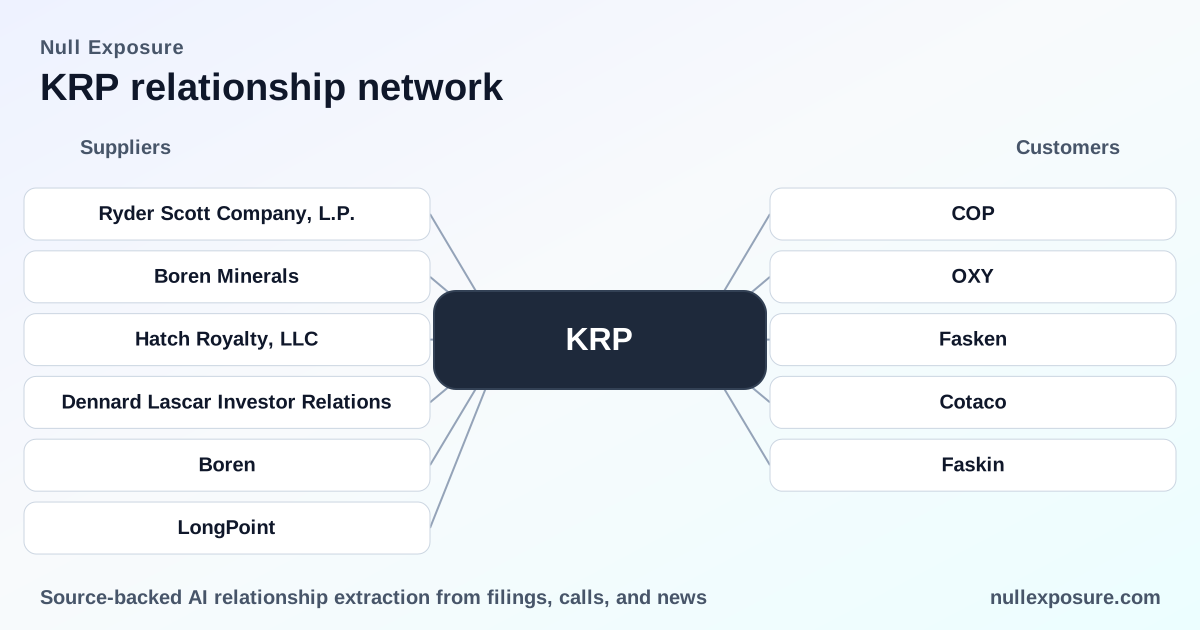
Kimbell Royalty Partners (KRP): supplier relationships and what they signal for investors
Kimbell Royalty Partners acquires and holds mineral and royalty interests across U.S. oil and gas properties and monetizes those assets through production‑linked cash flows and selective acquisitions financed with equity and credit facilities. Revenue comes from royalties and mineral payments tied to operator production, while the company outsources management and field operations to third‑party service and exploration operators, creating a low‑capex, cash‑yield profile that is sensitive to reserve quality and operator performance. For an ongoing view of supplier exposures and relationship signals, visit https://nullexposure.com/.
How Kimbell runs the business and who does the heavy lifting
Kimbell is fundamentally a royalty and mineral owner, not an operator. That operating posture creates two structural characteristics: stable cashflow upside from long‑lived assets and outsized reliance on external operators to extract value. Public filings and disclosures show the Partnership uses long‑term service agreements for management and administration, relies on hundreds of unaffiliated operators for production, and concentrates a meaningful share of revenue among a small set of purchasers (top ten accounted for ~41.2% of revenue as of Dec 31, 2024). Those facts imply a contracting posture that is contractually durable but operationally dependent — investors get predictable counterparty exposure rather than in‑house operational control.
Key company‑level signals to track:
- Long‑term contracting posture: the Partnership and many related agreements run multi‑year terms or year‑to‑year renewals after initial terms, which supports predictability in vendor relationships and fees (company filings through 2024–2025).
- Service provider model: management and administrative functions are provided under formal services agreements (Kimbell Operating and related managers), concentrating governance and acquisition execution externally.
- Active and mature supplier base: Kimbell reports revenue from roughly 1,400 operators and continues to execute acquisitions, indicating an active, scaling relationship footprint.
- Modest vendor spend bands: documented payments (e.g., ~$120,000 to K3 Royalties in 2024; monthly fees of ~$10,000 reported historically) imply operational vendor spend typically in the low‑six‑figure range, which limits single‑supplier financial concentration risk.
If you want a structured mapping of supplier and counterparty exposure, start here: https://nullexposure.com/.
The supplier list investors should know (every relationship from the results)
Ryder Scott Company, L.P.
Ryder Scott prepared an independent estimate of Kimbell’s proved reserves as of December 31, 2025, providing audited technical validation that underpins Kimbell’s production and reserve disclosures. This is the type of reserve engineering engagement that supports investor confidence in reported proved reserves (source: press release via Yahoo Finance, March 10, 2026 — https://uk.finance.yahoo.com/news/kimbell-royalty-partners-announces-fourth-120000079.html).
Boren Minerals / Boren (transaction counterparty)
Kimbell acquired mineral interests from Boren (a Saskatchewan partnership) in a Midland Basin transaction, with counsel provided to Boren by Vinson & Elkins on Texas and U.S. tax matters; management commentary also references a Boren acquisition in early 2025 as a high‑upside unconventional horizontal deal. These items together show Boren as an acquisition counterparty that fed Kimbell’s portfolio growth (sources: Vinson & Elkins announcement on the Mabee Ranch sale, FY2025 — https://www.velaw.com/news/kimbell-royalty-partners-lp-announces-231-million-midland-basin-acquisition-in-cash-and-unit-transaction/; and management remarks on the Q4 2025 earnings call transcript via InsiderMonkey, FY2026 — https://www.insidermonkey.com/blog/kimbell-royalty-partners-lp-nysekrp-q4-2025-earnings-call-transcript-1705273/).
Hatch Royalty, LLC
Kimbell completed a significant acquisition of mineral and royalty interests from Hatch Royalty in a transaction valued at approximately US$290 million, a deal that was executed alongside an underwritten equity offering — a clear example of Kimbell using third‑party asset purchases to expand royalty inventory. This acquisition was publicly advised by White & Case and reported in 2022 filings and press materials (source: White & Case press release on the US$290M acquisition, reported FY2022 — https://www.whitecase.com/news/press-release/white-case-advises-kimbell-royalty-partners-its-us290-million-acquisition).
Dennard Lascar Investor Relations
Dennard Lascar is cited as the investor relations contact for Kimbell (email and phone contact provided in recent press materials), indicating an engaged external IR vendor relationship that handles market communications and earnings outreach. This is the public IR channel Kimbell uses for investor queries and media liaison (source: company press release via Yahoo Finance, FY2025 — https://finance.yahoo.com/news/kimbell-royalty-partners-reaffirms-625-213000842.html).
LongPoint (portfolio acquisition reference)
Management specifically called out LongPoint as a prior acquisition that has delivered strong results, making LongPoint a meaningful historical supplier of production upside to the portfolio. That transaction highlights Kimbell’s strategy of buying attractive non‑operated positions and harvesting production growth through operator execution (source: Q4 2025 earnings call transcript via InsiderMonkey, FY2026 — https://www.insidermonkey.com/blog/kimbell-royalty-partners-lp-nysekrp-q4-2025-earnings-call-transcript-1705273/).
What these relationships imply for investors: operational constraints and risk vectors
The relationship evidence and contract excerpts produce a coherent operational picture: Kimbell is contractually insulated through long‑term agreements but operationally exposed to external operators and M&A execution. That dichotomy creates several investor‑relevant constraints:
- Contracting posture: Long‑term service and lease arrangements reduce near‑term vendor churn risk and underpin steady administration and acquisition workflows, but they also lock the Partnership into fixed fee structures that affect cost flexibility.
- Concentration and criticality: With ~41% of revenue coming from the top ten purchasers, revenue concentration is material; operator performance becomes the primary single‑point risk for cash flow volatility.
- Maturity and activity: The Partnership runs active acquisition programs (e.g., Hatch, Boren, LongPoint), so integration execution and reserve verification (e.g., Ryder Scott engagements) are critical to realizing projected yield accretion.
- Spend profile: Documented payments to service providers (examples include ~$120k to K3 Royalties and recurring monthly services fees) indicate vendor spend that is operationally important but not overwhelmingly large, suggesting most operational risk is clinical (operator execution) rather than vendor cost scale.
Investor action checklist
- Monitor Ryder Scott reserve certifications and any revisions closely; reserve restatements are the primary leading indicator of cashflow trajectory.
- Track integration milestones and production contribution from acquisitions like Boren and LongPoint to confirm acquisition economics and payout timelines.
- Watch operator counterparties and the makeup of the top purchasers bucket; a shift in concentration or operator underperformance is the main downside lever.
- Confirm continuity of management service arrangements and external IR communications to ensure governance and disclosure remain predictable.
For a mapped, interactive view of these and similar supplier relationships, go to https://nullexposure.com/ — it’s the fastest way to translate relationship signals into investment action.
Bottom line
Kimbell Royalty operates a capital‑light, acquisition‑driven royalty model that delivers predictable cash yields while ceding operational execution to third parties; the company’s vendor and counterparty relationships reduce day‑to‑day operational overhead but increase dependence on external operator performance and successful integration of purchased assets. Investors should prioritize reserve certification, acquisition execution, and purchaser concentration as the most materially actionable signals. Explore a deeper supplier exposure analysis at https://nullexposure.com/ to convert these relationship cues into portfolio decisions.