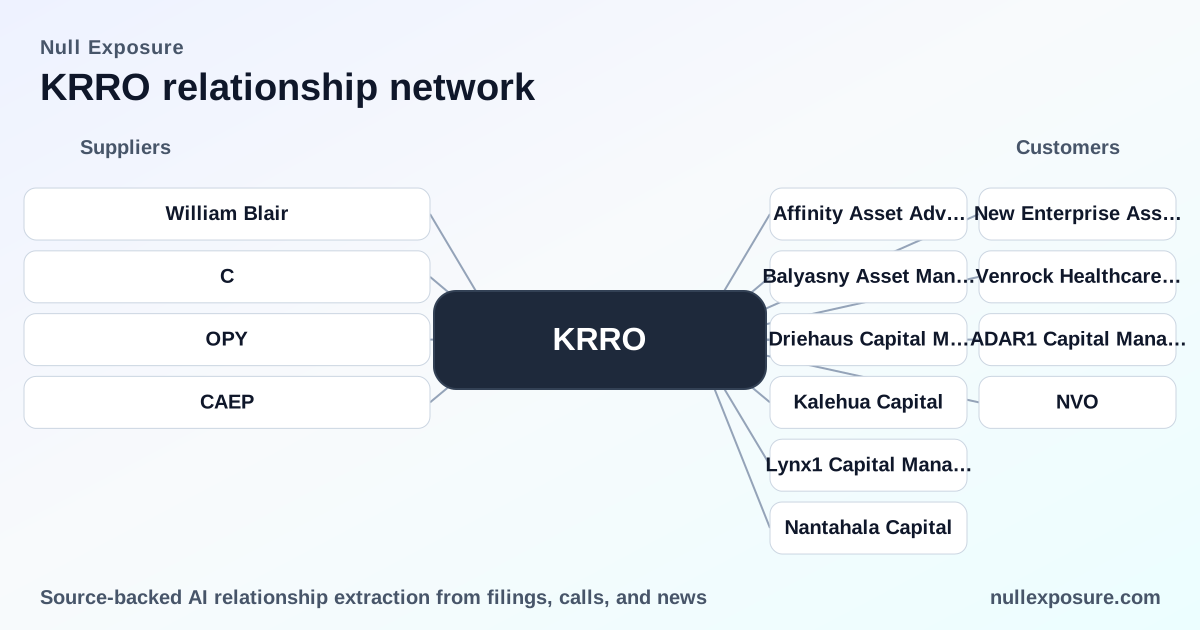
Korro Bio (KRRO) — supplier footprint and the placement-agent network behind the FY2026 PIPE
Korro Bio, Inc. (KRRO) is an early-stage genetic medicines company that discovers and develops RNA-editing therapies and monetizes through clinical progress and capital raises that fund IND-enabling work and early trials. The company relies on contract manufacturers and third-party service providers to produce oligonucleotides, viral vectors, and laboratory services while using financing syndicates to underwrite growth capital; the FY2026 $85 million private placement demonstrates a capital-intensive model that converts investor underwriting into runway rather than product revenue. Investors should view KRRO’s supplier posture as capital-driven and manufacturing-dependent: bench science is outsourced, commercial optionality is distant, and financing partners are functionally critical to near-term survival.
For ongoing supplier-monitoring and relationship intelligence, visit https://nullexposure.com/ for platform access and detailed supplier maps.
Why the FY2026 PIPE matters for supplier risk
Korro’s $85 million private placement is not just a funding event; it is a signal about the company’s operating cadence. The firm runs a capital-consumption model — limited revenue, negative operating margins, and clinical-stage costs — that requires periodic equity raises to maintain clinical programs. The selection of placement agents for a PIPE reflects both distribution reach and investor targeting: global banks bring institutional placement capacity while boutique firms provide specialized healthcare investor access. The financing converts bank underwriting into operational runway that directly supports CMO relationships and outsourced R&D spend.
Company-level operating constraints and what they mean for partners
-
Long-term real estate commitment: Korro leases approximately 50,453 sq ft of combined office and lab space in Cambridge with a lease term running through April 2034 and an option to extend five years, which signals a long-term physical commitment to in-house lab infrastructure and a predictable occupancy expense profile. This lease implies stable local operations and a fixed-cost base that benefits contract manufacturers by providing steady R&D throughput.
-
APAC sourcing exposure: The company sources certain materials from China and other countries outside the U.S., introducing supply-chain concentration risk and exposure to tariffs, geopolitical friction, and shipping disruption. For procurement and logistics partners, this marks a dependency on East Asian suppliers that requires dual-sourcing or inventory buffers.
-
Outsourced manufacturing and services are core: Korro explicitly intends to use qualified third‑party CMOs for manufacturing oligonucleotides, viral vectors, and other compounds for IND support and early clinical trials; it also relies on external IT/security and CRO networks. This operating model makes CMOs and specialized service providers critical suppliers, not optional vendors — contract terms, quality metrics, and capacity planning will materially affect timelines.
-
Maturity and concentration profile: Given the company’s small trailing revenue and negative margins, supplier relationships are concentrated around early-stage clinical needs rather than commercial scale manufacturing. Suppliers should price for development-phase variability and payment timing tied to financing cycles.
These constraints are company-level signals derived from regulatory excerpts and public disclosures; they are not assigned to specific placement agents or individual suppliers unless named in those excerpts.
Who handled the FY2026 PIPE — the relationships you need on your radar
Citigroup
Citigroup acted as one of the placement agents for Korro’s $85 million private placement, bringing global distribution reach and institutional investor coverage to the financing syndicate. According to a CityBiz report published March 10, 2026, Citigroup was named alongside other lead agents in the PIPE placement announcement.
Oppenheimer & Co.
Oppenheimer & Co. participated as a placement agent on the transaction, offering middle‑market and healthcare-focused placement capabilities that complement larger bank distribution. The CityBiz article covering Korro’s PIPE on March 10, 2026 lists Oppenheimer & Co. among the participating placement agents.
William Blair
William Blair served as a placement agent on the PIPE, providing healthcare sector relationships and sell-side research channels that help reach specialized biotech investors. The March 10, 2026 CityBiz announcement of the $85 million private placement cites William Blair as a named agent.
Cantor
Cantor (Cantor Fitzgerald-related entities) was included in the placement-agent group for the private placement, contributing capital markets execution and a network of fixed-income and equity investors. CityBiz’s March 10, 2026 coverage identifies Cantor as a participant in the financing syndicate.
Sources for the placement-agent attributions include the CityBiz coverage of Korro’s financing and parallel market‑news aggregation published March 10, 2026.
What operators and procurement teams should do next
-
Treat CMOs and critical suppliers as strategically important counterparties. Korro’s disclosed use of CMOs for clinical-stage manufacturing makes those contracts a primary operational lever; expect fixed-term capacity commitments and quality-claused milestone payments.
-
Model funding cadence into supplier credit terms. Given the company’s capital-raising profile and negative operating margin, tailor payment terms and milestone triggers to align with financing events rather than assuming steady revenue. Placement agents listed above converted capital markets activity into near-term runway — suppliers should track financing headlines as operational signals.
-
Mitigate APAC concentration risk. Implement dual-sourcing and inventory buffers for China‑sourced materials, and insist on clear escalation and continuity plans in supplier contracts for geopolitical or logistic disruptions.
If you want a complete supplier map and real-time alerts tied to KRRO’s financing events and contract disclosures, explore the platform at https://nullexposure.com/ to see how placement-agent activity and supplier concentration interact with operational risk.
Bottom line and recommended engagement posture
Korro is an early‑stage, capital-dependent biotech whose clinical program execution is built on outsourced manufacturing and specialist service providers. The FY2026 $85 million PIPE — underwritten by Citigroup, Oppenheimer, William Blair, and Cantor — is a financing event that directly shapes runway and thus the urgency and structure of supplier contracts. For investors and operators, the priority is twofold: monitor financing cadence as a proxy for operational continuity, and treat CMOs and APAC suppliers as mission-critical counterparties requiring stronger contract protections.
For practitioners evaluating supplier risk across Korro and comparable small-cap biotechs, begin with a financing-aware supplier diligence model; view placement-agent activity as a real-time indicator of runway and payment capacity. For direct access to supplier intelligence and relationship analytics, go to https://nullexposure.com/ and request a demo.