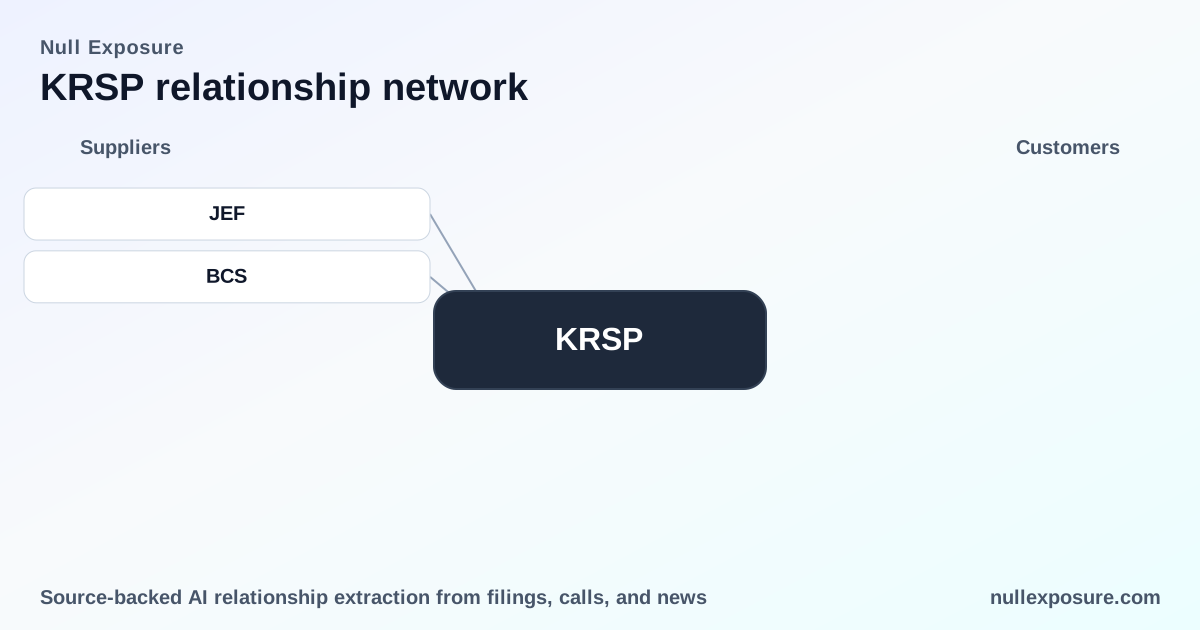
KRSP Supplier Intelligence: Bookrunners, Operational Implications, and Investor Action
Rice Acquisition Corporation 3 (KRSP) is a SPAC that raises capital through an initial public offering and monetizes by executing a business combination with a target in the energy and sustainability space; the company captures value through sponsor economics, warrants and post-merger equity appreciation following a successful transaction. KRSP’s immediate commercial footprint is dominated by underwriting and capital-marketing relationships that enable the IPO and any subsequent de-SPAC transaction. For investors and operators, understanding those supplier ties — who runs the books, how concentrated the relationships are, and what that implies for execution risk — is the priority.
Explore deeper supplier intelligence at https://nullexposure.com/.
How KRSP’s operating model actually works and why suppliers matter
KRSP functions as a classic SPAC: it sells shares to raise a trust of funds, then uses management expertise to identify a merger target in clean technology and renewable energy. Revenue for KRSP is realized only after a business combination or through sponsor economics on successful deals, so the firm’s route to value realization depends on capital-marketing execution and deal execution partners.
The March 2026 IPO pricing is a live reminder of that dependency — underwriting partners determine distribution reach, pricing discipline, and initial public-market reception. According to the company announcement, KRSP priced a $300 million initial public offering that positioned the vehicle to pursue acquisition targets in sustainability sectors (PR Newswire, March 10, 2026). That raise is the transaction around which supplier relationships activate.
Who KRSP is working with (explicit relationships found)
The public record for KRSP’s supplier-side relationships in the reviewed materials is compact but important. Each relationship below is drawn from the IPO announcement.
-
Jefferies — Jefferies served as one of the joint bookrunning managers for KRSP’s $300 million IPO, providing underwriting and distribution services to place the offering with institutional and retail channels. According to the IPO press release dated March 10, 2026, Jefferies and Barclays acted as joint bookrunning managers for the offering (PR Newswire, March 10, 2026).
-
Barclays — Barclays also served as a joint bookrunning manager on the same $300 million offering, sharing responsibility for pricing, allocation and distribution of the IPO shares. The PR Newswire announcement on March 10, 2026 lists Barclays and Jefferies as the joint bookrunners for the offering (PR Newswire, March 10, 2026).
These two entries capture every supplier relationship disclosed in the materials reviewed. Both entries derive from the same PR Newswire release announcing the IPO’s pricing (March 10, 2026).
What the bookrunner relationships imply for investors and operators
Underwriting relationships are inherently transactional but strategically critical for a SPAC in the offering phase. Bookrunners control market access, syndicate construction and initial pricing — functions that determine how comfortably the SPAC can finance its search and how the market will receive a future combination. The presence of two major banks — Jefferies and Barclays — spreads execution risk across recognized market participants and signals conventional underwriting credibility.
Operationally this means:
- Contracting posture: Engagements with bookrunners will be fee-based, documented under standard underwriting agreements, and concentrated around discrete deal milestones (pricing, closing, lock-up and potential follow-on financing).
- Concentration: The disclosed supplier set is narrow — two lead banks for the IPO — which is typical for an SPAC but leaves limited redundancy if either bank cannot fulfill its market role.
- Criticality: These relationships are critical during the capital-raising phase and materially influence the probability of a successful business combination.
- Maturity: As a newly public SPAC, KRSP’s supplier network is early-stage and transactional; long-term banking relationships may develop only after a target is announced or post-merger integration begins.
If you want to monitor KRSP’s evolving supplier map and risk profile, visit https://nullexposure.com/ for ongoing tracking and analysis.
Constraints and company-level supply signals
No supplier-specific contractual constraints were disclosed in the materials provided. At the company level, that absence communicates two points: first, KRSP is operating under a standard SPAC contracting model with transactional underwriting arrangements rather than long-term supply contracts; second, the supplier risk profile is concentrated and front-loaded around the IPO and any ancillary financing events. The lack of disclosed constraints indicates there are no publicly reported exclusivity, long-term service-level guarantees, or contingent contractual obligations tied to suppliers in the available filings.
Investors should treat this as a signal that operational execution depends on standard market mechanisms (underwriting performance, syndicate support, and eventual partner diligence) rather than negotiated supplier protections.
Risk factors worth watching now
- Execution concentration: Two bookrunners provide legitimacy but limited redundancy; any reputational or operational issue at either bank could complicate distribution or post-offering financing.
- Event-driven lifecycle: As a SPAC, KRSP’s commercial relevance and supplier activation are event-driven; underwriters and placement agents are most critical pre-merger and at de-SPAC execution.
- Disclosure gaps: Financial and operational metrics in the public overview are sparse, so investors should place extra emphasis on monitoring filings, press releases, and any underwriting supplements for changes in syndicate composition or fees.
Operational suggestions for managers and investors: maintain active dialogue with the underwriting banks on pipeline development, syndication appetite and potential forward financing arrangements; preserve optionality by keeping alternative placement channels under evaluation.
Bottom line and next steps for diligence
KRSP’s short-term supplier universe is small and transaction-focused: Jefferies and Barclays are the visible bookrunners for the IPO that funded the vehicle’s search for a sustainability-sector target. That dynamic creates operational leverage but also concentration risk that investors must price into diligence.
For immediate follow-up: request underwriting agreement terms, monitor prospectus supplements for changes to the syndicate, and track any announced adviser or placement-agent additions as the search progresses. For comprehensive supplier intelligence and ongoing relationship monitoring, visit https://nullexposure.com/ to see how these ties evolve and to access curated supplier-risk insights.
Final recommendation: treat underwriting relationships as mission-critical service suppliers for KRSP’s lifecycle and prioritize primary-source monitoring around any future transaction announcements and underwriting updates.