Karat Packaging (KRT): Supplier relationships, sourcing posture, and what investors should price in
Karat Packaging manufactures and distributes single‑use foodservice products, monetizing primarily through product sales via a broad distribution network and selective in‑house manufacturing; the firm retains distribution margin exposure while supplementing cash returns with a regular dividend and occasional equity financings. Investors should evaluate KRT on two fronts: sourcing concentration and supplier economics (affecting gross margins and working capital) and the company’s use of capital markets to manage growth and insider liquidity.
If you want a consolidated supplier-risk briefing and relationship map for active investors, start here and then review the original releases linked on the company site: NullExposure homepage.
The operating model that drives supplier risk and margin behavior
Karat’s operating model is primarily distribution-centric: it sources products from a diversified global network of over 140 vendors while maintaining selected U.S. manufacturing capabilities. This structure produces predictable revenue tied to foodservice demand and margin sensitivity driven by input costs and supplier terms.
- Contracting posture: Karat is unequivocally a buyer in its supplier relationships; it aggregates purchasing across a large vendor base and negotiates terms at scale. The company explicitly reduced reliance on China to roughly 20% of global purchases and shifted sourcing toward Taiwan, which accounted for more than 50% of global sourcing in 2024, reflecting an active procurement strategy to manage tariffs and trade risk (company disclosures for year ended December 31, 2024).
- Concentration and spend: Despite the large vendor count, purchases from at least one vendor exceed the 10% materiality threshold, and related‑party purchases reported were $35.1 million (2024) and $39.6 million (2023), which places that counterparty in the $10M–$100M spend band—large enough to be commercially meaningful to both sides.
- Criticality and maturity: The supplier network is mature and active, expanded from a handful to over 140 vendors by the end of 2024, which reduces single‑supplier failure risk but preserves vendor-level significance for top suppliers.
These characteristics mean gross margin sensitivity to commodity and freight cycles is real, while supply diversification lessens single‑country trade shock exposure. For further detail on supplier exposures and strategic sourcing, see our consolidated offering at NullExposure homepage.
Who Karat is working with — the supplier & service relationships you should know
Below are the counterparties and service providers surfaced in public disclosures and press activity; each entry is a concise, plain‑English summary with a source reference.
-
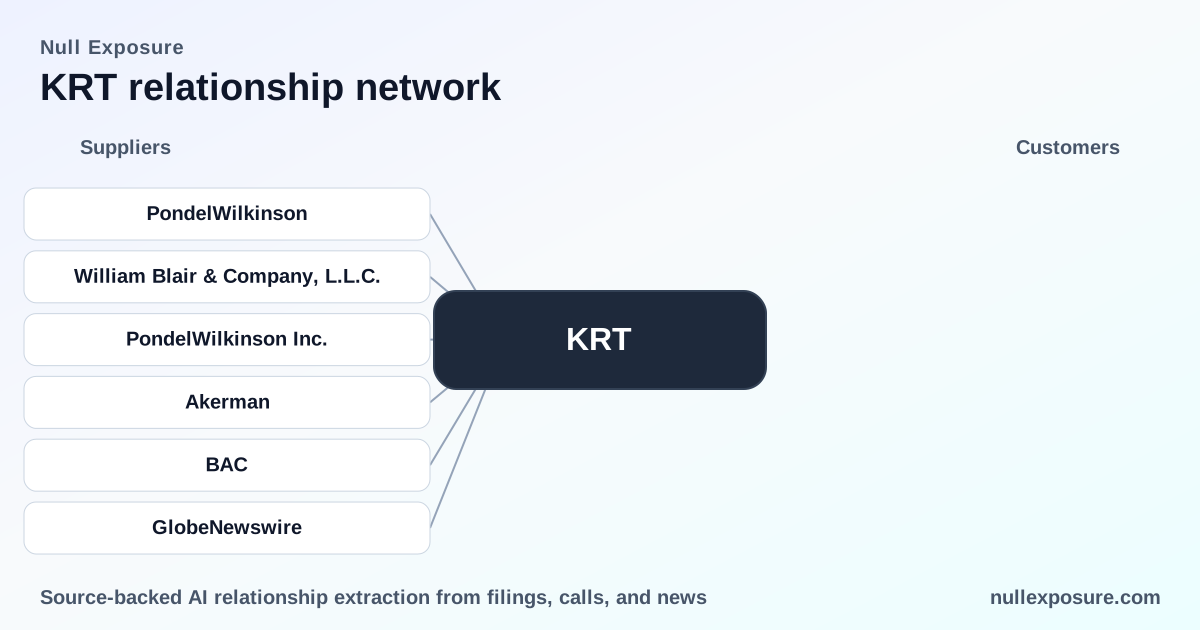
PondelWilkinson / PondelWilkinson Inc. — Karat’s retained investor relations firm and primary media contact for earnings and dividend announcements; the firm is listed as the contact in multiple press releases and conference call notices across FY2025–FY2026. Source: company press releases and conference call notices distributed via GlobeNewswire (2025–2026).
-
BofA Securities — Served as a joint lead book‑running manager on Karat’s $40.5 million secondary offering announced in 2025; the bank underwrote distribution and placement responsibilities for the offering. Source: GlobeNewswire press release announcing pricing of the secondary offering (June 11, 2025).
-
William Blair & Company, L.L.C. — Functioned as a joint lead book‑runner alongside BofA Securities on the same secondary offering, providing syndicate support and investor distribution. Source: Akerman and GlobeNewswire summaries of the June 2025 secondary offering.
-
Akerman — Acted as legal counsel to Karat Packaging and selling stockholders for the $40.5 million secondary offering, providing transactional legal services for the equity placement. Source: Akerman firm announcement regarding its role on the FY2025 secondary offering.
-
GlobeNewswire — Distribution channel used by Karat to publish financial results, dividend declarations, and offering notices; multiple press releases (earnings, dividend, offering) were distributed through GlobeNewswire in 2025–2026. Source: multiple GlobeNewswire press releases including the June 11, 2025 offering notice and various FY2025/FY2026 announcements.
-
QuiverQuant — Reposted Karat press releases and conference call notices; one repost includes a disclosure noting the summary was reproduced from a GlobeNewswire press release. Source: QuiverQuant postings of Karat’s corporate communications (FY2025).
-
SahmCapital — Syndicated or republished Karat’s investor communications announcing earnings and conference calls in early 2026, using the standard investor relations contact data. Source: SahmCapital news distribution referencing Karat’s FY2025 fourth-quarter results announcement (February 26, 2026).
-
The Manila Times — Republishes GlobeNewswire releases; carried Karat’s FY2025 fourth-quarter and full-year conference call notice in late February 2026. Source: ManilaTimes repost of GlobeNewswire release (February 26, 2026).
Each of these relationships is operationally narrow—IR and press distribution, underwriting, and legal counsel—rather than raw‑material suppliers, but they shape capital access, disclosure cadence, and market liquidity.
What this pattern means for investors (risks and opportunities)
- Capital markets access is operational: The $40.5M secondary offering and the participation of reputable underwriters (BofA, William Blair) show the company can access equity liquidity when insiders or growth plans require it; legal support from Akerman demonstrates standard deal governance. That preserves strategic optionality for balance‑sheet management.
- Investor communications are centralized: Repeated use of PondelWilkinson for IR and GlobeNewswire for distribution signals consistent disclosure practices and a single public‑relations channel, which benefits transparency and reduces information risk.
- Supplier economics dominate operating risk: The combination of a broad vendor base (140+ vendors) with meaningful spend concentration in a top counterparty and a heavy sourcing footprint in Taiwan creates a mixed profile: lower geographic concentration risk overall but material counterparty exposure to a few large vendors. That breeds margin leverage if input prices move or if top vendors tighten terms.
If you track Karat for portfolio allocation, prioritize margin sensitivity and the outcomes of quarterly inventory and procurement disclosures at the next earnings call.
For a focused supplier-risk briefing and to monitor future public disclosures, start your subscription and tracking at NullExposure homepage.
Bottom line and investor action steps
Karat Packaging operates as a scaled buyer‑distributor with targeted manufacturing, a regular dividend policy, and active use of capital markets when necessary. Key investment levers are procurement concentration, APAC sourcing composition (Taiwan weighting), and the company’s ability to maintain margins through supplier negotiation.
Actionable next steps:
- Review the June 11, 2025 offering disclosures and the FY2024 supplier notes for vendor‑level concentration.
- Monitor upcoming earnings calls where IR (PondelWilkinson) will disclose procurement and inventory dynamics.
- For a consolidated supplier and counterparty map tailored to investors, visit and subscribe at NullExposure homepage.
This assessment synthesizes public company communications and redistribution of those releases across financial news channels in FY2025–FY2026 to produce an actionable supplier-risk snapshot for investors and operating partners.