Kura Sushi USA (KRUS): Supplier relationships concentrate risk around a few Japanese distributors
Kura Sushi USA operates a technology-forward chain of Japanese restaurants in the U.S., monetizing through restaurant sales and related revenue streams; the business generates roughly $292 million in trailing revenue but runs with compressed profitability (TTM operating margin -4.7%, diluted EPS -$0.33). Procurement is a core profit lever for KRUS: a small set of Japanese distributors supplies a large share of food and beverage inputs, creating measurable vendor concentration risk that investors must price into valuation and downside scenarios.
Learn more about the supplier signals and how they affect exposure at https://nullexposure.com/.
Why supplier relationships matter for restaurant economics
Kura Sushi’s unit economics are sensitive to commodity and vendor pricing because food and beverage costs feed directly into gross margin. When a single supplier supplies more than half of food and beverage spend, negotiating leverage, single-point disruption, and cost pass-through dynamics become decisive for margin recovery. Kura’s financials (Price-to-Sales ~2.4; EV/EBITDA ~74.8) reflect growth expectations but also vulnerability to lumpy supply shocks and contract terms.
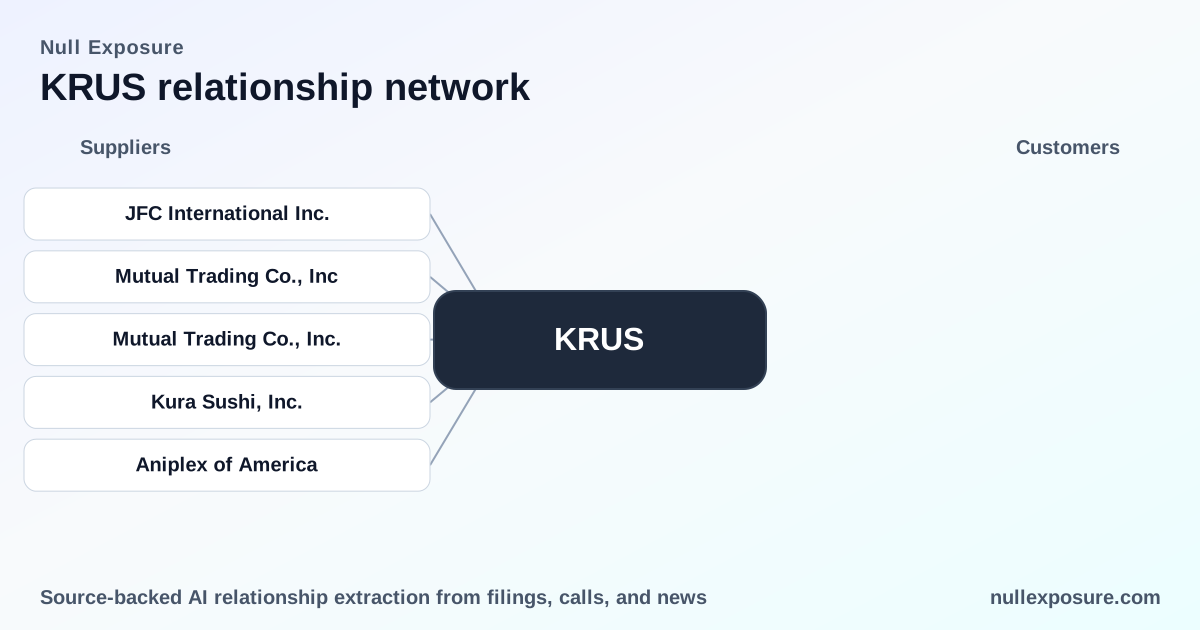
The supplier relationships you must know
The company’s disclosures and public reporting name a small group of suppliers and partners that drive procurement and marketing outcomes. Below are the relationships referenced in the public record, with concise takeaways and source context.
JFC International Inc.
Kura sourced a majority of its Japanese-related food and beverage through JFC, with JFC accounting for 58% of total food and beverage costs in FY2025 (55% in FY2024 and 49% in FY2023), making the relationship material to margins and operations. According to the FY2025 Form 10‑K filing (filed for the fiscal year ended August 31, 2025), JFC is a primary distributor and a concentrated supplier risk for KRUS.
Mutual Trading Co., Inc.
Mutual Trading supplied 32% of food and beverage costs in FY2025 (34% in FY2024) and was not significant in FY2023, indicating a rapidly rising role in procurement over the past two years. The FY2025 Form 10‑K states the purchases and their proportional share of food and beverage costs.
Kura Sushi, Inc. (majority stockholder)
Kura Sushi USA discloses reliance on vendors, suppliers and distributors that include its majority stockholder, Kura Sushi, Inc., reflecting a vertical link between the U.S. operator and the parent organization that sources product and supports supply chain activities. This relationship is highlighted in company press reporting and quarterlies covering FY2025–FY2026 results (see investor releases and news summaries in early 2026).
Aniplex of America
Kura Sushi has engaged in promotional collaborations—Aniplex of America partnered on a limited-time anime-themed promotion—representing marketing and fan-engagement partnerships rather than core food procurement. Local press coverage in 2023 documented the collaboration and its consumer-facing marketing lift.
(Each relationship summary above is drawn from company disclosures and public news reporting, including the FY2025 Form 10‑K and investor news releases in FY2025–FY2026.)
How Kura Sushi’s operating model shapes supplier exposure
Investors must translate disclosure snippets into operating assumptions. The public filings and reporting provide four clear company-level signals:
- Contracting posture: The company has long-term operating and finance leases for restaurants and equipment with terms up to 20 years, indicating a fixed-cost base and a long-duration physical footprint that increases sensitivity to gross-margin swings (evidence in FY2025 Form 10‑K). This is a company-level operating constraint, not tied to a specific supplier.
- Concentration and materiality: Food and beverage spend is heavily concentrated: JFC alone accounted for 58% of F&B cost in FY2025, and Mutual contributed another ~32% — together they dominate the procurement stack and therefore control a large share of price and availability risk (FY2025 10‑K).
- Relationship role and criticality: The named suppliers operate as distributors, not commodity spot vendors; distribution partnerships are critical to product availability and menu consistency, which constrains short-term supplier substitution (FY2025 10‑K).
- Working capital posture: KRUS collects cash rapidly from guests while typically having longer payment terms with vendors, which provides a working capital timing advantage but also implies dependency on extended trade credit when distributor terms tighten (company filing language).
These signals combine into a clear profile: high supplier concentration, durable real estate commitments, and distributor-based sourcing—a risk package that amplifies the impact of any supplier price shock or logistical disruption on margins.
Learn how these supplier signals translate into risk scores and insurance exposure modeling at https://nullexposure.com/.
Practical investment implications: risk and optionality
- Downside sensitivity: A cost increase from JFC or Mutual will flow quickly to margins unless offset by price increases or mix improvements; with operating margin already negative, the margin buffer is thin.
- Negotiation leverage: High concentration limits KRUS’s bargaining position; management’s ability to diversify suppliers or secure long-term pricing will be a strategic priority.
- Operational continuity: Distributor role means disruptions (logistics, import restrictions, or supplier-specific recalls) would be operationally disruptive and visible on same-store sales.
- Marketing and brand partnerships: Collaborations such as with Aniplex boost traffic and brand affinity but do not substitute for procurement diversification.
Recommended next steps for diligence
- Obtain the full FY2025 Form 10‑K to review supplier contract terms, payment terms, and any single-supplier agreements for JFC and Mutual. The 10‑K is the primary source for the concentration figures cited above.
- Model scenarios where JFC increases prices by incremental percentages and quantify the operating leverage through EBITDA and cash flow sensitivity.
- Assess the strategic nature of the relationship with majority stockholder Kura Sushi, Inc.: is there preferential access, guaranteed supply, or intra-group pricing that affects economics?
For a deeper supplier-focused exposure assessment and portfolio implications, visit https://nullexposure.com/.
Conclusion: concentrated suppliers are a defining risk factor
Kura Sushi USA’s procurement profile is characterized by concentrated distributor relationships that materially affect cost of goods sold, reinforced by a long-duration physical footprint and distributor-driven sourcing. Investors should treat supplier concentration—particularly JFC’s majority share of food and beverage spend—as a first-order risk when valuing KRUS and stress-test scenarios for supplier-driven margin compression. Final diligence should start with the FY2025 Form 10‑K and recent FY2026 earnings commentary to confirm any contractual protections or diversification plans.
Explore structured supplier risk analysis and bespoke exposure reports at https://nullexposure.com/.