KRYP (ProShares Trust): Supplier map and commercial implications for investors
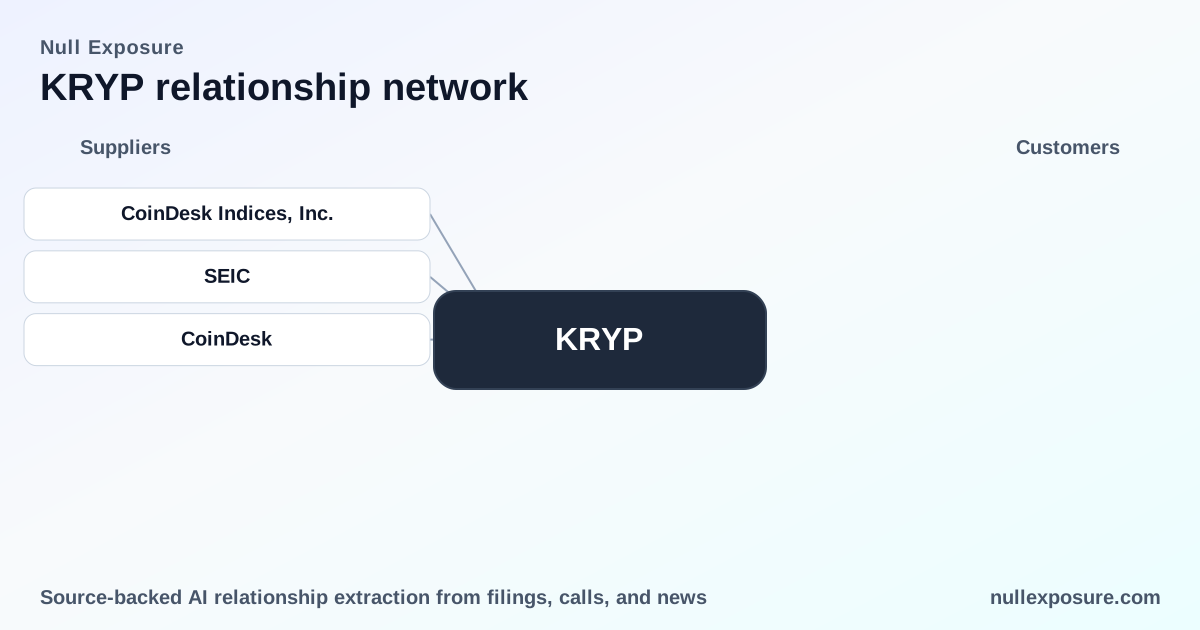
ProShares Trust operates as a product manufacturer and chief distributor of exchange-traded funds (ETFs); it monetizes primarily through management and advisory fees on listed funds, index licensing arrangements for benchmarked products, and third‑party distribution relationships that scale retail and institutional reach. The supplier relationships visible in public reporting and trade coverage show a deliberate, asset-class-led strategy: ProShares leverages external index vendors for niche exposure and outsources distribution to established platform providers to accelerate adoption. For a concise view of these supplier ties and what they mean for underwriting or partnership risk, see the firm’s supplier summary below and then read the operational takeaways.
Explore more supplier intelligence at https://nullexposure.com/.
The quick read: one-sentence takeaways
- ProShares uses licensed index intellectual property to launch thematic ETFs and relies on third-party distributors for fund placement and compliance wrappers.
- Index partners and distribution agents are operationally critical to product credibility and market access; their terms and reputations therefore drive commercial and regulatory risk.
- Investors should prioritize contract terms, fee capture, and counterparty concentration when evaluating KRYP exposure.
Supplier relationships detailed (every item from the coverage set)
CoinDesk Indices, Inc. — trademark and index licensing (ETF Trends webcast, FY2026)
ProShares has licensed the CoinDesk and CoinDesk 20 trademarks from CoinDesk Indices, Inc. to support an ETF that references the CoinDesk 20 benchmark; that is, ProShares is using CoinDesk Indices’ intellectual property as the underlying reference for a crypto-focused product. According to an ETF Trends webcast in March 2026, “CoinDesk and CoinDesk 20 are registered trademarks of CoinDesk Indices, Inc., licensed for use by ProShares.” (ETF Trends, March 2026)
SEI Investments Distribution Co. — fund distribution partner (ETF Trends webcast, FY2026)
ProShares’ funds are distributed by SEI Investments Distribution Co., which the firm identifies as a non‑affiliated distribution agent; this outsources placement, clearing relationships, and some shareholder servicing functions to SEI. The ETF Trends webcast notes that “ProShares are distributed by SEI Investments Distribution Co., which is not affiliated with the funds’ advisor or sponsor.” (ETF Trends, March 2026)
CoinDesk — benchmark provider cited in market coverage (Futunn report, FY2026)
Market coverage of ProShares’ new crypto ETF emphasizes that the fund is “designed to target the performance of the CoinDesk 20 Index,” confirming CoinDesk’s role as the benchmark provider referenced by product marketing and sell‑side summaries. A Futunn news post in March 2026 described the ETF’s objective as targeting CoinDesk 20 performance. (Futunn, March 2026)
CoinDesk — product description and diversification rationale (StructuredRetailProducts, FY2026)
Industry commentary in StructuredRetailProducts explains that ProShares’ ETF “offers a diversified exposure to 20 of the largest cryptocurrencies with a single ticker and seeks investment results that track the performance of the CoinDesk 20 Index,” reinforcing that CoinDesk’s index is central to the ETF’s positioning and diversification claims. (StructuredRetailProducts, March 2026)
What these suppliers imply about KRYP’s operating model and commercial posture
No explicit constraints excerpt was provided in the coverage set; treat the following as company‑level operating signals drawn from the supplier list and standard ETF industry practice.
- Contracting posture — standard, license-centric and outsourced. ProShares demonstrates a typical ETF sponsor posture: it secures licensing agreements for third‑party indices and engages third‑party distribution firms rather than vertically integrating those capabilities. That structure reduces fixed operating cost but increases reliance on counterparties for index continuity and distribution stability.
- Concentration — focused but not singular. The immediate supplier set shows dependence on a small number of specialized partners for specific product launches (CoinDesk for crypto benchmarking; SEI for distribution). Concentration risk is material at product level — a change in the index license or distribution terms would have an outsized impact on the affected fund’s economics.
- Criticality — high for index and distributor relationships. Index licensing governs benchmark credibility and tracking claims; distribution drives flows and retail placement. Both functions are critical to the product’s commercial success and regulatory positioning.
- Maturity — incumbent ETF sponsor practices. ProShares follows an established ETF rollout model: partner for specialized indexing, outsource distribution, and lean internal product manufacturing. This is a mature, capital‑efficient approach with predictable fee capture dynamics.
Risks investors must weigh (and what to monitor)
- Counterparty risk: The license with CoinDesk Indices and the distribution contract with SEI introduce operational single points of failure for product credibility and investor access. Monitor renewal terms, exclusivity clauses, and termination provisions when available.
- Reputational and regulatory risk in crypto products: Using a crypto index as the primary benchmark concentrates regulatory scrutiny; any regulatory action affecting the underlying market or index provider will transmit directly to fund flows and valuation.
- Fee compression and margin sensitivity: Outsourced distribution improves reach but dilutes gross margin through distribution fees and partner economics; model net management fee capture conservatively.
- Concentration of narrative risk: Media and industry coverage (as shown by multiple CoinDesk mentions) can amplify fund uptake or draw regulatory attention quickly; track trade coverage as a short‑term flow indicator.
Read more supplier intelligence and tracking tools at https://nullexposure.com/.
Recommended investor actions and next steps
- Request or review product prospectuses and licensing exhibits to confirm term length, termination rights, and fee sharing with CoinDesk Indices and SEI. These contract elements determine continuity and economics.
- Stress‑test sensitivity to index discontinuity and distribution disruption: model scenarios where tracking rights are revoked or distribution is terminated, and quantify flow and NAV impacts.
- Evaluate reputational exposure in crypto markets: include regulator‑action scenarios and heightened disclosure requirements in your downside case.
- Track fund flows and media coverage in real time; short‑term flow volatility will be the primary driver of NAV and revenue swings for newly launched themed ETFs.
For a practical supplier risk checklist and ongoing monitoring, visit https://nullexposure.com/ — the portal consolidates supplier visibility and contract signals for institutional diligence.
Final thought: KRYP’s supplier map reflects a deliberate, asset-class-led go‑to‑market model — licensing credible indices for product legitimacy while outsourcing distribution to scale reach. That model supports rapid product rollout and conservative capital intensity, but it transfers operational and reputational risk to a few critical partners; underwriting should therefore focus on contract terms, counterparty strength, and regulatory exposure around the referenced CoinDesk 20 benchmark.