Knightscope (KSCP) supplier relationships: what investors should know
Knightscope designs, builds and deploys autonomous security machines and supports those systems with service contracts and consumables; the company monetizes through robot sales, recurring service agreements and parts/service revenue while supplementing balance sheet needs with equity raises and advisor-led M&A activity. For investors evaluating supplier and advisor risk, the company shows a deliberate procurement posture—small-to-moderate committed spend on raw materials, a global supply chain exposure, and active use of external capital markets and advisors to execute growth by acquisition. If you want a consolidated view of supplier and advisor linkages for due diligence, see Null Exposure for an indexed review: https://nullexposure.com/.
Why the supplier picture matters for Knightscope’s business model
Knightscope operates a hybrid hardware-plus-services business where predictable supply of components is essential to maintain production throughput and ongoing service economics. A disclosed purchase agreement that commits roughly $40,000 per month from January 2025 through August 2026 (totaling $0.8 million) signals a measured, long-term contracting posture: the company is locking in materials for ASR production rather than running purely spot procurement.
At the same time, Knightscope’s filings state it is not highly dependent on any single supplier, which positions procurement toward redundancy and supplier substitution rather than single-vendor lock-in. The company also acknowledges global supply chain exposures, including tariff risk, which is material for an operator that sources components internationally. Taken together, these characteristics imply a procurement strategy optimized for continuity and modest scale rather than heavy supplier concentration or outsized vendor leverage.
If you are tracking how these supplier dynamics interact with capital strategy and M&A, review the advisor relationships covered below and in our platform: https://nullexposure.com/.
Discrete advisor and supplier relationships recorded in public sources
Below are every relationship item found in the records, summarized in plain English with source context and timing.
-
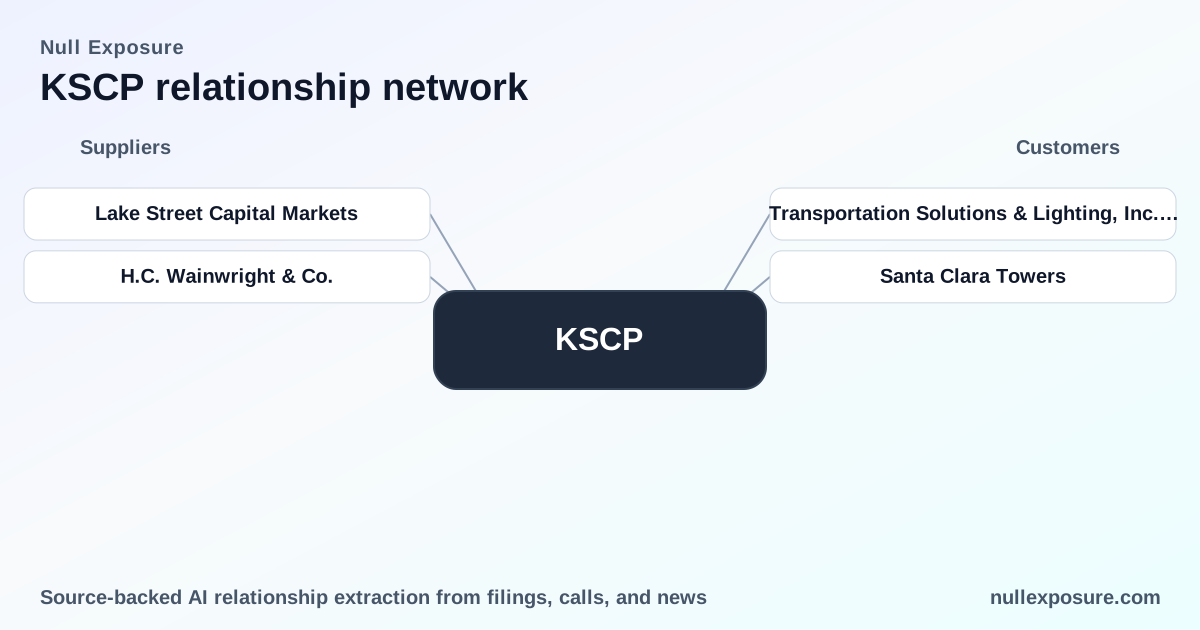
Lake Street Capital Markets — FY2026: Knightscope retained Lake Street as its exclusive buy-side financial advisor to support growth through acquisitions of complementary businesses and technologies, a step consistent with a deliberate M&A push. This was reported in a QuantiSnow insight first seen March 10, 2026.
Source: QuantiSnow insight (first seen 2026-03-10). -
H.C. Wainwright & Co. — FY2025: H.C. Wainwright acted as the exclusive placement agent for a registered direct offering of Knightscope common stock closed in March 2025, indicating the company’s continued use of placement agents to access equity capital. This appeared in a FinancialContent aggregation of a BusinessWire release dated March 31, 2025.
Source: FinancialContent / BusinessWire (Mar 31, 2025). -
Lake Street Capital Markets — FY2024: Knightscope previously retained Lake Street in filings for buy-side advisory services to support acquisition activity, demonstrating continuity in advisor selection across multiple reporting periods. This was captured in a QuantiSnow item first seen March 10, 2026 referencing the FY2024 disclosure.
Source: QuantiSnow insight (first seen 2026-03-10). -
Lake Street Capital Markets — FY2025: The company reiterated Lake Street’s buy-side role in FY2025 disclosures, underlining an ongoing strategic relationship focused on deal sourcing and transaction execution. This mention was documented by QuantiSnow (first seen March 10, 2026).
Source: QuantiSnow insight (first seen 2026-03-10).
What the constraints and procurement facts tell investors about risk exposure
The company-level disclosures and constraint excerpts generate a clear set of operational signals:
-
Contracting posture: long-term and predictable. The September 13, 2024 purchase agreement (monthly $40k through Aug 2026) shows Knightscope is committing to multi-period supply to support ASR production rather than relying solely on spot buys. That commitment brings production stability and predictable cost flow.
-
Spend scale: modest but non-trivial. Aggregate committed spend under the cited agreement (~$0.8M) sits within the indicated spend band (100k–1m) and represents a meaningful but contained share of Knightscope’s revenue base—useful context when assessing working capital and inventory risk relative to operations.
-
Concentration and criticality: low single-supplier dependence. The company declares it is not highly dependent on any one supplier and can source components from others, which reduces counterparty concentration risk and elevates operational resilience.
-
Geographic exposure: global supplier footprint with tariff risk. Knightscope’s supply chain spans geographies, creating potential cost and lead-time volatility from tariffs or trade policy changes; this is an explicit company signal rather than an inference.
These constraints are presented as company-level signals; none of the constraint excerpts explicitly names a supplier counterparty, so they should not be attributed to any specific advisor or vendor.
Implications for investors and operators — a concise checklist
-
Capital structure and advisor reliance: Knightscope uses external placement agents and retained buy-side advisors as part of its growth and financing strategy. Lake Street’s repeated role as buy-side advisor signals a focused M&A strategy; H.C. Wainwright’s role on a registered direct confirms continued equity financings. Monitor advisor mandates and deal announcements to gauge execution progress. For a consolidated advisor/relationship view, consult Null Exposure: https://nullexposure.com/.
-
Operational resilience versus scale risk: The firm’s procurement commitments and claims of low supplier dependence present a low to moderate operational risk profile. The $0.8M committed purchase agreement supports production continuity but is within a modest spend band, meaning a disruption would be absorbable relative to the business scale rather than catastrophic.
-
Policy and tariff vulnerability: Global sourcing creates exposure to trade policy, and any escalation of tariffs would increase input costs and compress already negative gross margins—this is a clear operating risk that investors should price into scenario analyses.
-
Near-term focus: M&A and balance-sheet activity. Repeated advisor engagements and placement-agent-supported equity raises indicate management is prioritizing inorganic growth and capital access. That changes the lens through which supplier relationships should be evaluated: procurement decisions will interact with acquisition integration and scale objectives.
Bottom line — how to use this intelligence in your diligence
Knightscope runs a low-to-moderate supplier risk profile: committed, long-term purchases that secure production, a declared ability to shift suppliers, and a global supply chain that introduces tariff exposure. The company’s strategic reliance on advisors for M&A and placement agents for equity raises is a material part of how it funds growth and expands capabilities; those advisor relationships are active and documented across FY2024–FY2026.
For investors and operators, focus due diligence on (1) upcoming contract renewals and supplier diversification metrics, (2) the pipeline and mandate scope for Lake Street-led M&A efforts, and (3) the terms and dilution impact of future capital raises managed by placement agents. To track these signals alongside other supplier and advisor disclosures, visit Null Exposure’s index of supplier relationships: https://nullexposure.com/.