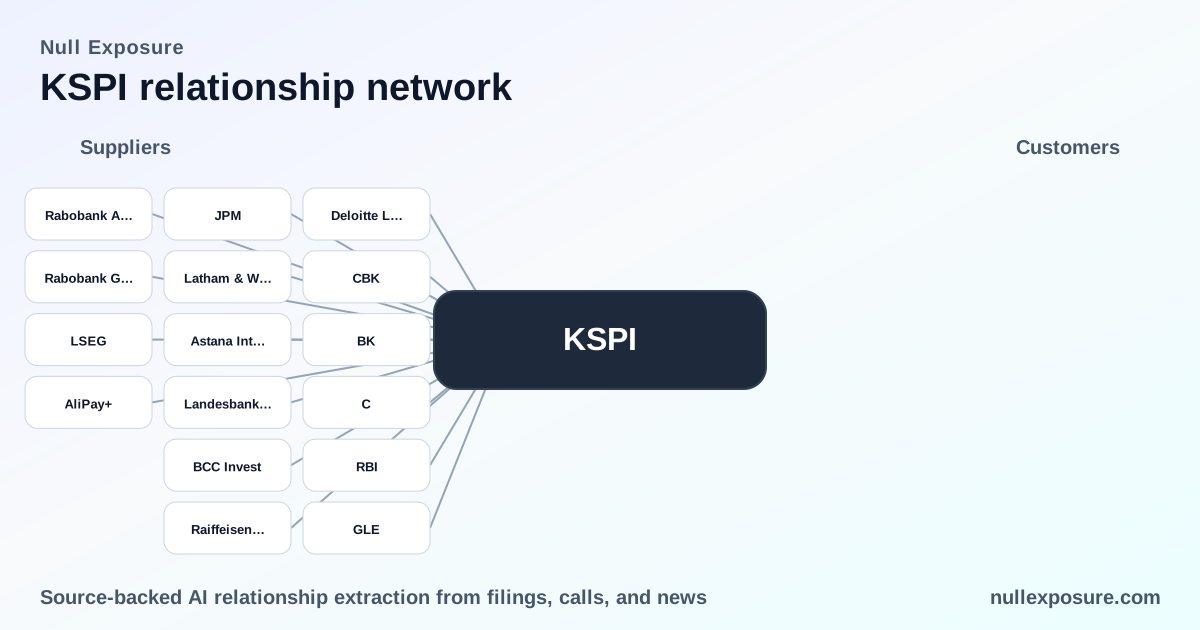
Kaspi.kz (KSPI) supplier map: what institutional investors need to know
Kaspi.kz operates as a diversified fintech and digital services platform in Kazakhstan, monetizing through payments processing, e‑commerce take‑rates, credit and lending margins, and platform fees tied to its digital banking and marketplace ecosystem. The company combines high-margin financial services with platform-driven transaction volume, and it sources critical operational and capital‑markets services from a compact set of global banks, professional advisers and payments partners that underpin liquidity, compliance and international issuance capability. Explore a rapid supplier-risk primer at https://nullexposure.com/ to see how these relationships map to investor risk and opportunity.
Why supplier relationships matter for a fintech platform operator
Kaspi.kz’s business model depends on three supplier categories: payments/rails and correspondent banks, external auditors and legal/capital‑markets advisers. Together these vendors deliver the plumbing for cross‑border liquidity, investor access and regulatory credibility. The vendor list in public disclosures signals a contracting posture that is standard for maturing fintechs: retain top‑tier partners for critical capabilities (auditing, bookrunning, legal counsel), and integrate payments networks for customer growth.
- Contracting posture: Kaspi contracts established global providers for high‑sensitivity functions, which indicates a risk-averse, compliance‑focused supplier strategy.
- Concentration and criticality: Correspondent banking relationships are concentrated on a handful of large international banks—these are critical for foreign currency flows and international settlements.
- Maturity: Reappointments and multi‑year capital‑markets mandates show an established, repeatable supplier ecosystem appropriate for an issuer managing cross‑border funding and corporate governance.
For a deeper supplier intelligence view tailored to institutional workflows, visit https://nullexposure.com/.
Constraints and company-level signals
The supplier feed returned no explicit constraint excerpts, which itself is a signal: public disclosures show no announced supplier terminations, public disputes, or contractual caveats in the captured sources. Company-level signals derived from the relationships include low supplier churn for auditors and advisers, moderate supplier concentration in correspondent banking, and high operational criticality for payment rails and global banks — all consistent with a fintech that has graduated to international capital markets.
Relationship-by-relationship summary (plain English, single-sentence takes)
-
Deloitte LLP — The Board recommended renewing Deloitte LLP as Kaspi.kz’s external auditor for FY2026 and earlier reappointments were confirmed for FY2024, reflecting continuity of external audit oversight. Source: notice of annual general meeting and extraordinary meeting results (FY2026; FY2024) reported on Sahm Capital/FinancialContent and related filings.
-
The Bank of New York Mellon — Kaspi.kz lists The Bank of New York Mellon as a correspondent bank used for international accounts, indicating access to established custody/settlement rails in the U.S. Source: Kaspi.kz investor response on international correspondent banking (FY2024) published via GlobeNewswire.
-
Citi Bank — Citi is named as a correspondent bank and acted as joint lead manager and bookrunner on Kaspi’s US$650m debut bond, showing both correspondent‑bank services and capital‑markets execution capability. Source: investor Q&A on correspondent banking (FY2024) and Latham & Watkins advisory note on the bond issuance (FY2025).
-
Societe Generale — Societe Generale appears in Kaspi’s list of international correspondent bank accounts, offering European banking connectivity for cross‑border flows. Source: GlobeNewswire investor response (FY2024).
-
Landesbank Baden‑Wuerttemberg — Listed among correspondent banks, Landesbank Baden‑Wuerttemberg provides German banking corridors for Kaspi’s international transactions. Source: GlobeNewswire investor response (FY2024).
-
Commerzbank AG — Commerzbank is cited as a correspondent bank, underlining access to major German clearing and correspondent services. Source: GlobeNewswire investor response (FY2024).
-
Raiffeisen Bank International AG — Named in Kaspi’s correspondent‑bank list, Raiffeisen Bank International AG supports regional euro‑currency operations and Austrian banking links. Source: GlobeNewswire investor response (FY2024).
-
Raiffeisen Bank (Russia) — Kaspi disclosed a correspondent relationship with Raiffeisen Bank (Russia), indicating coverage across CIS payment corridors. Source: GlobeNewswire investor response (FY2024).
-
J.P. Morgan — J.P. Morgan served as a joint lead manager and bookrunner on Kaspi’s US$650m notes, demonstrating first‑tier capital‑markets execution capability. Source: Latham & Watkins press release about the bond issuance (FY2025).
-
J.P. Morgan Securities plc — In FY2023 Kaspi contracted J.P. Morgan Securities plc to purchase and resell global depositary receipts, reflecting liquidity management related to GDRs and capital structure operations. Source: BizMedia coverage of the FY2023 GDR purchase agreement.
-
Latham & Watkins — Latham & Watkins advised Kaspi on its US$650m notes issuance, confirming long‑form legal counsel for international debt issuance. Source: Latham & Watkins client advisory (FY2025).
-
BCC Invest — BCC Invest acted as the Kazakhstan manager on the same bond transaction, indicating domestic lead management support for international issuance. Source: Latham & Watkins advisory on the bond issuance (FY2025).
-
Astana International Exchange — The notes were listed on the Astana International Exchange, which provides regional listing and trading distribution for the debt offering. Source: Latham & Watkins announcement of the notes issuance and listing details (FY2025).
-
London Stock Exchange — The notes were also listed on the London Stock Exchange’s International Securities Market, giving global investor access and benchmark listing status. Source: Latham & Watkins release on the notes issuance (FY2025).
-
Rabobank Group — Kaspi signed a share purchase agreement with Rabobank Group to acquire Rabobank’s Turkish subsidiary, signaling strategic expansion via inorganic acquisition in Turkey. Source: press release on the Rabobank A.Ş. acquisition (FY2025).
-
Rabobank A.Ş. — The target of the acquisition, Rabobank A.Ş., represents Kaspi’s entry point into Turkish banking assets through the share purchase agreement announced in March 2025. Source: press release and investor notice regarding the acquisition (FY2025).
-
AliPay+ — Kaspi Pay QR’s addressable market expanded through integration with AliPay+ and its partners, showing payments network diversification and acceptance expansion for Kaspi Pay. Source: Kaspi.kz financial results and investor materials noting AliPay+ integrations (FY2025).
Investor implications: concentrate where suppliers are critical
Kaspi’s supplier roster reads like a checklist for a fintech at scale: Big Four auditor continuity, top investment banks as bookrunners, respected legal counsel, and a set of correspondent banks that enable multi‑currency flows. These relationships reduce execution risk for capital markets activity and give Kaspi access to global payment rails, but they also concentrate critical functions—particularly correspondent banking—into a few providers. Investors should treat these suppliers as operationally critical: disruptions to correspondent access or clearing could materially affect cross‑border liquidity and funding flexibility.
For a scenario‑based assessment of counterparties and exposure modeling, see our supplier intelligence hub: https://nullexposure.com/.
Closing checklist for investment diligence
- Confirm auditor independence and rotation timelines given Deloitte’s reappointments.
- Monitor correspondent‑bank corridors and sanctions/regulatory changes that could affect euro/USD rails.
- Track completion and integration risk for the Rabobank A.Ş. acquisition and how it affects earnings and capital allocation.
- Evaluate incremental growth from AliPay+ integrations on Kaspi Pay transaction volumes.
Kaspi’s supplier picture supports an investment thesis of a growth fintech with institutionalized funding and compliance practices, but investors must monitor banking rails and cross‑border execution risk closely. For tailored supplier risk scoring and ongoing monitoring, visit https://nullexposure.com/.