KTH: A concise read on a trust-style security, its supplier ties, and what investors should watch
Structured Products Corp’s CorTS vehicle for Peco Energy Capital Trust III (ticker KTH) operates as a legal trust that issues corporate-backed trust securities (CorTS) and preferred-style certificates to investors, monetizing through the cash flows of the underlying energy-capital assets and built-in fee waterfalls to the depositor and trustee. For investors, KTH is a yield-oriented, trust-wrapped exposure to Peco Energy financing with limited trading float and a governance model governed by trust documentation rather than an operating corporate balance sheet. If you evaluate counterparty risk and contractual durability before allocating, start with the trust papers and trustee arrangements. For an operational review, visit https://nullexposure.com/.
How the capital mechanics work and what matters to returns
KTH functions as an institutional trust vehicle: assets or receivables tied to Peco Energy’s capital structure are placed into a trust, Structured Products Corp acts as the depositor under a Base Trust Agreement, and certificates (CorTS) are issued to investors who receive distributions according to the trust waterfall. Revenue to certificate-holders comes from the underlying asset cash flows minus administrative and depositor/trustee fees; the trust structure creates predictable, contract-driven payments rather than enterprise-style cash generation.
Market fields reported alongside the trust show a high distribution profile (reported dividend yield ~6.61%), narrow recent trading range (52-week high/low around $29.19 / $26.83), and effectively no public float or outstanding share count disclosed, which signals limited liquidity and secondary-market depth. The next scheduled distribution is listed for 2026-04-30. These are the mechanics that determine both yield attractiveness and liquidity risk.
What the public record lists as a supplier relationship
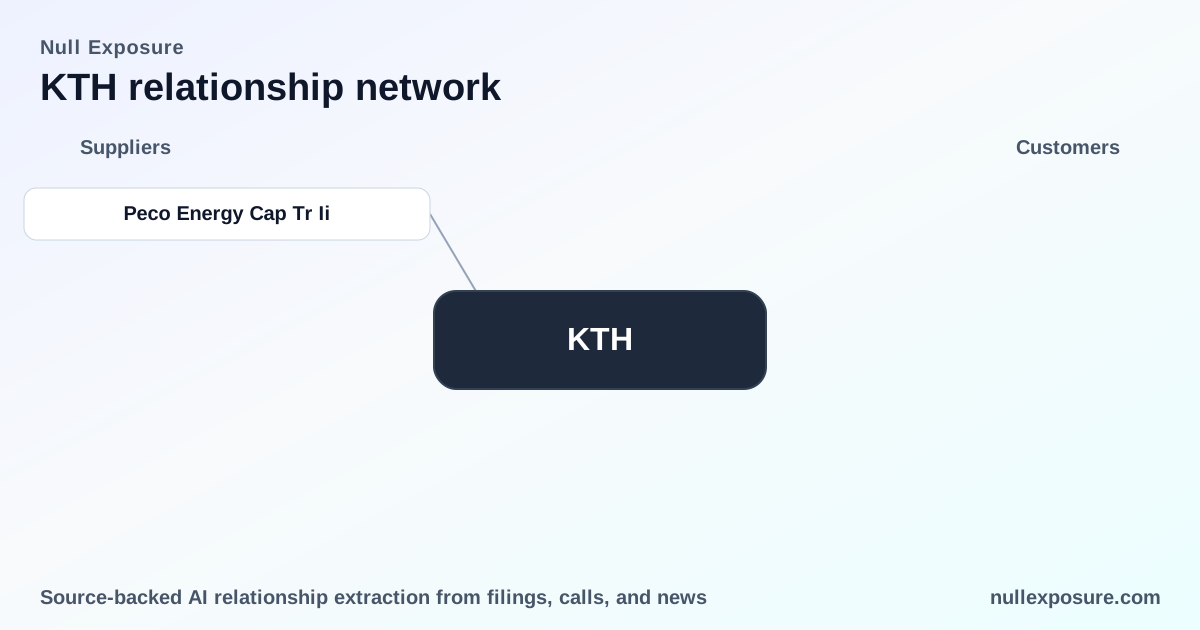
Peco Energy Cap Tr Ii — A news release referenced the issuance of preferred stock tied to Peco Energy Cap Tr II under the KTH designation; the item identifies Peco Energy Cap Tr II in connection with KTH issuance activity. (Source: StockTradersDaily news release, 2026-03-10 — https://news.stocktradersdaily.com/news_release/17/Understanding_the_Setup:_KTH_and_Scalable_Risk_022026110202_1771603322.html)
What the trust documentation signals about operating posture and constraints
- Depositor role and trustee reliance are structural. Trust documentation explicitly identifies Structured Products Corp as the depositor under the Base Trust Agreement (dated December 15, 2000) and the CorTS Supplement (2001-1), with U.S. Bank Trust National Association serving as trustee and the legal vehicle for certificate issuance. This language establishes a legally rigid contracting posture where key actions—distributions, amendments, enforcement—flow through trustee mechanics rather than corporate management decisions.
- Service-provider characterization. Relationship-signal extraction classifies the organization in a service-provider role with moderate confidence (60%) based on the depositor/trustee architecture. Presently, that is a company-level signal describing how KTH is structured and governed rather than a commercial supplier dependency to an operating company.
- Maturity and criticality are baked into paperwork. Trust structures like CorTS are mature financial instruments with long-established legal templates; modifications are procedural and typically require trustee or bondholder processes. That reduces operational ambiguity but increases legal and counterparty importance—if the trustee or depositor relationship is disrupted, investor outcomes are determined by contractual remedies, not managerial discretion.
Risk profile investors and operators must weigh
- Counterparty and concentration risk. The vehicle’s economics depend on Peco Energy-related assets placed in the trust and the administrative roles of Structured Products Corp and the trustee; investors have exposure concentrated in those contractual parties rather than a diversified operating company.
- Liquidity and marketability risk. Public filings report effectively no shares outstanding or float, which implies secondary trading can be thin and bid/ask spreads wide; this is a structural liquidity constraint for portfolio managers seeking to scale positions.
- Legal and operational rigidity. The trust model creates certainty in distributions but places outsized weight on document interpretation and trustee action for resolving disputes or adapting to credit events.
- Yield vs. capital risk trade-off. The reported dividend yield (~6.61%) is attractive in isolation, but yield must be evaluated against locked-in capital, illiquidity, and counterparty concentration.
Mid-article next step for analysts
If you are modeling exposure or operational dependence, download and read the Base Trust Agreement and CorTS Supplement, confirm trustee powers and amendment thresholds, and reconcile scheduled distributions with underlying Peco Energy cash flows. For curated access to trust-level intelligence and relationship maps, visit https://nullexposure.com/.
Practical checklist for due diligence
- Obtain full trust documentation and the depositor/trustee service agreements to verify fee waterfalls and amendment requirements.
- Confirm the identity and track record of the trustee (U.S. Bank Trust NA is named in the trust materials) and the depositor’s responsibilities and remedies.
- Reconcile market-data indicators—dividend date (2026-04-30), dividend yield, trading range—with counterparty credit signals for Peco Energy exposures.
- Assess exit strategy given reported zero float and limited公开 share metrics.
Final read and recommended actions
KTH is a legal-structure play: a pay-through trust that converts Peco Energy capital into yield-bearing certificates governed by trustee-managed contracts. For investors, the core questions are contract enforceability, counterparty credit, and liquidity—not operating margin expansion or organic growth. The single public relationship flagged in news coverage points to active issuance tied to Peco Energy Cap Tr II; trust documents name Structured Products Corp as depositor and U.S. Bank Trust as trustee, which are the operational levers for distributions and legal recourse.
For managers deciding whether to add KTH exposure, the next decisive actions are document-level review and counterparty credit work. To start that work and get structured supplier intelligence, go to https://nullexposure.com/.
Key takeaway: KTH offers yield via a mature trust structure, but trading liquidity and concentrated contractual counterparties are the dominant risk vectors — evaluate legal documentation and trustee credit before allocating.