Kratos (KTOS) supplier relationships: what investors need to know
Kratos Defense & Security Solutions is a government-focused contractor that monetizes through systems engineering, prototype-to-production manufacturing, and long-term program work with defense primes and international partners. The company converts intellectual property and hardware capabilities—particularly unmanned systems, microwave subsystems, and energetics—into multi-year contracts and joint ventures that feed recurring program revenue. For investors evaluating supplier exposure, the most material dynamic is Kratos’ role as a manufacturer and integrator in prime-led programs and bilateral industrial partnerships; these relationships both de-risk market access and concentrate program execution obligations. Learn more about partner visibility and supplier risk at https://nullexposure.com/.
The operating model in one paragraph
Kratos operates as a mid-cap defense manufacturer and systems integrator with a hybrid contracting posture: direct awards from defense customers for R&D and systems, plus supplier/subcontract agreements with major primes and foreign defense firms. This structure creates a mix of near-term contract wins and longer-term revenue tied to prime procurement cycles. The company's financial profile shows elevated valuation multiples relative to current cash flow (Price/Sales ~12.4, EV/EBITDA ~155), reflecting investor expectations around program growth rather than present margins. The 2025 Q4 earnings commentary and company disclosures emphasize active manufacturing procurement: “We procure critical material, components, products and subsystems from domestic and global supply partners,” a company-level signal of manufacturing centrality in the operating model (KTOS 2025 Q4 earnings call, March 7, 2026).
What Kratos’ earnings call reveals about strategic partners
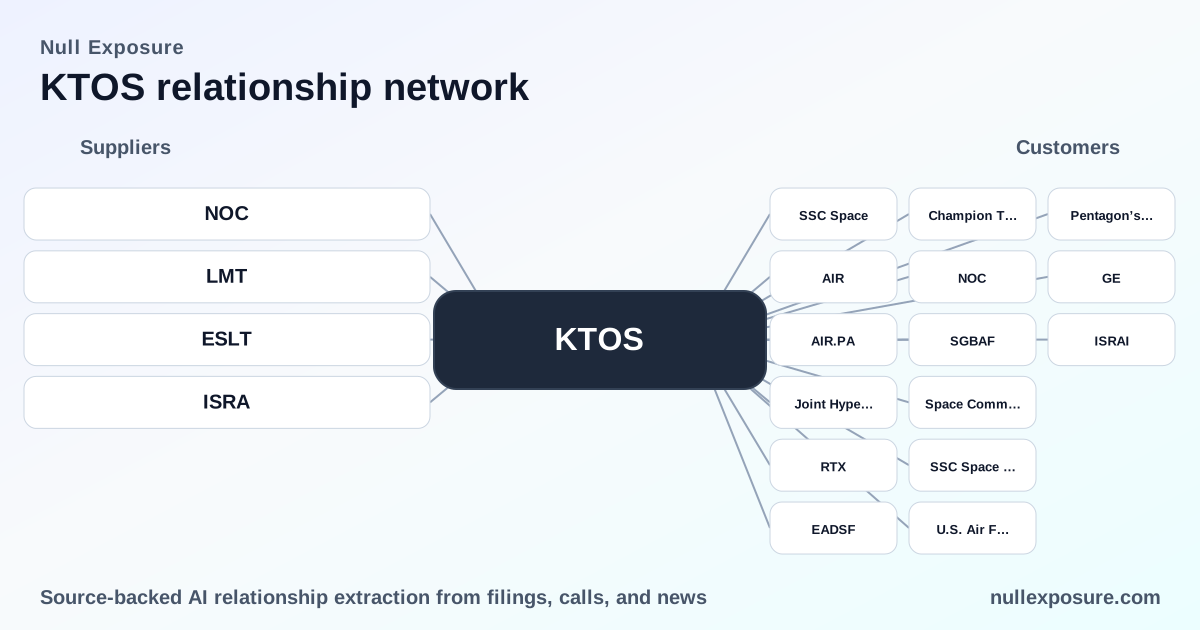
The company’s most visible partner references in the 2025 Q4 earnings call highlight four relationships that shape program execution and growth outlook: Northrop Grumman, Lockheed Martin, Elbit Systems, and Rafael. These mentions reflect both prime-sub dynamics and international industrial teaming that feed Kratos’ backlog and manufacturing cadence.
Northrop Grumman (NOC)
Kratos cited an initial MUX TACAIR award of approximately $230 million split roughly 50-50 between Kratos and Northrop, with a ~24‑month period of performance, signaling a near-term, materially sized cooperative program where Kratos shares in execution and revenue. According to Kratos’ 2025 Q4 earnings call (March 7, 2026), this award establishes a concrete, time-boxed revenue stream tied to a joint program with a major prime.
Lockheed Martin (LMT)
Management referenced multi-year deals, including with Lockheed, for air defense and missile-related systems that Kratos supports, positioning Kratos as a critical subsystem and support supplier on extended prime contracts. The 2025 Q4 earnings call (March 7, 2026) framed these relationships as part of longer-duration defense procurements that underpin recurring workload.
Elbit Systems (ESLT)
Kratos described its Israeli microwave operations and longstanding collaboration with Elbit, noting several hundred employees in Israel and decades-long working relationships with Elbit and other Israeli defense firms, which provides Kratos with advanced subsystem engineering and regional integration capability. Management discussed these relationships during the 2025 Q4 earnings call (March 7, 2026).
Rafael (ISRA)
Kratos announced the groundbreaking for the Prometheus facility, a solid rocket motor and energetics partnership with Rafael, and stated that the project is on track with the previously briefed business plan—an industrial-scale move that embeds Kratos into energetic manufacturing capacity and future propulsion programs. This detail was disclosed in the 2025 Q4 earnings call (March 7, 2026).
How these relationships affect supply posture and program risk
Together, the partner set shows Kratos is both a subcontractor to U.S. primes and an industrial partner to sovereign defense companies, creating specific operating characteristics:
- Contracting posture: A mix of prime-led subcontracting and co-development partnerships; revenue is tied to both prime awards and bilateral industrial agreements.
- Concentration: Material program dollars can be concentrated around a few prime programs (e.g., the MUX TACAIR award with Northrop), increasing sensitivity to single-program outcomes.
- Criticality: Kratos supplies critical subsystems (microwave, propulsion/energetics, unmanned platforms) that are difficult to substitute quickly, increasing bargaining leverage but also execution risk if production or supply chain problems arise.
- Maturity: Several programs referenced are multi-year (some up to seven years per management commentary), which supports forward visibility but requires sustained capital and manufacturing discipline.
These company-level signals follow directly from management’s public comments and the procurement language used in the call; they are not attributed to any one partner unless management explicitly named that partner.
If you want a deeper look at how these partner relationships map to contract timing and supplier exposure, review our supplier profiles at https://nullexposure.com/.
Investment implications: upside and risks
- Upside: Strategic partnerships with Northrop, Lockheed, Elbit and Rafael broaden Kratos’ addressable market and create multiple entry points to large, prime-led procurements; the Prometheus partnership and the MUX split are concrete revenue catalysts. Management’s emphasis on manufacturing and Israeli industrial ties supports technology transfer and exportable subsystems that can accelerate top-line growth.
- Risk: High valuation multiples imply that current share price discounts little execution slippage. Concentration around prime awards and the reliance on program milestones elevate binary delivery risks, and manufacturing scale-ups (e.g., rocket motor production) require tight capital and supply chain management. Institutional ownership is high (~85.7%), which can amplify move-on-event dynamics around contract announcements or setbacks.
Final read and action
For investors and operators, the takeaway is straightforward: Kratos’ supplier and partner relationships materially bolster its program pipeline, but they also centralize execution risk around a small set of prime and international partners. Active monitoring of program milestones—award splits, performance periods, and facility ramp timelines—will be decisive for valuation realization.
Explore the full supplier intelligence and track these partner dynamics in real time at https://nullexposure.com/. For procurement managers and institutional investors seeking structured intelligence on Kratos and its partners, start here: https://nullexposure.com/.
Key takeaway: Kratos converts contracts and industrial partnerships into predictable program windows, but investors must price in execution and concentration risk against an already aggressive market multiple.