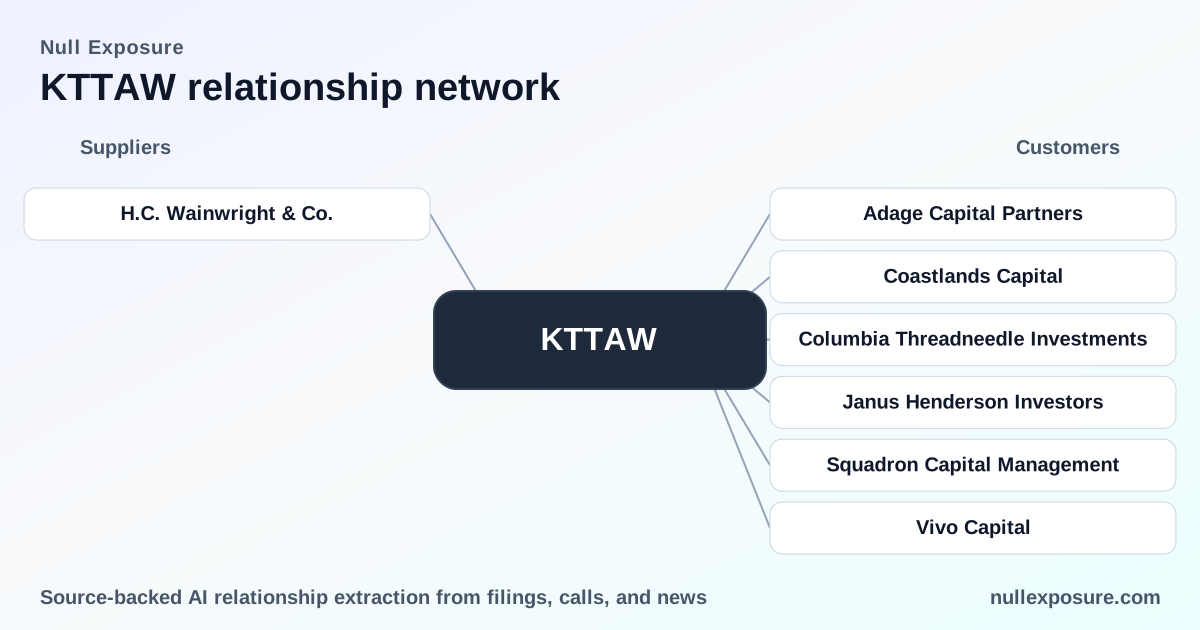
KTTAW (Pasithea Therapeutics Warrant): supplier profile and operational risks investors should price in
Pasithea Therapeutics is an early-stage biopharma focused on CNS and orphan indications; it develops candidates such as PAS‑004 and monetizes through equity financings, milestone/license outcomes, and—eventually—product commercialization. The KTTAW instrument tracks warrant exposure to Pasithea’s equity story, so supplier relationships that affect clinical timelines and manufacturing continuity directly influence valuation. Capital markets activity funds near-term operations, while a concentrated manufacturing base and third‑party service reliance create execution risk that investors must quantify. For more supplier-risk intelligence, visit https://nullexposure.com/.
Capital markets support and placement partners: why H.C. Wainwright shows up in the record
H.C. Wainwright & Co. acted as the exclusive placement agent for Pasithea’s $60 million equity offering that was priced on November 28, 2025, and closed in early December 2025. This placement role confirms the bank’s centrality to Pasithea’s near-term capital strategy and underwrites liquidity for ongoing development programs (source: Sahm Capital reports published Nov–Dec 2025, https://www.sahmcapital.com/news/content/pasithea-therapeuticsannounces-pricing-of-60-million-public-offering-of-common-stock-2025-11-28 and https://www.sahmcapital.com/news/content/pasithea-therapeuticsannounces-closing-of-60-million-public-offering-of-common-stock-2025-12-02).
The supplier list investors need to read carefully
Below I cover the named counterparties and contract relationships that show up in filings and public reports; each short note links the relationship to source text or reported events.
-
H.C. Wainwright & Co.: Served as exclusive placement agent for Pasithea’s $60 million public offering (pricing Nov 28, 2025; closing Dec 2, 2025), confirming a singular capital markets advisor role for the financing round (Sahm Capital news, Nov–Dec 2025: https://www.sahmcapital.com/news/content/pasithea-therapeuticsannounces-pricing-of-60-million-public-offering-of-common-stock-2025-11-28; https://www.sahmcapital.com/news/content/pasithea-therapeuticsannounces-closing-of-60-million-public-offering-of-common-stock-2025-12-02).
-
WuXi (CMO): The company discloses a single contract manufacturer in China (WuXi) for PAS‑004 drug substance and drug product, and states that termination of this relationship would disrupt development, making the manufacturer critical to timelines (per company filings cited in disclosures).
-
PsychoGenics, Inc.: Pasithea contracted with PsychoGenics in April 2023 for a preclinical study and paid approximately $0.3 million over the term; that engagement concluded in September 2023 (per company filing language on service-provider engagements).
-
Prof. Steinman (consultant): A named individual consultant, Prof. Steinman, provides clinical and business‑development advisory services under a consulting agreement and is paid $25,000 per quarter, confirming an individual counterparty relationship for advisory functions (per the Steinman Consulting Agreement language in company filings).
-
Marcum LLP (independent auditor): The board appointed Marcum LLP as independent registered public accounting firm and reported audit fees of $222,800 for fiscal year ended December 31, 2024, indicating a measurable annual spend band for professional services (per the company’s fiscal disclosures).
What these relationships reveal about Pasithea’s operating model
Pasithea’s supplier posture is classical for a small clinical-stage biotech: capital market intermediaries fund operations, CMOs and CROs execute development, and named consultants deliver strategic guidance. The constraint signals combine into a coherent operating profile:
-
Contracting posture: Pasithea outsources manufacturing and many development tasks to third parties and relies on fee‑for‑service CMOs and CROs; contracting is arms‑length and project based (company filings on CRO/CMO arrangements).
-
Concentration and criticality: High concentration risk exists in manufacturing because Pasithea uses a single CMO (WuXi) for drug substance/product, a relationship explicitly labeled as critical in filings; any disruption has direct programmatic impact.
-
Geography and regulatory sensitivity: Manufacturing is located in China (APAC), while clinical sites are distributed across North America and Eastern Europe; this cross‑jurisdictional footprint introduces regulatory and logistics complexity, notably U.S. scrutiny of China‑based suppliers (per filing excerpts).
-
Maturity and spend profile: Relationships are early and transaction‑level rather than long‑term vertically integrated contracts; professional services such as the annual audit sit in the $100k–$1m spend band (Marcum audit fees $222,800), while individual preclinical engagements have been modest ($0.3m with PsychoGenics).
For supplier risk due diligence and portfolio construction, those characteristics materially change how you price time‑to‑event and probability of successful programs.
Operational and valuation implications investors should weigh now
-
Manufacturing dependency is the principal single‑point risk. With one CMO handling PAS‑004 production, production delays, capacity constraints, or regulatory actions in APAC will create enrollment and filing delays that depress warrant time value.
-
Capital markets support is active and centralized. The exclusive placement agent role for the $60 million offering signals that Pasithea is executing a deliberate financing plan to cover near‑term cash needs; monitor any shifts in placement agent relationship or financing cadence (H.C. Wainwright, Nov–Dec 2025).
-
Third‑party services are modest but essential. CRO/CMO expenditures and consulting fees are manageable today, but a single failed trial or manufacturing deviation could multiply remediation spend and dilute outcomes.
-
Regulatory geopolitics matter. APAC manufacturing plus U.S. clinical sites and Eastern European trial locations create a cross‑border regulatory surface area that investors must underwrite into timelines and costs.
If you want deeper supplier exposure analysis or a bespoke counterparty risk brief, start with a supplier map on the company and the capital stack at https://nullexposure.com/.
Practical monitoring checklist for operators and investors
- Track any changes to the WuXi manufacturing agreement or public statements about alternative CMOs.
- Monitor H.C. Wainwright engagement and any subsequent placements or stockholder secondary activity.
- Review quarterly filings for CRO progress updates, consultant engagement renewals (Steinman), and audit fee disclosures.
For additional intelligence—counterparty scoring, concentration heat maps, and contractual maturity analysis—visit https://nullexposure.com/ and request a supplier risk brief.
Bottom line: price concentration and capital dynamics into KTTAW valuations
KTTAW’s value is a function of Pasithea’s clinical progress and balance‑sheet health; both are governed by a small set of external counterparties. The manufacturing relationship with WuXi is the dominant operational lever, while H.C. Wainwright’s placement activity underwrote the latest financing round. Investors should incorporate supply‑chain concentration, APAC regulatory exposure, and the company’s reliance on discrete service engagements into scenario models and optionality premium. For targeted supplier risk assessments and to translate these signals into position sizing, consult the team at https://nullexposure.com/.