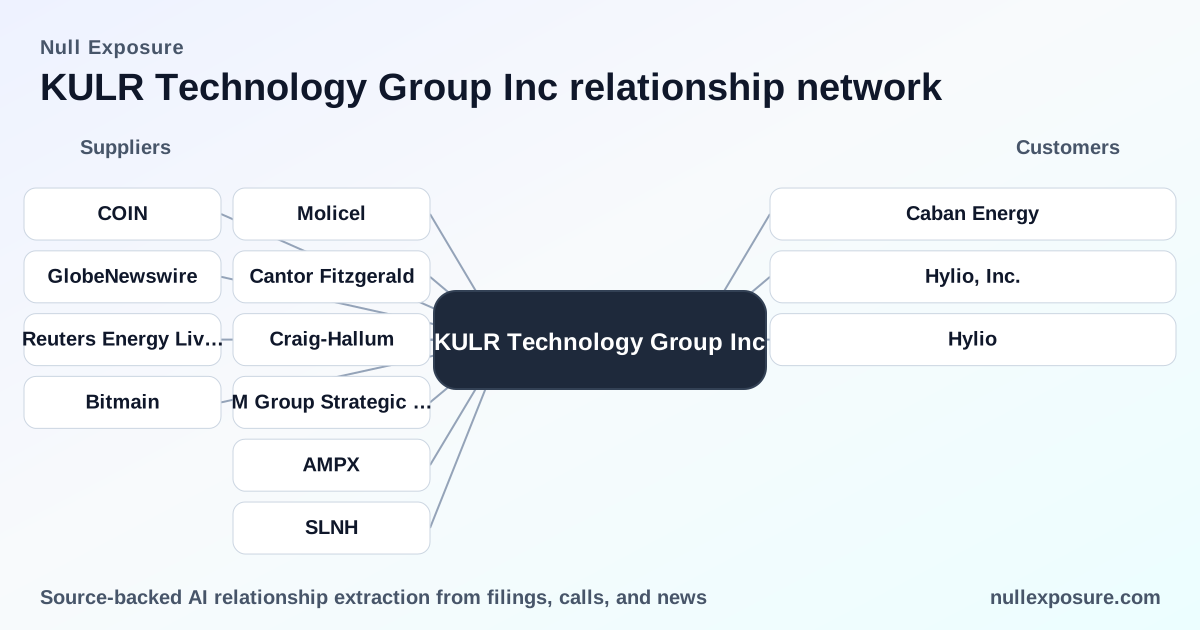
KULR Technology Group: supplier map, contract posture, and what partners reveal to investors
KULR Technology Group operates as a thermal-management and high-performance energy-systems company that monetizes through product sales, licensing of patented technologies, and strategic commercial deployments—augmented by a corporate treasury strategy that includes bitcoin holdings and mining operations. Revenue comes from component sales and systems (battery thermal management and backup units), recurring royalties under licensing, and monetization of a Bitcoin+ treasury and mining business, while cashflow dynamics are affected by periods of negative EBITDA and active capital programs. For investors and operator-partners, the partner list and public contract signals deliver a concise view of KULR’s commercial posture, funding levers, and operational dependencies.
Learn how supplier relationships affect counterparty risk and operational continuity at https://nullexposure.com/.
How KULR makes money and where partners fit in
KULR sells thermal-management hardware and integrated battery systems to defense, space, data center, and telecom OEMs, and it licenses intellectual property that generates royalty income. The company also runs a hybrid corporate thesis—selling products while holding and growing bitcoin assets and operating mining rigs—which creates non‑traditional revenue and balance-sheet dynamics (revenue TTM $16.7M; EBITDA negative $30.5M; market cap ≈ $127M per FY2025 filings and public releases).
The supplier and partner roster fills three strategic roles for KULR:
- Component and cell supply / product integration (battery cell partners for integrated systems).
- Capital markets and liquidity services (investment banks and credit facilities supporting treasury and ATM programs).
- Service and marketing channel partners (PR, events, and outsourced IT/R&D).
For a practitioner view of KULR’s partner network and counterparty signals, visit https://nullexposure.com/.
Partner map — who KULR is working with and why it matters
Below are every partner or counterparty cited in public materials aggregated through FY2025–early 2026, with concise plain‑English summaries and source references.
Amprius Technologies
KULR integrated Amprius’ ultra‑high energy density SiCore® cylindrical cells into its K1A product line for unmanned aircraft systems, signaling product-level co‑engineering with an advanced-cell supplier for high-energy applications. According to a SuasNews report and KULR’s FY2025 earnings release (Nov 2025), the K1A combines KULR thermal tech with Amprius cells. (SuasNews Aug 2025; GlobeNewswire Nov 18, 2025.)
Molicel
Molicel’s high‑power P50B cells are part of the same K1A integration, indicating KULR sources multiple cell chemistries and vendors for mission applications where both energy density and high power are required. (SuasNews Aug 2025; GlobeNewswire Nov 18, 2025.)
Soluna Holdings, Inc.
Soluna will operate ~3.3 MW of Bitcoin mining capacity for KULR at its Project Sophie facility in Kentucky, demonstrating KULR’s use of outsourced hosting to scale mining operations rather than building all capacity in-house. This arrangement is disclosed in KULR’s Q3 FY2025 results. (GlobeNewswire Nov 18, 2025.)
Bitmain
KULR publicly reported deployment of 3,570 Bitmain S19 XP 140T miners in Paraguay, indicating Bitmain as a hardware supply partner for KULR’s large-scale mining footprint. This deployment was referenced in sector coverage of KULR’s bitcoin holdings. (GlobeNewswire Aug 14, 2025; Bitcoin Magazine report.)
Coinbase Credit, Inc. (subsidiary of Coinbase Global, Inc.)
KULR secured a $20 million credit facility with Coinbase Credit, demonstrating a non‑bank credit line that supports KULR’s treasury and bitcoin purchasing/surplus cash operations. (GlobeNewswire Aug 14, 2025.)
Coinbase
KULR attributes part of its BTC yield to the Coinbase credit facility and its treasury strategy; public commentary cites Coinbase’s role in enabling KULR’s bitcoin accumulation and yield calculations. (Bitcoin Magazine FY2025 commentary.)
Cantor Fitzgerald
KULR had an at‑the‑market (ATM) equity offering program administered with Cantor Fitzgerald that the company paused through June 30, 2026, revealing the use of public-equity liquidity as a recurring funding lever. The pause was announced in December 2025. (GlobeNewswire Dec 22, 2025; QuiverQuant Dec 2025.)
Craig‑Hallum
Craig‑Hallum co‑administered the ATM equity program alongside Cantor Fitzgerald; the joint arrangement underscores reliance on equity markets plus dealer syndication for flexible capital access. KULR announced a six‑month pause to the program in Dec 2025. (GlobeNewswire Dec 22, 2025; SahmCapital Dec 22, 2025.)
M Group Strategic Communications
M Group is KULR’s media relations firm for investor and media outreach, listed as the contact on multiple press releases—evidence of outsourced PR and communications to manage public narrative and investor relations. (GlobeNewswire Aug 14, 2025; SahmCapital Dec 2025.)
GlobeNewswire
GlobeNewswire served as the distribution channel for KULR’s financial and corporate announcements, reflecting standard press distribution for corporate disclosures and investor communication. (GlobeNewswire releases Aug–Dec 2025.)
Reuters Energy Live 2025 (event)
KULR sponsored Reuters Energy Live 2025 and presented on next‑generation BBUs, showing active participation in industry forums to commercialize data‑center and BBU products. (GlobeNewswire release dec 09, 2025 announcing event sponsorship.)
What contract signals and constraints reveal about execution and risk
KULR’s public filings and press materials surface three company‑level constraint signals that shape its operating model:
-
Licensing revenue with minimum royalties: KULR entered a licensing agreement (Format Fractional Thermal Runaway Calorimeter) that included a $60k upfront payment and minimum annual royalties of $20k and a 5.5% royalty rate, indicating an IP‑monetization leg with modest guaranteed cashflow. This is a company-level contractual posture tied to recurring royalty streams rather than to a single supplier. (Company filing, April 2023 disclosure summarized in FY2024–25 filings.)
-
Long‑term real estate commitment: A new office lease in Webster, Texas with an initial term of 63 months demonstrates multi‑year fixed operating expense commitments, affecting near‑term cash burn and giving the company a multi‑year fixed-cost base for engineering and manufacturing activities. (Lease disclosed Jan 27, 2024.)
-
Use of outsourced service providers: KULR leverages external partners for IT, software development, battery cell R&D, and machine automation—this is an operational model that trades internal capital intensity for supplier dependency and speed to market. (Company FY2025 commentary.)
Taken together, these signals show a mixed maturity profile: product commercialization with IP licensing and long leases indicates established operational commitments, while outsourced R&D and reliance on ATM programs and external credit facilities show ongoing capital-financing and scaling behaviors.
Concentration, criticality, and counterparty risk
- Concentration: Partnerships with specific cell vendors (Amprius, Molicel) and mining-hardware suppliers (Bitmain) create supplier concentration risk for critical inputs in systems and mining operations.
- Criticality: The ATM programs (Cantor Fitzgerald/Craig‑Hallum) and the Coinbase credit facility are critical liquidity levers; pausing the ATM program reduces immediate dilution but also removes a quick equity financing pathway. (Dec 22, 2025 press release; Aug 14, 2025 financial results disclosure.)
- Maturity: Licensing and lease commitments are mature contractual elements; the mining and bitcoin treasury strategy—backed by hosting partners like Soluna and credit from Coinbase Credit—is operational but remains capital‑intensive and dependent on crypto market dynamics.
Investment takeaways and next steps
- Key strength: KULR combines product revenue, intellectual property licensing, and an unconventional treasury strategy—this diversification supports multiple monetization vectors.
- Key risk: Negative EBITDA and reliance on external capital and service providers increase execution risk during market stress; supplier concentration in cells and mining equipment raises operational vulnerability.
- Actionable investor step: Monitor ATM program status, Coinbase credit utilization, and the scale/timing of cell integrations (Amprius/Molicel) to assess near‑term cashflow and delivery risk.
For a deeper counterparty and supplier-risk assessment, explore supplier maps and contract signal intelligence at https://nullexposure.com/.
Near-term events to watch: public filings on cash and debt, announcements from Amprius/Molicel on supply schedules, updates to the ATM program or credit facility, and operational reporting from Project Sophie/Bitmain deployments.
If you want tailored supplier-risk analysis or a compact dossier on KULR’s counterparty exposures, begin here: https://nullexposure.com/.