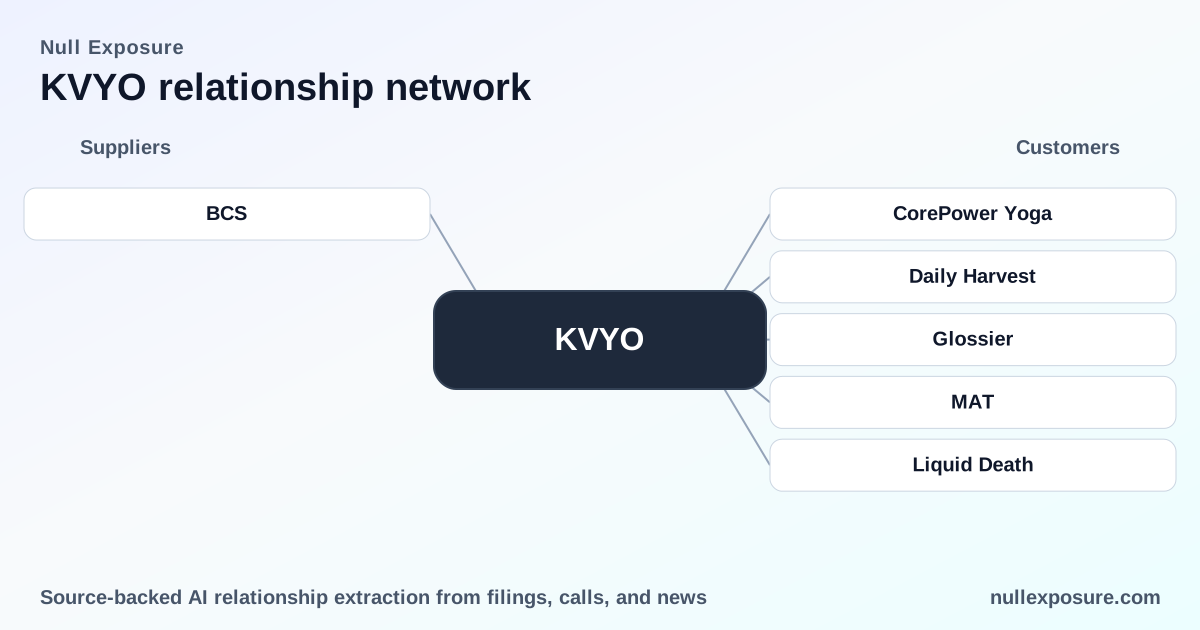
KVYO (Klaviyo) supplier profile: underwriting partner and outsourced infrastructure risks
Klaviyo (KVYO) operates a cloud-native marketing and customer data platform for e‑commerce and direct‑to‑consumer businesses and monetizes through subscription and usage‑based fees tied to message volumes and customer lists. Investors should evaluate supplier relationships not as ancillary line items but as operational leverage: underwriting and financing partners affect capital access, while third‑party service providers determine uptime, security, and cost structure.
For a quick, integrated view of supplier risk and contracts, visit https://nullexposure.com/.
What one underwriting relationship signals about financing and market access
A recent market notice records Barclays acting as the underwriter for a Klaviyo secondary offering, underscoring active capital markets engagement and reliance on established investment banks for transaction execution. A Yahoo Finance report dated March 10, 2026 noted Barclays’ role in pricing the secondary offering, indicating Klaviyo’s use of external capital markets intermediaries to manage liquidity events and equity distribution.
The supplier landscape that actually matters: service providers, hosting, and long-term contracts
Klaviyo’s supplier risk profile is dominated by three firm-level signals drawn from company disclosures:
-
Long‑term contracting posture. The company discloses material long‑term non‑cancellable contractual obligations with marketing vendors and service providers, which establishes a structural cost base and reduces near‑term vendor procurement flexibility. This is a company-level signal drawn directly from the firm’s own filings.
-
Operational criticality of third‑party services. Klaviyo relies on external providers and technologies to run core systems that process confidential and personal information — including encryption, authentication, content delivery, and back‑office functions — making these vendors mission‑critical for continuity and compliance.
-
Outsourced infrastructure model. The company outsources substantially all platform infrastructure to a third‑party hosting provider, concentrating operational risk in the hosting relationship while reducing capital expenditure on owned data centers.
Together these constraints produce an operating model that is highly service‑provider dependent, contractually sticky, and operationally concentrated. Investors should treat vendor outages or contract renegotiations as potential earnings and retention risks rather than minor supplier disruptions.
Barclays — underwriting for the FY2025/FY2026 secondary offering
Barclays is acting as an underwriter for a Klaviyo secondary offering, which signals the company is actively engaging capital markets and deploying established investment‑banking channels for equity transactions. This underwriting relationship is a capital‑markets partnership and does not indicate operational dependency on Barclays for platform services. The role and timing were reported by Yahoo Finance on March 10, 2026.
Source: Yahoo Finance, “Klaviyo announces pricing of secondary offering,” March 10, 2026.
How these supplier characteristics affect valuation and operational risk
- Cost predictability and margin pressure. Long‑term non‑cancellable contracts create predictable vendor spend that supports revenue delivery but can compress margins if usage drops or if vendors raise prices; this is a structural lever into SG&A and gross margin forecasting.
- Concentration risk and single points of failure. Outsourcing virtually all hosting to a single third‑party hosting provider creates a critical concentration that investors must treat as a form of operational leverage — severe outages, regulatory actions against the host, or unexpected price increases would have immediate customer impact.
- Data protection and regulatory exposure. Reliance on third‑party technologies to handle encryption/authentication and customer data elevates compliance risk and the potential for reputational damage; underwriters and investors will prioritize vendor security posture in diligence.
- Negotiation leverage is asymmetric. Material long‑term commitments reduce Klaviyo’s near‑term bargaining power with service providers even as the company benefits from predictable service continuity.
For a deeper interrogation of vendor exposure and how it maps to contract terms, see https://nullexposure.com/.
Practical monitoring checklist for investors and operators
- Track SEC filings and prospectuses for named hosting providers and any changes to service agreements.
- Review underwriting announcements and prospectus language when capital events occur to understand dilution, distribution mechanics, and advisor fees.
- Include vendor concentration metrics and contract expiration timelines in operating model stress tests.
- Assess cybersecurity attestations, SOC reports, and encryption/authentication vendor qualifications as part of ESG and operational diligence.
Complete list of supplier relationships in the record (one entry)
- Barclays — Barclays is acting as the underwriter for Klaviyo’s secondary offering; this is a capital‑markets engagement rather than an operational vendor relationship. Source: Yahoo Finance, March 10, 2026.
Closing perspective and next steps
Klaviyo’s current supplier footprint is defined by capital‑markets partnerships for financing transactions and deep operational dependence on third‑party service providers and a hosting provider under long‑term contractual arrangements. For investors, the correct framing is that supplier risk is central to continuity, compliance, and margin stability — not a peripheral footnote.
If you want a consolidated supplier-risk scorecard and rolling monitoring for KVYO and comparable companies, visit https://nullexposure.com/ to learn how we translate filings and market action into actionable intelligence.
For bespoke diligence help or to subscribe to continuous supplier monitoring, start at https://nullexposure.com/ — we convert contractual signals into investor-grade insights.