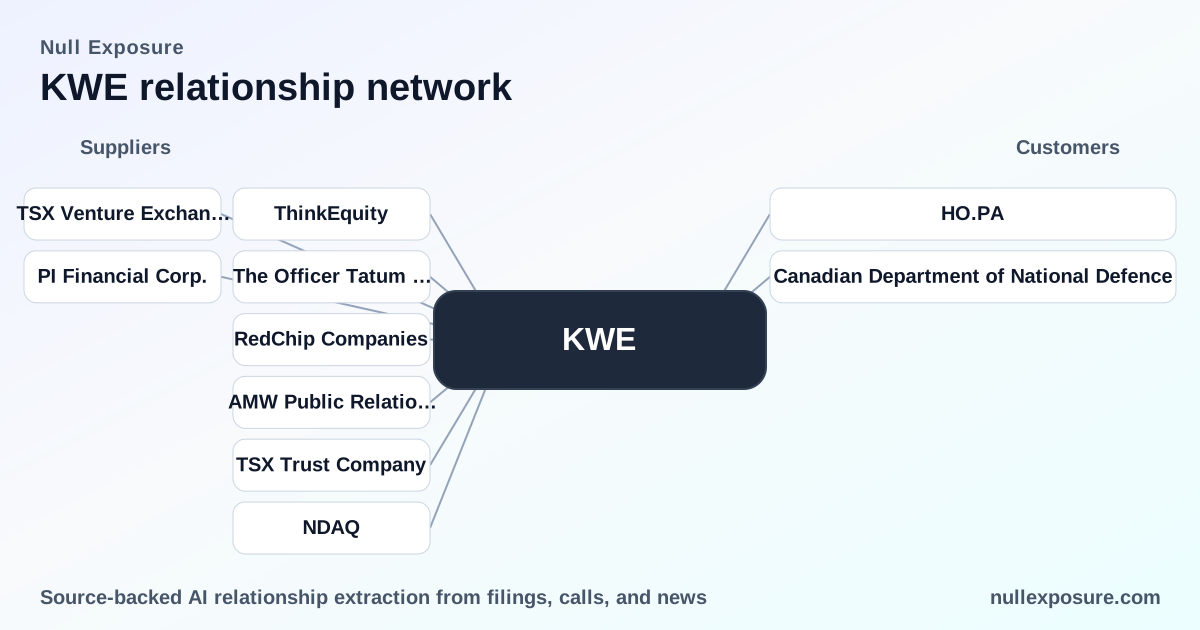
KWE: A supplier-relationship map that reveals how KWESST scales commercialization and capital access
Thesis: KWESST Micro Systems (ticker KWE) monetizes by developing less-lethal and electronic countermeasure systems and then commercializing through a network of PR/IR firms, placement agents, contract manufacturers and law-enforcement channel partners; the company finances growth via small-cap capital markets transactions and fee-bearing lending/placement arrangements. For investors and operators evaluating supplier exposure, the pattern is clear: KWESST outsources investor-facing functions, leverages strategic channel partners to accelerate product-market entry, and uses third-party manufacturing and integrators to keep core engineering focused on product development rather than scale production.
For a quick read on supplier exposure and counterparty risk, see more at https://nullexposure.com/.
What the supplier map tells investors about KWESST's operating model
KWESST’s supplier mix shows a company in growth mode that relies heavily on external specialists for four functions: capital markets intermediation, investor and media communications, commercial channel access, and production/integration. That contracting posture is consistent with an early-stage public company prioritizing speed-to-market and capital efficiency over vertical integration. Important risk signals are present: related-party payments and royalty arrangements, concentrated use of small boutique financial/PR firms, and dependence on third-party integrators and contract manufacturers for U.S. market entry.
- Contracting posture: Outsourced IR/PR and reliance on placement agents (ThinkEquity, PI Financial, RedChip, AMW) indicate transactional, fee-for-service relationships rather than deep strategic JV commitments.
- Concentration & criticality: A handful of partners (investor relations, PR, a U.S. contract manufacturer and an authorized integrator) perform mission-critical roles—failure or withdrawal would materially slow fundraising or commercialization.
- Maturity signal: Use of boutique firms and share consolidation to meet Nasdaq requirements point to a microcap still actively managing listing status, investor access, and public narrative.
If you want a structured supplier risk profile for portfolio due diligence, visit https://nullexposure.com/ for tools and further analysis.
Relationship roundup: each named counterparty and why it matters
Below are each of the reported supplier relationships tied to KWEST/KWE, with a concise description and source reference.
-
ThinkEquity — ThinkEquity served as sole book-running manager and placement agent for multiple offerings and charged fees tied to loan financings, illustrating KWESST’s use of a single boutique investment bank for U.S. capital raises (reports across FY2022–FY2025). According to InvestingNews and Newsfile releases in FY2022–FY2025, ThinkEquity acted as sole placement agent and received transaction fees including a USD$37,000 fee related to loan financing in FY2025.
-
The Officer Tatum LLC — KWESST entered an 18‑month advisory/advocacy agreement with Brandon Tatum’s firm that included performance stock units, restricted stock units and SARs, indicating the company uses performance-linked equity to secure public advocacy and law-enforcement introductions (Proactive Investors, FY2021).
-
Stryk Group USA — PARA OPS partnered with Stryk Group USA to commercialize products through digital and traditional distribution channels, signaling a go‑to‑market partnership for non‑lethal cartridge systems (InvestingNews, FY2022).
-
RedChip Companies — KWESST engaged RedChip for investor relations to manage outreach and investor contacts; multiple press releases list RedChip as the company's IR lead (InvestingNews and Newsfile releases, FY2022 and FY2025).
-
AMW Public Relations — KWESST retained AMW PR in New York to lead public relations, brand strategy and media communications, reflecting outsourced corporate communications to a specialist agency (InvestingNews, FY2021).
-
Persistent Systems, LLC — Persistent designated KWESST as an authorized integrator, which positions KWESST to leverage Persistent’s channels for systems integration and deployment (Newsfile, FY2026).
-
DFSCW / DEFSEC (related-party) — A Newsfile FY2024 disclosure shows KWESST paid a December 2024 LEC royalty early to DEFSEC, a private company owned by KWESST’s Executive Chairman, with a negotiated reduction; this is a direct related‑party cash flow and merits scrutiny for governance and cash‑management implications (Newsfile release, FY2024).
-
TSX Trust Company — TSX Trust Company acted as transfer agent, distributing a letter of transmittal to registered shareholders in connection with the one‑for‑21 share consolidation (Newsfile and Yahoo Finance, FY2025).
-
Nasdaq Capital Market / NDAQ — KWESST applied for and proceeded with a dual listing on the Nasdaq Capital Market (ticker KWE and warrants KWESW), and the company announced consolidated trading around April 23, 2025, signaling a strategic push for U.S. investor visibility (InvestingNews and Yahoo Finance, FY2022–FY2025).
-
Nordon Inc. — KWESST announced a strategic partnership with U.S.-based contract manufacturer Nordon Inc., indicating a move to outsource manufacturing for scaled production in the U.S. market (Investing.com, FY2025).
-
Police Ordnance Company Inc. (POC) — KWESST acquired POC and its ARWEN less-lethal product line to fast-track law-enforcement market entry for KWESST’s Low Energy Cartridge products via POC’s existing channels (InvestingNews, FY2021).
-
PI Financial Corp. — KWESST agreed to pay a finder’s fee to PI Financial in connection with subscription closings, demonstrating use of Canadian broker-dealer services for equity placements (InvestingNews, FY2022).
-
TSX Venture Exchange — The company engaged with the TSXV for share consolidation approvals and regulatory matters, reflecting continued use of Canadian public‑market infrastructure (Newsfile and Yahoo Finance, FY2025).
Key commercial and governance takeaways for investors
- Capital-markets intermediaries are a major supplier class. KWESST repeatedly uses boutique placement agents, finders and IR/PR firms — this reduces fixed overhead but concentrates execution risk with small providers and creates recurring fee exposure.
- Channel partnerships accelerate product entry into law enforcement. Acquisitions and distribution partnerships (POC, Stryk Group, Persistent Systems) show a deliberate strategy to buy or partner for channels rather than build them internally.
- Manufacturing and systems integration are outsourced. The Nordon contract-manufacturing relationship and Persistent integrator designation indicate KWESST prioritizes product R&D while delegating scale manufacturing and field integration to third parties.
- Governance note: related-party royalties. The DEFSEC payment recorded in FY2024 is a material governance signal; investors should track future related-party transactions and the board’s approvals.
Final read for decision-makers
KWESST’s supplier architecture aligns with a microcap pursuing rapid commercialization and public‑market funding: lean internal production, outsourced commercialization and communications, and tactical use of capital-market intermediaries. That model preserves cash and speeds time‑to‑market but concentrates operational risk across a narrow set of specialized suppliers and introduces governance scrutiny via related‑party arrangements.
For a structured supplier-risk assessment you can use in investment memos, see our resources at https://nullexposure.com/.
Bold actions for analysts: build scenario analyses that stress-test fundraising timelines and channel realization (POC/Stryk/Persistent), and confirm the terms and duration of agency/IR contracts to understand cash‑burn and reputation dependence.