KWESW — How the securities plumbing around KWESST monetizes and matters to counterparties
KWESW functions in the capital-markets layer tied to KWESST Micro Systems’ securities lifecycle: the entity’s economic activity is driven by issuing and listing warrants and related equity instruments, and by routing those instruments through exchange and trustee service providers that charge fees and impose contractual controls. For an investor or operator evaluating supplier risk, the business model is firmly finance-facing — revenues and liquidity for holders depend on exchange listings, transfer-agent/indenture trustee relationships, and the enforceability of warrant instruments.
If you want a concise supplier map and commentary for underwriting counterparty exposure, start here: https://nullexposure.com/
Why exchange and trustee relationships matter to KWESW investors
The value and liquidity of warrant issues are not intrinsic to the issuer alone; they are a function of market access and the integrity of governance documents. Listing approvals, warrant indentures, and trustee arrangements are operationally critical because they determine whether warrants are tradeable, how redemptions and exercises are processed, and who enforces holder rights. For investors, contractual posture and counterparty selection are as material as product-market fit in conventional operating companies.
Key operating-model characteristics to watch:
- Contracting posture: public filings indicate formal indentures and listing applications that transfer operational control over certain processes (e.g., registration, custody, and enforcement) to specialized suppliers.
- Concentration: reliance on a small set of exchange and trust service providers creates concentration risk if a single supplier controls listing or trustee functions.
- Criticality: these supplier roles are high-criticality; a disruption at the exchange or trustee level can suspend trading or complicate exercises and redemptions.
- Maturity: the use of established exchanges and trust companies signals standard-market practice and a higher degree of operational maturity compared with ad hoc arrangements.
Learn more about supplier exposures and how they translate to counterparty risk: https://nullexposure.com/
What the record shows — the relationships that matter
Below I cover every relationship returned in the available records and explain why each matter to investors and operators.
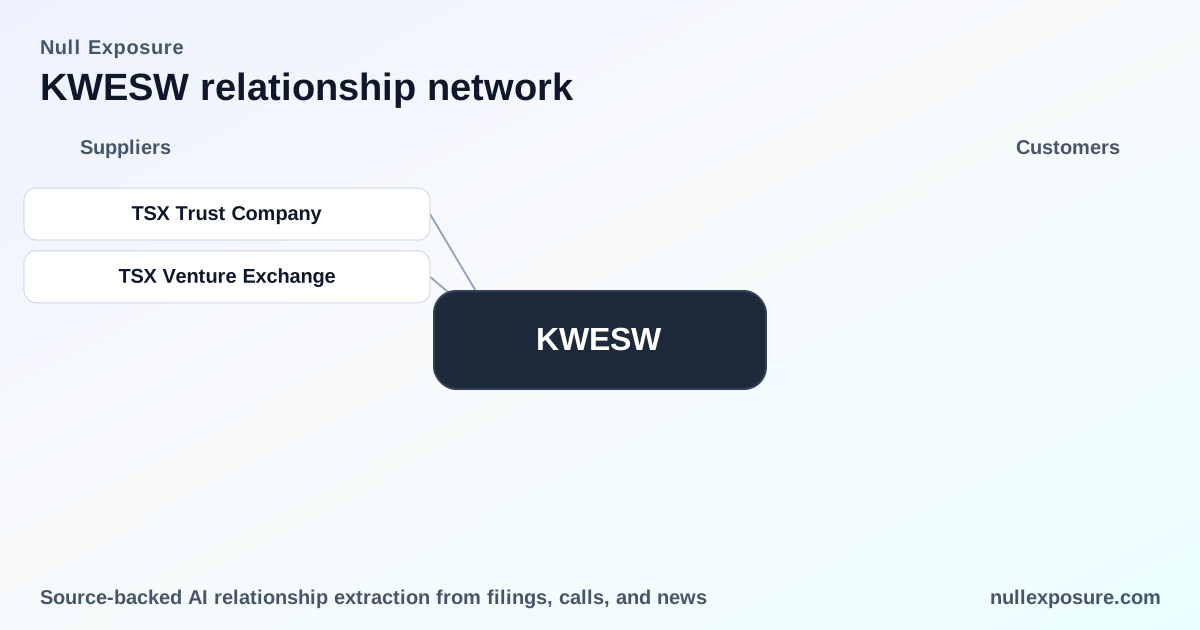
TSX Trust Company — the trustee and indenture counterparty
TSX Trust Company is documented as the governing trustee under a warrant indenture dated April 29, 2021, meaning the trustee holds and administers the warrant terms and enforcement mechanics that affect holder rights and transfers. According to a Newsfile press release referencing the document, the warrants are governed by that indenture, which establishes the formal legal framework for exercise and settlement. (Newsfile press release, March 10, 2026; indenture dated April 29, 2021.)
Why this matters: the trustee’s responsibilities include record-keeping, processing exercises and transfers, and acting as the legal custodian for creditor/holder protections — failures or disagreements here directly impact liquidity and enforceability.
TSX Venture Exchange — the market access provider
KWESST applied to the TSX Venture Exchange for listing of 3,536,057 common share purchase warrants, which places the TSXV at the center of market access and liquidity for those warrants. A company press release distributed via Newsfile documented the application and the number of warrants involved. (Newsfile press release, March 10, 2026.)
Why this matters: exchange acceptance determines where and how instruments trade, the applicable listing rules, and the public visibility of the securities. Exchange decisions also impose ongoing compliance obligations on the issuer that affect corporate governance and disclosure cadence.
Practical implications for investors and supply-side risk management
The documented supplier relationships show a conventional capital-markets setup: trustee + exchange. For institutional investors and operators, that structure implies several actionable considerations:
- Operational concentration risk: reliance on a single exchange and a single trust company concentrates failure modes. If either supplier invokes restrictive measures or is unable to operate, holders face execution friction and legal complexity.
- Contractual clarity: the existence of a dated warrant indenture is positive for enforceability; investors should review the indenture terms for transfer restrictions, exercise windows, and trustee powers.
- Regulatory and compliance dependencies: exchange listing imposes reporting obligations; any suspension or non-compliance could materially affect price and liquidity.
- Counterparty credit and continuity: assess the financial and operational resilience of the trust provider and the exchange’s regulatory standing.
A compact investor checklist:
- Confirm the warrant indenture terms and trustee fee structure.
- Track the listing approval status and any conditions imposed by the exchange.
- Evaluate fallback mechanisms for holder remedies if a supplier becomes unavailable.
Constraints and company-level signals
The record returned no explicit supplier constraints or contractual caveats in the available data. That absence itself is informative: no reported constraints should be treated as a neutral company-level signal, not as confirmation of absence of risk. In practice, absence of documented constraints means analysts must proactively obtain the indenture, listing application materials, and any ancillary service agreements to evaluate termination clauses, indemnities, and dispute resolution frameworks.
When constraints are not provided in public summaries:
- Treat supplier relationships as potentially high-criticality until contract review proves otherwise.
- Prioritize obtaining primary documents (indenture and listing condition letters) for legal and operational due diligence.
Bottom line and investor action points
The documented relationships for KWESW center on standard capital-markets infrastructure: a trustee (TSX Trust Company) and an exchange (TSX Venture Exchange). These relationships are core to liquidity and enforceability — they directly affect valuation and operational risk for holders. Investors should obtain and review the warrant indenture and listing documentation, validate the trustee’s operational capabilities, and model outcomes under exchange suspension or trustee disputes.
For a deeper supplier-risk scorecard and relationship mapping tailored to KWESW, start your diligence on our platform: https://nullexposure.com/
If you need a bespoke briefing or legal-document review support for KWESW’s indenture and listing materials, reach out through the same link for a focused engagement: https://nullexposure.com/
Sources referenced: A company press release distributed via Newsfile (March 10, 2026) describing the warrant indenture governed by TSX Trust Company (indenture dated April 29, 2021) and the issuer’s application to the TSX Venture Exchange to list 3,536,057 warrants.