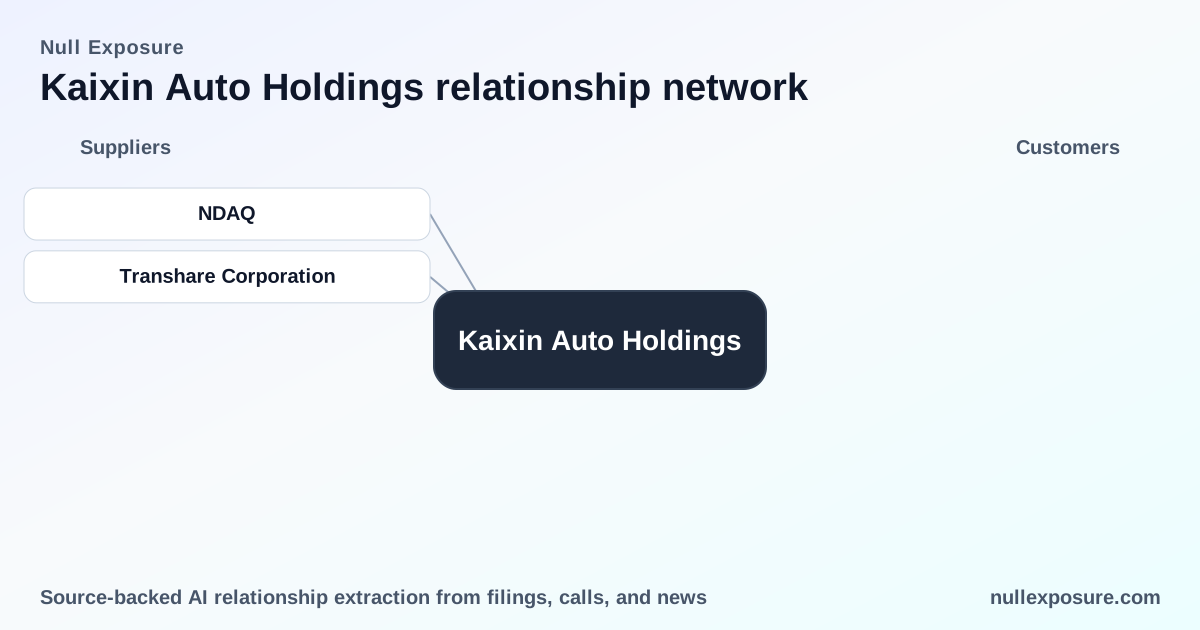
Kaixin Holdings (KXIN) — supplier relationship profile and investment thesis
Kaixin Holdings operates as a publicly listed acquisition vehicle whose core economic logic centers on managing capital held in a trust account, executing an investor-backed business combination, and deriving value through underwriting and post-combination equity ownership. The company monetizes through its listing (Nasdaq: KXIN), the proceeds and fees associated with its IPO and capital transactions, and any value created in a completed business combination. For commercial partners and counterparties, the relevant considerations are listing and transfer mechanics, the concentration of cash in government securities, regional operational footprint in Hong Kong, and reliance on external advisors and underwriters. For deeper vendor and counterparty intelligence, visit https://nullexposure.com/.
What recent disclosures reveal about KXIN’s supplier posture
Kaixin’s recent public filings and market coverage show three concrete operational relationships that affect how counterparties interact with the company: the Nasdaq listing, a transfer agent role played by Transhare Corporation, and ongoing advisor/underwriting engagements evidenced in IPO expense disclosures. These relationships shape contracting posture (standard exchange rules and transfer-agent workflows), counterparty concentration (a listed venue and a small set of service providers), and criticality (listing status and transfer-agent continuity are operationally critical).
The relationships mentioned in public sources
Nasdaq Capital Market — share consolidation and listing mechanics
QuiverQuant reported that Kaixin’s Class A ordinary shares will continue trading on The Nasdaq Capital Market under the symbol “KXIN” after a 1-for-30 share consolidation effective December 1, 2025, with a new CUSIP assigned for the post-consolidation shares. This action confirms Nasdaq remains the central market infrastructure for Kaixin’s equity and corporate actions (QuiverQuant press release on the share consolidation, referencing the effective date December 1, 2025).
Nasdaq exchange — governance and listing pressure during financial distress
A MarketMinute report from November 10, 2025 documented sharp share price declines and flagged Nasdaq’s active oversight of listing compliance, noting management’s struggles to navigate the company’s financial stress and listing standards enforcement. This coverage signals that the exchange is an immediate counterparty for regulatory compliance and potential delisting risk (MarketMinute, FinancialContent, November 10, 2025).
Transhare Corporation — transfer agent and exchange-agent for consolidation
QuiverQuant’s announcement of the share consolidation names Transhare Corporation as Kaixin’s transfer agent and exchange agent for handling certificate exchanges with shareholders of record, emphasizing the agent’s operational role in the mechanics of share conversion and investor communications (QuiverQuant press release on the share consolidation, effective December 1, 2025).
Constraints and company-level signals that shape supplier risk
-
Government securities concentration: Company disclosures show the trust account held $210,451,869 in U.S. Treasury securities and a small cash balance as of December 31, 2018. This is a company-level signal that capital is parked in sovereign paper, lowering counterparty credit exposure for trust assets but also signaling a SPAC-style capital structure that depends on successful deployment of that capital through a business combination. The contracting posture here is conservative on investment counterparty credit but dependent on the mechanics of unlocking value through M&A or cancellation events (company filing trust-account disclosure).
-
APAC operational footprint: Kaixin maintains principal executive offices in Hong Kong (Suite 1306, 13/F, AIA Central), and its sponsor’s investment manager provides office space, indicating regional concentration and regulatory exposure to Hong Kong/APAC rules. For suppliers, this implies contracted parties must be equipped to operate across APAC time zones and regulatory regimes, and counterparties face jurisdictional considerations in dispute resolution and corporate governance (company filing with principal office disclosure).
-
Service-provider dependency and maturity of arrangements: The company disclosed material underwriting discounts, commissions, and engagements with financial advisors such as EarlyBirdCapital, Inc., along with explicit payments tied to its IPO and business-combination marketing activities. This is a company-level indicator of heavy reliance on external advisors and underwriters for capital markets execution, which increases operational dependency on a small set of specialized suppliers and elevates vendor-criticality for transaction success (registration statement S-1 and Exhibit disclosures).
Together these signals describe a supplier posture that is transaction- and market-structure driven: contracts align to exchange rules and transfer-agent workflows, counterparty credit risk is concentrated in sovereign instruments, and successful monetization depends on the maturity and performance of advisor and underwriter relationships.
For a full vendor-risk briefing and counterparty scorecards tailored to KXIN, see https://nullexposure.com/.
Implications for investors and counterparties
-
Operational criticality is concentrated. Nasdaq’s role as the listing venue and Transhare’s role as transfer agent are functionally critical: any disruption to either relationship would materially affect share liquidity, corporate actions, and shareholder communications.
-
Counterparty credit risk is low for held cash but headline risk is high. The trust account’s Treasury allocation reduces asset-side credit risk, but market and governance risk—highlighted by delisting conversations—drive valuation and counterparty exposure for trading counterparties and service providers.
-
Supplier relationships are specialized and potentially concentrated. The company pays meaningful advisory and underwriting fees and relies on those firms to execute business-combination marketing and shareholder-engagement tasks; if those providers underperform or terminate, Kaixin’s ability to complete transactions is impaired.
-
Jurisdictional considerations matter. The Hong Kong base and sponsor-office arrangements create operational and legal characteristics that influence contracting terms, dispute forums, and regulatory compliance obligations for vendors.
Actionable considerations for operators and investors
-
Demand operational continuity clauses and explicit SLAs with transfer agents and exchange-service vendors given their criticality. Ensure contingency plans for transfer-agent failover and certificate-exchange workflows.
-
For counterparties providing advisory, underwriting, or transaction support, negotiate fee structures that reflect concentrated reliance and include termination and performance remediation terms.
-
Monitor listing compliance milestones and issuer disclosures closely; Nasdaq oversight is a direct lever on the company’s trading status and counterparty exposure.
For tailored due diligence or to subscribe for continuous monitoring of Kaixin’s supplier and counterparty profile, visit https://nullexposure.com/.
Bottom line
Kaixin’s public disclosures create a clear supplier map: Nasdaq controls the trading and compliance mechanics, Transhare administers share transfers, and external advisors/underwriters underpin transaction execution. The company’s capital is conservatively held in U.S. Treasuries, but its economic outcome relies on successful business-combination execution and sustained listing compliance. Counterparties should price the concentration and jurisdictional risks into contracting terms and contingency planning.
If you evaluate counterparties or manage vendor exposure for financial portfolios, Nullexposure offers focused intelligence and monitoring for companies like Kaixin — start your review at https://nullexposure.com/.