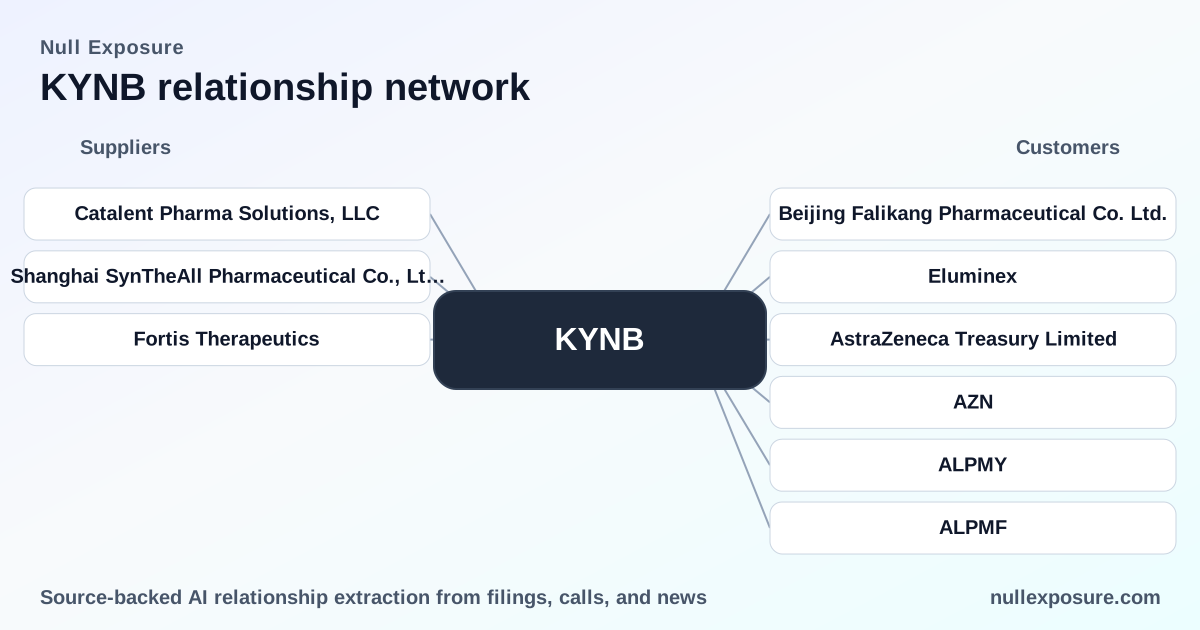
Kyntra Bio (KYNB) — supplier map, operating constraints, and investor implications
Kyntra Bio develops oncology and specialty therapeutics and monetizes through product development, licensing, and future commercial supply agreements while relying on third‑party manufacturers and in‑licensed assets to advance its pipeline. Understanding who manufactures active ingredients and drug product, and how supply flows through APAC and U.S. partners, is central to any investor or operator assessment of KYNB’s delivery risk and commercial scalability. For deeper supplier intelligence and relationship tracking visit https://nullexposure.com/.
How Kyntra runs the program and where cash flows will come from
Kyntra operates as a development‑stage biopharma that uses a hybrid model: in‑license promising assets, advance clinical development, and contract out manufacturing and commercial supply. Revenue will originate from licensing milestones and eventual product sales; near term value is driven by clinical progress and the strategic placement of manufacturing contracts that de‑risk scale‑up. Kyntra’s procurement posture is typical of small biotech: it delegates raw material procurement and production to contract manufacturers, retaining regulatory oversight but lacking direct control of upstream sourcing.
Supplier relationships you need to know
Below are the suppliers and licensors identified in Kyntra’s public records and news coverage. Each entry includes a concise, plain‑English take and the source context.
Catalent Pharma Solutions, LLC
Catalent supplies Kyntra’s drug product tablets globally, with the FY2024 filing noting exceptions for Japan and China where other manufacturers produce regional supply. According to Kyntra’s FY2024 Form 10‑K, Catalent is a primary contract manufacturer for the company’s finished drug product. (FY2024 10‑K, filed 2026)
Shanghai SynTheAll Pharmaceutical Co., Ltd. (WuXi STA)
Kyntra has a commercial supply arrangement with Shanghai SynTheAll (WuXi STA) as a primary manufacturer of its active pharmaceutical ingredient (API); the company explicitly lists WuXi STA alongside Catalent in its manufacturing plan. This is documented in the FY2024 Form 10‑K. (FY2024 10‑K, filed 2026)
Fortis Therapeutics
Kyntra in‑licensed FG‑3246 (FOR46), a potential first‑in‑class antibody‑drug conjugate, exclusively from Fortis Therapeutics and is advancing development for metastatic castration‑resistant prostate cancer. The in‑license and subsequent positive investigator‑sponsored data were reported in press coverage in February–March 2026. (GlobeNewswire, Feb 23, 2026; Yahoo Finance report, Mar 10, 2026)
What the public constraints say about Kyntra’s operating model
The public excerpts and constraint signals describe a company whose manufacturing and supply relationships drive both vulnerability and runway management. These constraints should be viewed as company‑level operating characteristics unless the filing explicitly names a partner.
- Geographic risk concentrated in APAC logistics. Kyntra’s disclosures highlight shipment of materials and intermediates from China and India as a source of added time and loss risk, indicating supply chain exposure to APAC transit, customs, and regulatory cadence. (Company disclosure referencing logistics from China and India)
- Supply is material to operations. The company characterizes inventory and lead times as material to meeting partner and development needs, noting regulatory approvals and sourcing outside the U.S. increase delay and shortage risk. This positions supply as a material operational constraint for commercial execution. (FY2024 Form 10‑K)
- Primary manufacturing outsourced and explicitly named. The 10‑K explicitly lists Catalent and Shanghai SynTheAll (WuXi STA) as primary manufacturers for drug product and API, respectively, confirming the company’s reliance on established contract manufacturing organizations for core production. (FY2024 Form 10‑K)
- Active, ongoing supplier relationships and delegated procurement. Kyntra states it relies on contract manufacturers to purchase some necessary materials and does not have direct control over these upstream acquisitions, indicating an operational posture of delegated procurement and ongoing active supplier dependencies. (FY2024 Form 10‑K)
How these constraints translate into investment and operational risks
Kyntra’s supplier footprint and the constraints above imply several concrete implications for valuation and partner selection:
- Concentration and criticality: With primary API and drug product manufacturing assigned to WuXi STA and Catalent, Kyntra runs a concentrated network where a disruption at one partner would impose meaningful program delays and potentially regulatory complications. Manufacturing concentration is a single‑point operational risk.
- Contracting posture and leverage: As a small developer dependent on contract manufacturers, Kyntra’s negotiating leverage on lead times and priority is limited until commercial volumes or milestone payments change dynamics; this raises time‑to‑revenue risk under stress scenarios.
- APAC logistics amplifies timeline variability: Shipping intermediates from APAC increases the probability of delays tied to customs, inspections, or transport disruptions, which directly affects inventory burn and trial timelines. Investors must price scheduling volatility into near‑term milestones.
- Maturity and diligence signals: Using established CMOs such as Catalent signals a drive for regulatory quality and scale readiness, while reliance on third‑party procurement necessitates stronger contract terms and supply visibility to reduce execution risk.
If you want ongoing alerts on supplier shifts or alerts when a supplier relationship changes, explore our platform at https://nullexposure.com/.
Practical takeaways for investors and operators
- Treat supply as a leading indicator for pipeline timing: manufacturing delays will surface before clinical readouts slip contractually. Monitor Catalent and WuXi STA operational disclosures and public CMO statements.
- Focus diligence on contract terms — lead times, change‑in‑control clauses, and secondary sourcing commitments materially affect de‑risking timelines.
- Track licensed assets separately: Fortis’s exclusive license of FG‑3246 introduces a parallel dependency where clinical progress and license economics will define value capture.
For a granular, continuously updated view of KYNB supplier relationships and to integrate supplier risk into your investment models, visit https://nullexposure.com/.
Closing assessment
Kyntra’s supplier map reflects a standard small‑biotech operating model: strategic in‑licenses, primary manufacturing outsourced to recognized CMOs, and meaningful APAC logistics exposure that increases timeline volatility. Investors should value the company on clinical and commercial de‑risking events but price in supply concentration and APAC transit risk until Kyntra secures diversified or onshore secondary capacity. For targeted supplier monitoring and real‑time alerts to these exact relationships, see https://nullexposure.com/.