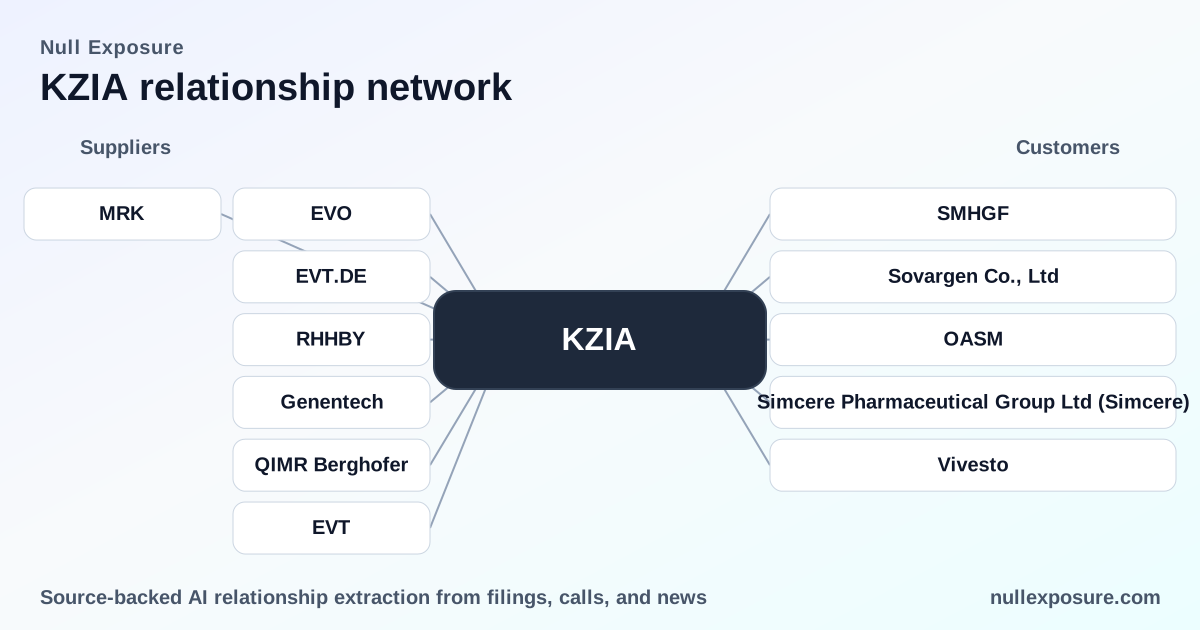
Kazia Therapeutics (KZIA) — supplier relationships and what they mean for investors
Kazia Therapeutics operates as a clinical-stage biopharmaceutical company that builds value by licensing, developing, and selectively out-licensing oncology and CNS small-molecule assets. The company monetizes through milestone and licensing fees, clinical-stage value creation (partner-funded and internal trials), and strategic combinations with larger pharma for development and commercialization pathways — exemplified by recent licensing activity and combination trials reported in public releases. For investors, KZIA is effectively a deal-driven developer: intellectual property licenses and external partnerships are the core supply relationships that determine both near-term funding optionality and long-term commercialization value.
If you want concise, relationship-level intelligence on suppliers and partners, visit the Null Exposure homepage: https://nullexposure.com/
Partner map: a strategic few, high-impact relationships
Kazia’s public disclosures and press activity show a concentrated supplier/partner base anchored on licensed compounds and academic collaborations rather than broad manufacturing supply chains. That concentration concentrates both upside — if a core asset progresses — and downside — if counterparties change strategy or clinical results disappoint. The following sections cover every partner cited in our collected results and what each relationship contributes to Kazia’s operating model.
Evotec SE — source of EVT801, a licensed small-molecule program
Kazia is developing EVT801, a small-molecule VEGFR3 inhibitor that was licensed from Evotec SE in April 2021, and Evotec’s origin of the program remains a material part of Kazia’s pipeline narrative. This licensing relationship supplies a mid-stage oncology asset that broadens Kazia’s portfolio beyond its lead PI3K/AKT pathway candidate. According to press releases and corporate updates cited in PRNewswire and BioSpace (March 2026), Kazia continues to reference Evotec as the origin for EVT801.
Source: PR Newswire and BioSpace press releases, March 2026.
Genentech — original licensor of paxalisib and upstream IP provenance
Kazia’s paxalisib was licensed from Genentech in late 2016, and that origin story matters because paxalisib is central to several clinical programs and combination strategies discussed publicly. Multiple filings and market reports note that paxalisib “is or has been the subject of ten clinical trials” in the targeted disease area, underlining Genentech’s role as the upstream IP supplier whose earlier work enabled Kazia’s clinical pathway. Financial press coverage and company communications in March 2026 consistently reference Genentech as the original licensor.
Source: Yahoo Finance and company press releases summarized in market coverage, March 2026.
QIMR Berghofer — academic collaboration for novel degrader program
Kazia entered into a collaboration and licensing agreement with QIMR Berghofer to develop an NDL2 PD-L1 degrader program, representing a strategic academic-sourced discovery feed into Kazia’s pipeline. This relationship supplies early-stage, first-in-class intellectual property that diversifies the company’s scientific approach beyond kinase/PI3K inhibitors. The collaboration was documented in company updates and market reports in FY2025.
Source: Yahoo Finance company coverage summarizing the FY2025 business update.
Merck & Co., Inc. — clinical combination partner (Keytruda)
Kazia reported an early clinical combination evaluating paxalisib with Merck’s Keytruda (pembrolizumab) plus chemotherapy, and public reporting noted preliminary results from the first patient in that Phase 1b regimen. Merck’s Keytruda functions as a clinical combination partner that can materially affect the development profile and commercial attractiveness of paxalisib, given Keytruda’s market-leading position in immuno-oncology. This combination was reported in finance-focused press coverage in March 2026.
Source: Yahoo Finance coverage of Kazia’s Phase 1b results and combination regimen reporting, March 2026.
What these relationships tell investors about Kazia’s operating model
- Contracting posture: Kazia operates with a licensing-heavy posture — it acquires clinical assets and academic IP rather than building all discovery in-house. That posture reduces discovery spending but increases dependency on counterparties for IP and early validation.
- Supplier concentration: The company shows high supplier concentration: a small number of upstream licensors (Genentech, Evotec, academic partners) and clinical collaborators (e.g., Merck) supply the majority of its program value. Concentration amplifies partner negotiation leverage and counterparty risk.
- Criticality of partnerships: Licensed assets constitute mission-critical inputs: paxalisib and EVT801 are central to near-term valuation and trial activity, so licensors and co-development partners directly influence timelines and optionality.
- Maturity profile: Counterparty relationships skew toward early-to-mid clinical maturity, with licensed assets that have substantial prior development history (Genentech) or were discovery-licensed (Evotec, QIMR). That mix positions Kazia between discovery-stage risk and clinical-stage binary outcomes.
These firm-level signals are derived from public partner disclosures and company updates; they reflect structural characteristics of Kazia’s business rather than any single counterparty document.
If you track strategic supplier exposure for small-cap biotech portfolios, get more structured insight at https://nullexposure.com/
Investment implications — risks and upside framed by partners
- Upside: Partnerships with recognized originators (Genentech, Evotec) and a combination with Merck’s Keytruda provide legitimacy and potential acceleration toward commercialization value; a successful readout in paxalisib combinations would materially rerate Kazia.
- Downside: The concentrated licensing model creates single-asset dependency risk and counterparty negotiation exposure; failure in a lead trial or an adverse change in partner priorities would reduce optionality quickly.
- Operational considerations for operators: Maintain active licensing governance and milestone visibility, and hedge development risk through additional academic collaborations or selective out-licensing to capture near-term value — tactics Kazia has used (for example, recent licensing activity announced in company press releases).
Source references here are drawn from multiple March 2026 press pieces and corporate updates that describe licensing provenance and clinical combination activity.
Concise relationship takeaways
- Evotec SE: EVT801 was licensed from Evotec in April 2021, supplying Kazia with a VEGFR3 inhibitor program that diversifies the pipeline (PR Newswire, BioSpace, March 2026).
- Genentech: Paxalisib’s original licensor (late 2016); the asset underpins multiple clinical trials and remains central to Kazia’s development strategy (Yahoo Finance and company releases, March 2026).
- QIMR Berghofer: Academic collaboration and licensing agreement for an NDL2 PD-L1 degrader program; this supplies early-stage, first-in-class IP to Kazia (Yahoo Finance, FY2025 update).
- Merck & Co., Inc.: Clinical combination partner via Keytruda in a Phase 1b regimen; Merck’s agent materially influences the development and commercial framing of paxalisib (Yahoo Finance, March 2026).
Final view and next steps
Kazia’s supplier and partner footprint is small, strategically chosen, and high-impact. For investors, that combination means outcomes hinge on a few development events tied directly to licensed IP and co-development partners. Active monitoring of trial readouts, milestone announcements, and any changes in partner licensing terms will be the most informative signals for valuation.
For ongoing, relationship-level monitoring and to see how supplier exposure shapes small-cap biotech risk, visit Null Exposure: https://nullexposure.com/
Bold takeaway: Kazia is a deal-centric developer — its value is driven by licensed assets and a tight set of high-profile partners; that structure compresses both the path to upside and the concentration of downside.