Kezar Life Sciences (KZR): Supplier relationships and what they mean for investors
Kezar Life Sciences operates as a clinical-stage small-molecule biotech focused on immune-mediated diseases and oncology. The company does not yet generate product revenue and monetizes through equity and debt financings, strategic partnerships, and the future commercialization or licensing of clinical assets; its operating model is therefore capital-intensive and highly dependent on third-party suppliers and financial counterparties. For an investor evaluating counterparty exposure and supplier risk, the immediate questions are counterparty concentration, contractual criticality, and how past financing and advisory relationships shape strategic optionality. Visit https://nullexposure.com/ for a concise supplier-risk view across your portfolio.
How Kezar runs the program and pays the bills
Kezar is a South San Francisco–based, clinical-stage biotech with no reported revenue (RevenueTTM: 0), negative operating metrics (EBITDA and EPS negative), and a market capitalization near $50.5 million. The company funds R&D and trials through capital markets and credit facilities; historically it used underwritten public offerings and lender arrangements to extend runway. Capital markets access and lender relationships are therefore integral to sustaining operations until a partnering or commercialization event occurs.
The corporate record shows active engagement with underwriters and capital markets advisors dating to the IPO and more recently with strategic advisory retention during regulatory setbacks. Those engagements are operationally relevant: underwriting relationships establish financing windows, while strategic advisors influence exit or monetization paths.
Who Kezar contracts with — the full supplier and counterparty list
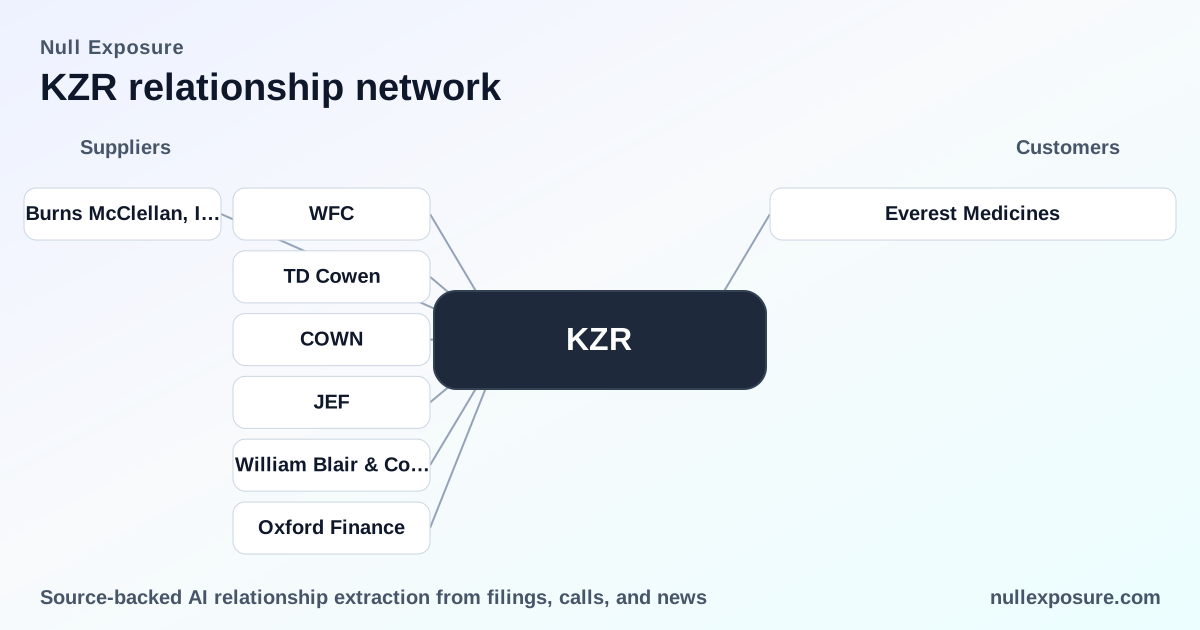
Below are every supplier, lender, underwriter, advisor, and investor‑relations firm referenced in the source material, with a concise plain-English description and the cited source.
Wells Fargo Securities, LLC
Wells Fargo acted as one of the book‑runners for Kezar’s initial public offering, participating in the underwriting syndicate that delivered primary capital to the company in FY2018. According to a PR Newswire release on the IPO closing, Wells Fargo was a named book‑runner.
Cowen and Company, LLC (Cowen)
Cowen acted as a joint book‑running manager on Kezar’s IPO and is also referenced contemporaneously in later communications; the firm’s name appears both in the underwriting announcement and as part of capital markets activities. The PR Newswire IPO release lists Cowen as a joint book‑running manager in FY2018.
Jefferies LLC
Jefferies joined Cowen as a joint book‑running manager for the IPO, providing underwriting execution and distribution services for Kezar’s public offering in FY2018. The participation was detailed in the PR Newswire announcement covering the offering close.
William Blair & Company, L.L.C.
William Blair is recorded as part of the FY2018 underwriting group alongside Wells Fargo, contributing to the offering execution that supplied capital to Kezar. The underwriting composition was disclosed in the PR Newswire release on the IPO closing.
TD Cowen
Kezar retained TD Cowen to support a strategic review process following regulatory setbacks in FY2025; multiple press reports cite the engagement as part of management’s effort to evaluate options for the company and its Zetomipzomib program. PharmaWeb and Benzinga reported that the firm was engaged to assist with the strategic review in late 2025.
Oxford Finance
Oxford Finance acted as a lender to Kezar; Kezar’s repayment of the Oxford loan was reported as reducing interest expense for the remainder of 2025, improving near‑term cash burn dynamics. A TradingView summary of Kezar’s SEC disclosures highlights the interest‑expense reduction tied to Oxford Finance repayment.
Burns McClellan, Inc.
Burns McClellan provided investor relations contact services linked to the IPO disclosure, supplying investor communications and contact information during the offering process in FY2018. The PR Newswire IPO announcement included Burns McClellan as an investor‑relations contact.
What the supplier evidence says about Kezar’s operating posture
Kezar’s public disclosures and the relationship roster collectively reveal an operating model built on outsourced manufacturing and service providers and dependent on capital‑markets counterparties to fund development.
- The company relies on third‑party contract manufacturing organizations (CMOs) for raw materials, intermediates, active pharmaceutical ingredients (API), and finished drug product for clinical trials; this establishes high operational criticality for manufacturing partners (company‑level signal from filings).
- Kezar contracts third parties for filling, labeling, packaging, storage, and distribution, indicating that supply‑chain continuity and logistics partners are essential to trial execution and regulatory filings.
- The constraints dataset marks these relationships as active, which signals established, ongoing contractor arrangements rather than one‑off engagements.
Taken together, these are not just vendors — they are operational linchpins. Loss or disruption of a qualified CMO or packaging partner would directly threaten trial timelines and valuation catalysts.
Visit https://nullexposure.com/ to see how supplier concentration and contractual roles map to valuation risk in similar clinical‑stage companies.
Risk profile and value drivers for investors
Several investment‑relevant themes emerge from the supplier and counterparty profile:
- Funding dependency: Historical underwriting activity (Wells Fargo, Cowen, Jefferies, William Blair) and the retention of TD Cowen for a strategic review demonstrate that Kezar’s path to value is a combination of financing and strategic transactions rather than product sales today.
- Operational concentration risk: Outsourcing of API and finished product manufacturing creates counterparty concentration and onboarding risk; manufacturers and packaging vendors are critical single points for trial continuity.
- Balance‑sheet relief from lender actions: The reported repayment of the Oxford Finance loan reduces interest expense and modestly extends runway, improving the near‑term cash position without changing the structural revenue absence.
- Advisory signal: Engaging TD Cowen for a strategic review is a clear signal that management is exploring alternatives — from partnership to sale or asset rationalization — which can re‑rate the equity if executed convincingly.
Key takeaway: Kezar’s valuation is driven by clinical and regulatory outcomes plus its ability to access capital markets or strategic partners; supplier stability and lender arrangements materially influence both timeline and financing cost.
Actionable next steps for analysts and operators
- Review current manufacturing and supply contracts in SEC filings to quantify single‑vendor exposure and change‑of‑control or termination clauses.
- Monitor TD Cowen engagement updates and any announced strategic review outcomes for potential transaction catalysts.
- Track cash runway and the effects of Oxford Finance repayment on interest expense in subsequent 10‑Q/10‑K filings.
For a faster supplier‑risk readout on Kezar and comparable small‑molecule developers, go to https://nullexposure.com/ — the platform aggregates counterparty roles and materiality to help prioritize diligence.
Final read
Kezar is a textbook clinical‑stage biotech: no product revenue, negative operating income, outsourced manufacturing and logistics that are operationally critical, and an active reliance on financial counterparties to sustain development. Underwriters and advisors have provided financing and strategic guidance historically, while lender activity has modestly improved cash dynamics. The most immediate investor focus is supplier continuity and the outcome of the strategic review — both drive the company’s ability to preserve value between now and a commercial inflection. For ongoing monitoring and comparative supplier analytics, visit https://nullexposure.com/.