Loews (L) — what the bank syndicate and reinsurance posture tell investors
Loews operates as a diversified holding company that monetizes through subsidiaries across insurance, energy, and industrial businesses, generating operating cash flow, underwriting and investment income, and dividend flows to the parent. Capital markets actions and reinsurance decisions are principal levers management uses to manage balance-sheet volatility and fund subsidiary growth. For investors assessing supplier and counterparty risks, the most actionable signals come from recent underwriting relationships on debt issuance and treaty-level reinsurance arrangements tied to its insurance arm, CNA. For a full supplier mapping and ongoing updates, visit https://nullexposure.com/.
Why the underwriting group matters for credit and liquidity
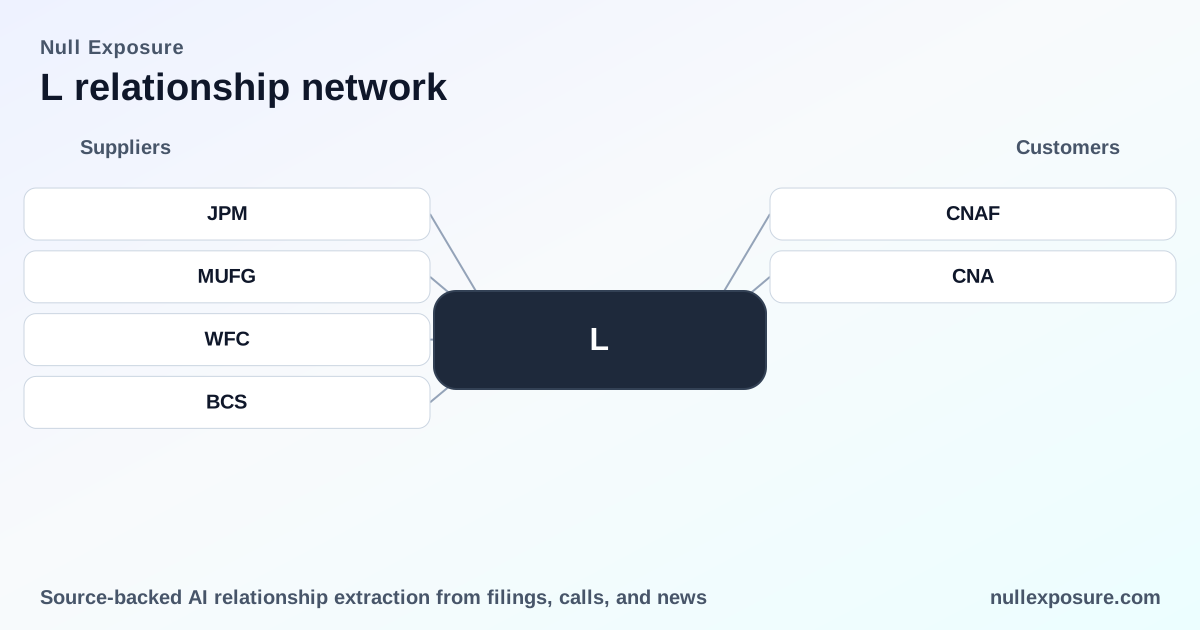
Loews’ choice of underwriters for a debt issue is a direct statement about market access and syndicate depth. A four-bank underwriting group led by J.P. Morgan, Barclays, MUFG and Wells Fargo signals established capital-markets relationships and diversified distribution channels for the parent’s financing needs. The participation of global banks also supports secondary-market liquidity for the new paper, lowering execution risk for future raises.
- Takeaway: the underwriting composition reduces single-counterparty concentration for funding while reflecting institutional credit-market placement capability.
The named relationships — what investors should know
J.P. Morgan — J.P. Morgan served as a lead underwriter on Loews’ $500 million senior notes offering, underpinning primary distribution and bookrunning for the transaction. TradingView reported the underwriting role on March 10, 2026. (TradingView, March 10, 2026: https://www.tradingview.com/news/tradingview:a22d29c563b8d:0-loews-prices-500m-4-94-senior-notes-due-2036/)
MUFG — MUFG was part of the lead syndicate for the senior notes, providing additional distribution reach into Asia and institutional clients that follow Asia-focused banks. TradingView noted MUFG’s underwriting role in coverage of the offering on March 10, 2026. (TradingView, March 10, 2026: https://www.tradingview.com/news/tradingview:a22d29c563b8d:0-loews-prices-500m-4-94-senior-notes-due-2036/)
Wells Fargo — Wells Fargo joined the underwriting group, contributing U.S. commercial and wealth channels to the placement and signaling continued U.S. bank support for Loews’ debt program. The underwriting role is recorded in the same market report dated March 10, 2026. (TradingView, March 10, 2026: https://www.tradingview.com/news/tradingview:a22d29c563b8d:0-loews-prices-500m-4-94-senior-notes-due-2036/)
Barclays — Barclays participated as a lead underwriter, expanding European and institutional investor reach for the deal and validating cross-border distribution strength. TradingView’s transaction coverage lists Barclays as a co-lead on March 10, 2026. (TradingView, March 10, 2026: https://www.tradingview.com/news/tradingview:a22d29c563b8d:0-loews-prices-500m-4-94-senior-notes-due-2036/)
Reinsurance, claims administration and other supplier constraints — company-level signals
Beyond the bank group, Loews’ operating risk profile is heavily shaped by CNA’s reinsurance and claims-administration posture. The available evidence reveals three company-level constraints that materially affect counterparty risk, operating leverage, and renewal dynamics:
-
Short-term contract posture. CNA’s catastrophe excess-of-loss treaty runs June 1, 2025 to June 1, 2026, indicating a one-year renewal cadence for material catastrophe protection. This short-term tenor increases exposure to pricing volatilities on renewals and requires active placement each year rather than a long-dated hedge.
-
North American concentration with cross-border coverage. CNA bought reinsurance that explicitly covers U.S. states, territories and Canadian exposures underwritten in North American and European companies, highlighting geographic concentration in North American property portfolios even when ceded capacity is procured from broader markets.
-
Reliance on third-party service providers and reinsurers. CNA outsources significant claims administration functions to external administrators and cedes material risk to reinsurers to manage large-loss exposure and diversification needs. This establishes operational dependency on external claims workflows and ceded-capacity markets that are critical to loss adjustment and solvency management.
Each of these constraints should be read as a signal about Loews’ operating model: highly active capital-market engagement, rolling reinsurance renewals, and externalized claims/reinsurance relationships that are critical to short- and medium-term balance-sheet stability.
For a larger supplier network and mapping resources, see https://nullexposure.com/.
How these signals change the investment thesis
Three practical implications flow from the combined evidence:
-
Liquidity and market access are intact but distributed. The four-bank syndicate demonstrates continuing access to wholesale funding across multiple markets, reducing single-bank dependency for new issuance.
-
Earnings and capital are sensitive to annual reinsurance cycles. The one-year treaty window means underwriting economics can shift quickly with catastrophe losses or hardening markets, making earnings and capital ratios contingent on renewal pricing and capacity availability.
-
Operational criticality is outsourced. Heavy reliance on third-party claims administrators and reinsurers creates external operational dependencies that are core to loss settlement and capital relief — this is a governance and vendor-management priority for investors monitoring operational resilience.
Risk checklist investors should track
- Renewal pricing and capacity for CNA’s catastrophe excess-of-loss treaty at the June 2025–June 2026 renewal point.
- Counterparty exposure to the four lead banks for future primary distribution, including fee and relationship concentration dynamics.
- Performance and stability of third-party claims administrators, especially after a major catastrophe event that would stress service delivery.
- Geographic loss patterns in the U.S. and Canada that drive reinsurance attachment and exhaustion points.
Bottom line and next steps
Loews presents a financing and risk-transfer model that blends diversified capital-market access with short-term reinsurance positioning and outsourced claims operations. For investors and operators, the priority is monitoring renewal outcomes and vendor performance as primary drivers of near-term credit and operational risk.
If you want a deeper supplier-by-supplier view and continuous monitoring of these relationships, start with our hub at https://nullexposure.com/. For bespoke diligence on counterparty concentration or reinsurance renewal exposure, the NullExposure platform can be engaged to produce targeted supplier intelligence — visit https://nullexposure.com/ to begin.