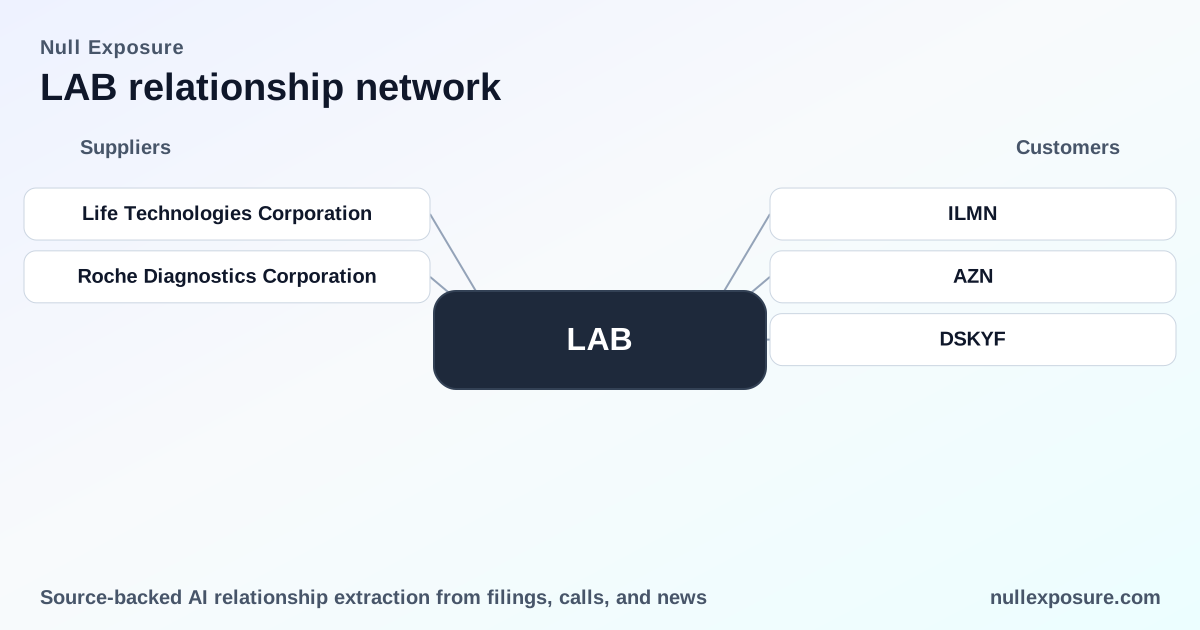
LAB: Supplier map and what it means for investors and operators
LAB sells and supports molecular diagnostic instruments—including its X9 real‑time qPCR system—and captures recurring revenue from the consumables, reagents and services that flow with those instruments. The company monetizes through a classic instruments‑plus‑consumables model: capital equipment sales drive a stable installed base and high-margin recurring spend on reagents, disposables and logistics, while outsourced manufacturing and third‑party shipping convert fixed costs into variable, partner‑dependent execution. For investors evaluating supplier risk, the most important thesis is simple: LAB's revenue engine depends on a concentrated supplier footprint for critical components and on a small set of execution partners for assembly and distribution. Learn more at https://nullexposure.com/.
Why the supplier footprint matters to valuation and operations
LAB's public filings make two investor‑relevant points explicit. First, the company relies on a “limited number of third‑party suppliers” with single and sole‑source exposure for key components; the loss of one such supplier would require significant time and effort to replicate. Second, LAB shifts assembly and fulfillment outside the organization: instruments are assembled by contract manufacturers in Singapore, and the company depends on shipping providers to deliver products globally. These are not peripheral observations—they define LAB’s contracting posture and operational leverage.
- Contracting posture: LAB operates with a supplier‑lean model that reduces fixed manufacturing overhead but increases counterparty concentration and dependence on third parties for quality and lead times.
- Concentration & criticality: The filing classifies certain suppliers as single/sole sources and labels those inputs as critical; supply interruption would have outsized operational impact.
- Maturity & substitutability: Sourcing alternatives require qualification time, suggesting mid‑to‑long lead times for re‑sourcing components and limited immediate substitutability.
- Execution reliance: Outsourced assembly in Singapore and dependence on global shippers means operational risk is driven by partner performance and logistics volatility rather than internal capacity.
These structural features should be priced into both operational budgets (inventory, dual‑sourcing expenses) and the company’s risk premium.
Who LAB calls out in its filings (and what that implies)
LAB’s FY2024 Form 10‑K references leading reagent suppliers and direct competitors in the qPCR reagents market. Both relationships are noted in the context of the X9 system and real‑time qPCR reagents.
Life Technologies Corporation (now part of Thermo Fisher Scientific)
LAB identifies Life Technologies—now part of Thermo Fisher—as a leading supplier of reagents for real‑time qPCR reactions and places it in the same competitive neighborhood as the company’s X9 system and its licensees. According to LAB’s FY2024 10‑K, Life Technologies is cited among the leading reagent suppliers in the qPCR market (FY2024 10‑K).
Roche Diagnostics Corporation
LAB names Roche Diagnostics as another leading supplier of real‑time qPCR reagents and notes Roche as a direct competitor in that reagent space in its FY2024 10‑K (FY2024 10‑K).
Both references appear in the context of reagent supply and competition for qPCR customers; the filing frames these firms as industry incumbents that influence reagent availability and competitive dynamics.
Operational implications by relationship and role
The two named reagent suppliers are large, established firms with integrated reagent and instrument portfolios; their presence in LAB’s filing signals competitive intensity and potential supplier leverage in reagent markets. Separately, LAB’s company‑level disclosure about single/sole source suppliers, contract manufacturing in Singapore, and reliance on shipping providers highlights four concrete operational constraints:
- The company accepts single/sole‑source risk for specific components, which raises inventory and qualification costs for continuity planning.
- Contract manufacturing moves capital risk off the balance sheet but concentrates manufacturing geography and supplier oversight in Singapore facilities.
- Logistics dependency means delivery performance and global freight dynamics have direct revenue impact, particularly for time‑sensitive reagents and instrument rollouts.
- The overall supplier posture reduces capital intensity but increases exposure to external counterparties’ stability and strategic choices.
These constraints are presented at the company level in LAB’s FY2024 10‑K; they are not tied to a single named vendor in the excerpts, but they are critical to how LAB runs and scales.
If you are assessing LAB as a counterparty or an investment, consider the tradeoffs between lower fixed costs and higher external dependency—then price in the realistic cost of de‑risking (dual sourcing, safety stock, contract terms and supplier audits). For a deeper supplier profile and continuous monitoring, visit https://nullexposure.com/.
Risk mitigation and what operators should demand
Operators negotiating with LAB or managing similar supplier footprints should insist on three practical mitigations:
- Contractual visibility: right to audit and defined service level agreements with contract manufacturers and shipping partners.
- Supply continuity clauses: secondary sourcing timelines and supplier qualification windows built into procurement contracts.
- Inventory governance: targeted buffer stocks for sole‑source parts tied to projected re‑qualification timelines.
For investors, these operational measures translate directly into capex and working capital assumptions; adjust forecasts for the time and cost to re‑qualify suppliers and for increased inventory holdings during product launches or regulatory transitions.
Bottom line: what to watch and how to act
LAB’s supplier disclosures draw a clear risk map: concentrated sourcing for critical components, assembly outsourced to contract manufacturers in Singapore, and dependence on external shippers. The named reagent incumbents—Life Technologies (Thermo) and Roche—underscore competitive and supply pressures in the qPCR reagents market (FY2024 10‑K). Investors should treat these factors as persistent, not transitory, when modeling cash flow volatility or negotiating covenant language. Operators should convert high‑level disclosure into specific supplier audits and contingency plans.
To examine LAB’s supplier relationships continuously and compare them across peers, begin your diligence at https://nullexposure.com/. For portfolio teams and procurement leads looking to map counterparty concentration into actionable mitigations, NullExposure’s platform offers structured intelligence and monitoring—start at https://nullexposure.com/.
Key takeaways:
- Supplier concentration is a structural risk for LAB’s consumables‑driven revenue model.
- Outsourced manufacturing and logistics shift operational risk to partners and increase the premium for continuity planning.
- Large reagent incumbents noted in the 10‑K shape both competition and access to consumables.
Sources: LAB FY2024 Form 10‑K (fiscal period FY2024) citing reagent suppliers and supplier/contracting disclosures, as described in the company’s public filing.