LAC supplier relationships: what investors need to know before underwriting project risk
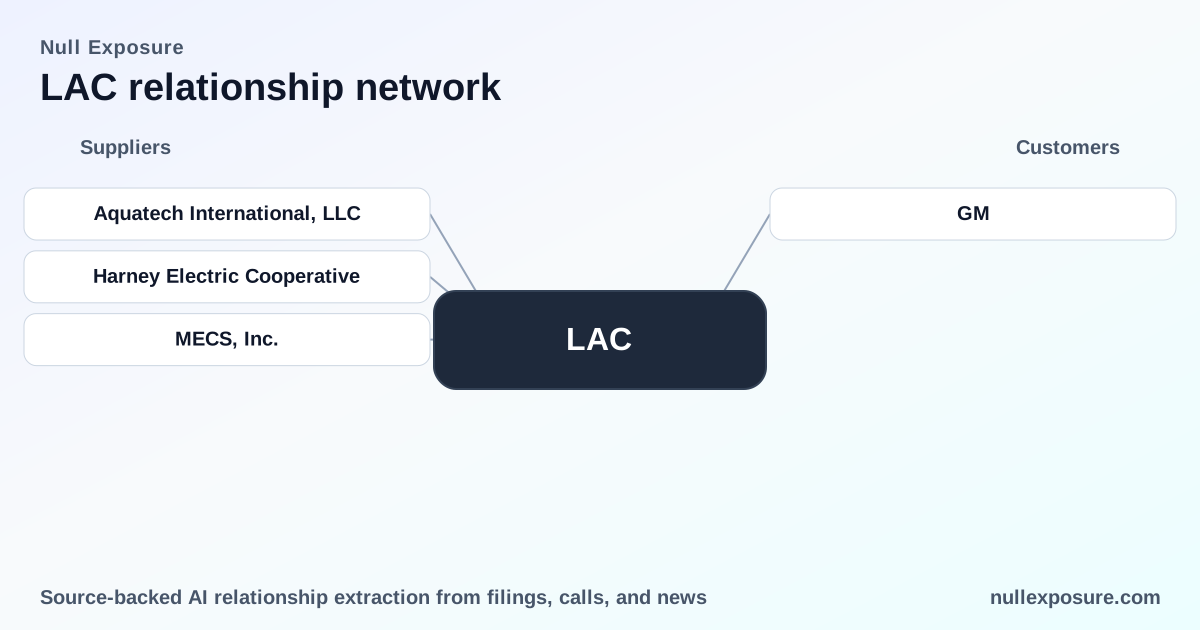
Lithium Americas (LAC) operates an integrated lithium carbonate project whose value is driven by large, capital-intensive construction, long-term contracts with infrastructure partners, and technology licensing that underpins plant operations. The company monetizes through future production of battery‑grade lithium carbonate sold into the EV and battery materials supply chain, while its supplier relationships convert capital and technology commitments into deliverable operational capacity. For investors evaluating counterparty and execution risk, the supplier mix combines engineering vendors, grid utility arrangements, and a technology licensor—each with distinct contract economics and operational criticality. Learn more at https://nullexposure.com/.
Why supplier relationships matter for project finance
Supplier contracts determine schedule risk, cost exposure, and the strategic optionality to scale or adapt the asset. Long‑term service and terminal agreements anchor logistics and off‑take pathways; technology licenses lock in process performance assumptions; utility arrangements secure operational continuity. Understanding these relationships is equivalent to assessing a project’s underwriter — who will build it, who will power it, and who controls the know‑how that makes product spec achievable.
The three LAC supplier relationships you must account for
Aquatech International, LLC
Aquatech was engaged under a master services agreement in 2021 to deliver confirmation test work, equipment engineering, manufacture and supply for purification and final product crystallization systems for the lithium carbonate plant. According to Lithium Americas' FY2024 Form 10‑K, Aquatech’s scope is focused on the purification and crystallization train that produces finished lithium carbonate, making it a direct supplier to the plant’s product quality and throughput (FY2024 10‑K).
Harney Electric Cooperative
Electrical power for Thacker Pass will be supplied by a combination of on‑site generation and grid power from the local utility cooperative, Harney Electric Cooperative (HEC). The FY2024 10‑K specifies HEC as the grid counterparty, establishing external grid dependency for sustained operations and the operational interface for power reliability (FY2024 10‑K).
MECS, Inc.
In 2023 Lithium Americas entered a License Agreement with MECS, Inc. for intellectual property related to the design, operation and performance of proprietary acid‑plant equipment; the license is structured as a one‑time, fully paid‑up fee payable in four installments plus technical services from MECS. The FY2024 10‑K records this arrangement, making MECS a critical technology licensor whose performance and IP terms are embedded in plant process guarantees (FY2024 10‑K).
What the contract evidence tells investors about the operating model
-
Long‑term contracting posture: Company filings establish multi‑year commitments at the corporate level — including a $2.26 billion DOE loan closed in October 2024 and a Transload Terminal Services Agreement with an initial 10‑year term and automatic extensions — which signal capital anchoring and predictable counterparty relationships over a decade or more. These commitments reduce short‑term merchant exposure and transfer timing risk to long‑dated financing and service frameworks (company FY2024 disclosures).
-
Service provider orientation: The 10‑K documents multiple outsourced arrangements for specialized engineering, construction management, and mining services. Aquatech’s master services engagement is explicitly cited as a vendor supplying key process equipment, reflecting a strategic reliance on third‑party technical vendors for critical process systems (FY2024 10‑K).
-
Licensing and know‑how concentration: The MECS license is contractually explicit: a paid‑up technology license plus accompanying technical services for the acid plant. That structure creates operational dependence on a single licensor for a key process step, with implications for maintenance, upgrades, and operational troubleshooting that investors must quantify.
-
Maturity and predictability: The portfolio mixes mature utility relationships (HEC) with specialized vendors (Aquatech, MECS). Utility supply provides predictable operational inputs, while vendor and licensor commitments convert capital contracts into engineering deliverables. This blend reduces certain execution risks but increases vendor concentration and IP risk.
Mid‑article action: further diligence resources
If you want a structured review of counterparty risk and contract terms for LAC, start with a consolidated supplier map and contractual maturity schedule at https://nullexposure.com/. This is the practical next step for underwriters and portfolio managers assessing exposure.
Investment implications — what to watch in the next 12–24 months
- Schedule and delivery risk tied to equipment vendors. Aquatech’s role in purification and crystallization is functionally critical; delays or performance shortfalls in those systems translate directly to commercial production schedules and ramp‑up timelines.
- Power stability and redundancy. The HEC grid connection, combined with on‑site generation, is essential for continuous operation. Any constraining of grid capacity or interconnection delays will materially affect operating readiness.
- IP and operational control. The MECS license consolidates acid‑plant process knowledge outside of company ownership, so service continuity and ongoing technical support payments are an embedded operational cost and a potential negotiating lever.
- Contract tenor aligns with financing. The presence of long‑term financing and terminal agreements supports project bankability and reduces short‑term counterparty turnover, but heightens the importance of long‑dated performance guarantees from suppliers.
Risk checklist for credit committees and operators
- Confirm delivery milestones and liquidated damages in Aquatech’s equipment supply contract.
- Validate interconnection guarantees and redundancy provisions with Harney Electric Cooperative.
- Review the MECS license for restrictions on aftermarket support, spare parts, and performance warranty duration.
- Map contract expiries against the DOE loan covenants and the Terminal Agreement’s 10‑year initial term to ensure alignment of obligations and recourse.
Closing call-to-action and final read
For a consolidated supplier risk brief and contract timeline for LAC, see the project dossier at https://nullexposure.com/. Investors underwriting LAC exposure must treat supplier contracts as first‑order drivers of timing, capital deployment, and operational uptime; the mix of long‑term financing, utility dependence, and a paid‑up technology license creates a clear, actionable risk profile. For tailored diligence or to commission a supplier‑risk memorandum, begin with the home page at https://nullexposure.com/.
Key sources: Lithium Americas FY2024 Form 10‑K reporting on supplier agreements and licensing (FY2024 10‑K).