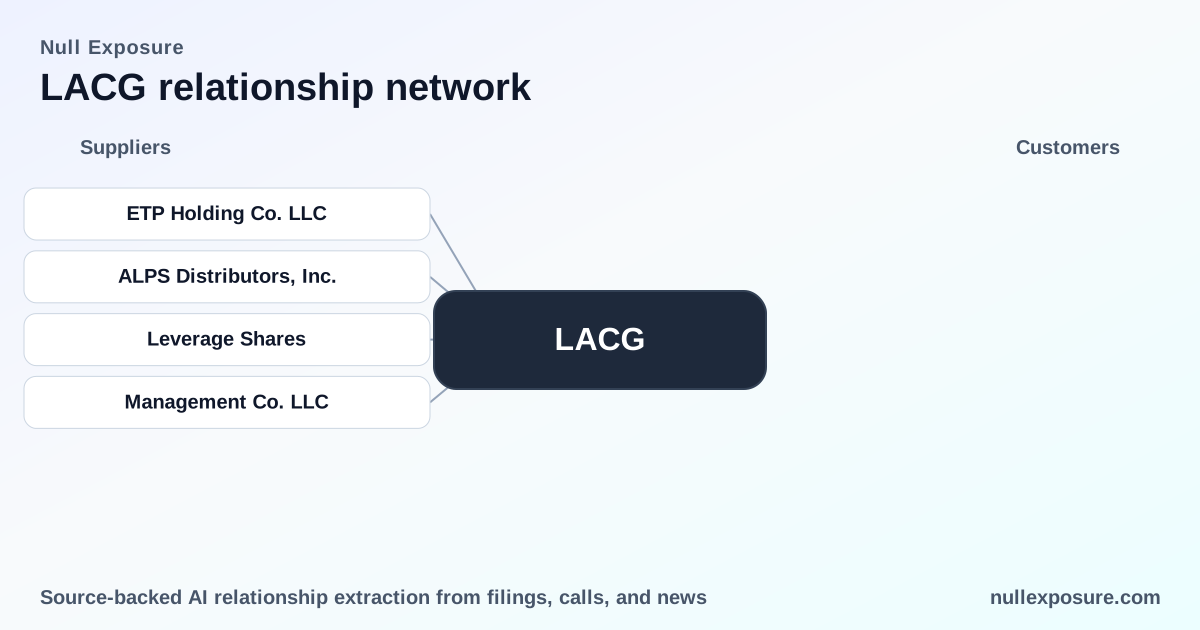
LACG supplier map: who underwrites, distributes and advises the product
LACG is a listed instrument whose economics are driven through a multi-party commercial structure: shares are issued by an affiliate issuer, distributed through a named distributor, marketed under a recognized brand, and governed by a primary advisor — each relationship creating fee lines and operational dependency for investors and operators evaluating counterparty exposure. This supplier map clarifies who captures issuance and distribution economics and where operational concentration and governance risk live. For a concise vendor-risk readout and ongoing monitoring, see https://nullexposure.com/.
How LACG monetizes: a short investor thesis
LACG generates revenue and cost flows through four primary channels: issuance/structuring (issuer fees), distribution (placement and platform fees), branding/licensing (marketing lift and brand alignment), and advisory/governance (portfolio management or compliance oversight). That structure means financial returns to stakeholders are sensitive to counterparty stability, distribution reach, and the commercial terms between the issuer, distributor, brand owner, and advisor.
- Issuance economics are captured at the issuer level when shares are created and listed.
- Distribution economics are realized by placement agents and platforms that sell or list the product.
- Brand and advisory roles drive marketability and operational control, respectively.
For a practical vendor-risk scorecard and supplier diligence playbook, visit https://nullexposure.com/.
The relationships you should know (concise, sourced)
Below are the supplier relationships flagged in public reporting and media references associated with LACG. Each entry is a plain-English takeaway and its source.
ETP Holding Co. LLC — the issuer
ETP Holding Co. LLC is identified as the entity that issues LACG shares, indicating that primary issuance authority and the related issuer-level fees and legal responsibility sit with this holding company. According to TradingView’s BOATS-LACG page (first seen March 10, 2026; fiscal period FY2025), LACG shares are issued by ETP Holding Co. LLC (TradingView, Mar 10, 2026).
ALPS Distributors, Inc. — the distributor
ALPS Distributors, Inc. is named as a distributor for LACG, which signals that placement, client onboarding, and distribution fee capture are channeled through an established distributor relationship; this creates a concentration point for go-to-market access. TradingView’s BOATS-LACG entry lists ALPS Distributors, Inc. as a distributor (first seen March 10, 2026; FY2025) (TradingView, Mar 10, 2026).
Leverage Shares — the brand partner
Leverage Shares is referenced as the brand associated with the product, indicating brand licensing or co-branding that supports investor recognition and liquidity. That brand alignment affects marketing reach and secondary-market demand. The BOATS-LACG trading page cites Leverage Shares as the brand for LACG (first seen March 10, 2026; FY2025) (TradingView, Mar 10, 2026).
Themes Management Co. LLC — the primary advisor
Themes Management Co. LLC (listed in source text as the primary advisor) is recorded as the product’s advisor, which implies a role in portfolio construction, compliance oversight, or advisory fees tied to governance and investment decisions. TradingView’s BOATS-LACG page identifies Themes Management Co. LLC as the primary advisor to LACG (first seen March 10, 2026; FY2025) (TradingView, Mar 10, 2026).
What this relationship map implies about LACG’s operating model
The supplier topology reflects an outsourced and partner-dependent operating posture: issuance is handled by an affiliate issuer, distribution is third-party, brand management is external, and advisory services are contracted. Those characteristics produce a few company-level signals investors and operators must weigh.
- Contracting posture: LACG operates through contractual third parties rather than vertically integrating issuance, distribution, and advisory functions — this reduces fixed cost but raises counterparty governance reliance.
- Concentration: A small set of named partners covers core functions (issuer, distributor, brand, advisor), so counterparty failure or contract renegotiation would have immediate operational impact.
- Criticality: Distributor and issuer roles are operationally critical — they control market access, legal issuance, and fee realization — while brand and advisory roles drive demand and compliance respectively.
- Maturity and continuity: Public references are tied to FY2025 and were first observed in March 2026, indicating the structure is in place for the current listing cycle and is not purely speculative.
These are company-level signals derived from the relationship map and public references; they describe how LACG is operated and monetized rather than attributing contract terms to a single partner.
For a structured supplier-risk assessment you can act on today, check https://nullexposure.com/.
Investment implications and risk checklist
The mapped relationships create clear investment questions and operational risk nodes:
- Counterparty concentration risk: With core functions concentrated among a few named entities, perform counterparty credit and continuity checks for the issuer and distributor.
- Fee and revenue leakage: Understand fee splits between issuer, distributor, brand owner, and advisor; waterfall mechanics determine net returns to holders.
- Brand and marketability risk: Brand association with Leverage Shares supports liquidity, but brand reputation risk is asymmetric — negative events at the brand owner can transmit to LACG demand.
- Governance and execution risk: The advisor’s role in compliance and portfolio oversight is pivotal; confirm governance rights, reporting cadence, and oversight mechanisms with Themes Management Co. LLC.
Actionable next steps for operators: validate legal issuance documentation with ETP Holding Co. LLC, verify distribution agreements and platform availability with ALPS Distributors, and obtain advisory mandate details from Themes Management Co. LLC.
Bottom line — concentrated partnerships create both leverage and vulnerability
LACG is an instrument monetized through a compact ecosystem: ETP Holding Co. LLC issues the shares, ALPS Distributors places them, Leverage Shares supplies brand pull, and Themes Management Co. LLC provides advisory governance. That setup delivers operational efficiency and speed to market, but it also concentrates execution and counterparty risk into a handful of supplier relationships. Investors and operators should prioritize verification of contractual terms, counterparty resilience, and fee waterfalls before allocating capital.
For continuous monitoring and a supplier-risk playbook tailored to listed products like LACG, visit https://nullexposure.com/.