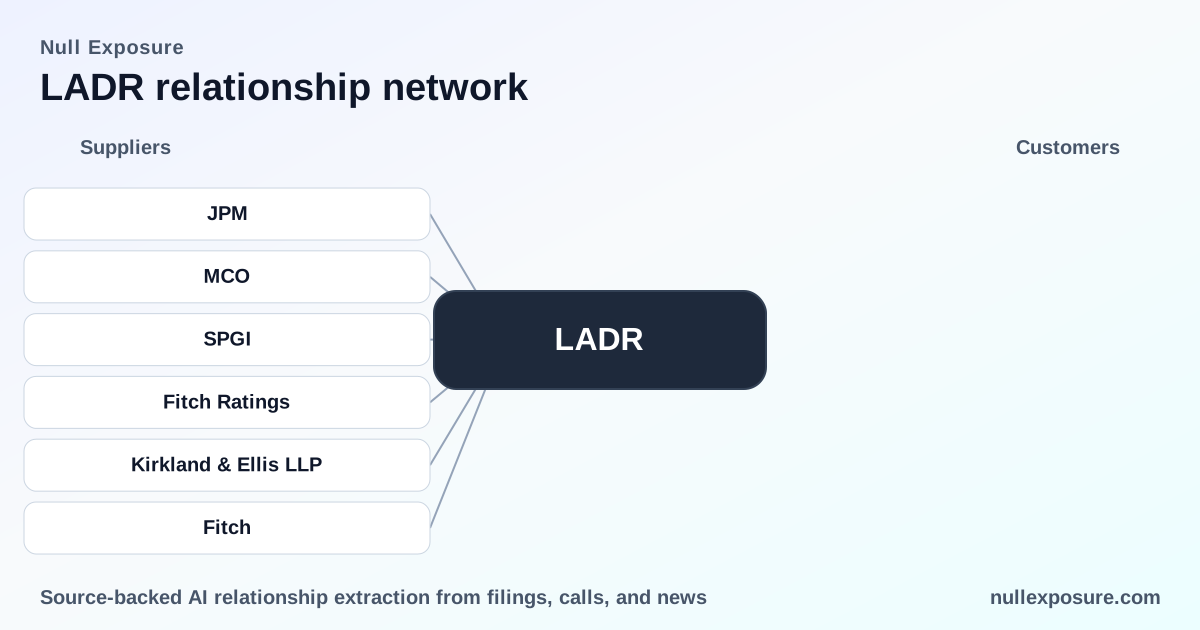
Ladder Capital (LADR) — supplier relationships, capital posture, and what investors should know
Ladder Capital operates as a mortgage REIT and commercial real estate financier that monetizes through interest income, spread management across secured and unsecured funding channels, and structured capital markets activity (bonds, repurchase agreements, CLOs). The firm grows by originating and holding commercial real estate loans and securities while funding those assets with a mix of short- and long-term wholesale financing; returns are driven by credit selection, asset-liability management, and access to capital. For investors assessing supplier and counterparty risk, the signal set around Ladder shows institutional funding depth, investment-grade ratings, and active legal and advisory relationships that underwrite scale—but also concentrated funding lines at large absolute sizes. Learn more about relationship analytics at https://nullexposure.com/.
Why these relationships matter to your underwriting thesis
Ladder’s cash returns are a function of financing cost and balance-sheet durability. When large banks act as agents for syndicated facilities, or when rating agencies upgrade the credit standing, the company lowers its all-in funding cost and expands origination capacity. Conversely, concentration of large funding instruments—senior unsecured notes and repo lines—creates single-point operational and refinancing risk at material dollar levels. Investors should treat Ladder as a well-capitalized mortgage REIT that has moved into a more conservative operating posture, with explicit evidence of investment-grade ratings and sizable outstanding debt.
For a quick review of third-party relationships and how they influence risk, see the full coverage below or visit https://nullexposure.com/ for deeper supplier mapping.
Complete relationship log — every entry from the reporting set
-
JPMorgan Chase Bank, N.A. (FY2026): On a multi-lender amendment, JPMorgan served as administrative and collateral agent for the amended credit facility where 13 lenders participated, reflecting bank-led syndicated oversight of Ladder’s revolving liquidity. Source: GlobeSt coverage of Ladder’s Feb 2026 financing activity.
-
Moody’s (FY2026): Moody’s upgraded Ladder to Baa3 in 2025, marking the company’s attainment of investment-grade status and signaling improved credit metrics and governance in the eyes of a major ratings provider. Source: Earnings call transcript published on InsiderMonkey (Q4 2025 / FY2026).
-
S&P (FY2026): Standard & Poor’s raised Ladder to BB+ with a subsequent action moving the company into investment-grade territory, a public affirmation of the firm’s disciplined balance sheet and leverage profile as described on the company’s year-end commentary. Source: InsiderMonkey earnings call transcript (Q4 2025 / FY2026).
-
Moody’s Ratings (FY2026, FY2025 entries): Company filings and press releases state that Ladder holds a Baa3 rating from Moody’s (stable outlook), a central element of its stated conservative capital structure—a point reiterated in multiple releases across FY2025–FY2026. Source: NatLawReview press release (FY2026) and FinancialContent / Marketscreener notices (FY2025–FY2026).
-
Fitch Ratings / Fitch (FY2025–FY2026 entries): Fitch has Ladder at BBB- with a stable outlook, a complementary rating to Moody’s that supports Ladder’s claim to investment-grade status and underpins access to a broader investor base for unsecured notes and institutional funding. Source: NatLawReview press release (FY2026), Marketscreener and InsiderMonkey excerpts (FY2025–FY2026).
-
Kirkland & Ellis LLP (FY2026): Kirkland & Ellis served as legal counsel to Ladder on the capital raise and amended credit facility, providing top-tier transactional counsel consistent with large-scale debt and origination activity. Source: GlobeSt report covering the $675 million capital raise (Feb 2026).
(Each entry above reflects the distinct reported item in the results set; sources are internal press reports and the company’s public earnings and press releases as cited.)
What the constraints tell us about Ladder’s operating model
The reporting set includes structured constraints that reveal Ladder’s contracting posture and funding composition:
-
Contract maturity mix: Ladder combines long-term financing (five-year unsecured money market borrowing arrangement and widespread use of long-term non-recourse mortgage debt) with selective short-term liquidity. This signals an intentional maturity ladder to lower refinancing cliff risk while retaining tactical short-term facilities for liquidity management.
-
Scale and concentration: The company-level signal for spend/balance magnitude is material—billions in senior unsecured notes and hundreds of millions in repo debt outstanding—which defines Ladder as a large borrower whose counterparty relationships are dollar-critical.
-
Criticality of financing: Financing is explicitly central to the business model; these are not peripheral vendor contracts but core counterparty relationships required for origination growth and dividend policy.
-
Service-provider posture: Ladder operates with an internal leadership team augmented by outsourced technology and legal service providers; the company treats suppliers as integral service providers supporting credit, compliance, and operations.
-
Global counterparty set: The firm names both domestic and international institutions among counterparties, indicating a geographically diversified funding footprint that helps spread country-level exposures but increases cross-border operational complexity.
These constraints are company-level signals and should be read as characteristics of Ladder’s funding and supplier posture rather than attributes of any single third party unless explicitly named.
How these signals affect investor risk/reward
-
Credit upside: Investment-grade ratings from Moody’s and Fitch expand Ladder’s investor base and lower borrowing spreads—this directly increases net interest margin potential on new originations. Rating upgrades reduce funding cost and unlock scale.
-
Refinancing and concentration risk: Large outstanding lines and note volumes (multi-hundred-million to billions) create refinancing sensitivity; a failed renewal of a major facility or breakdown in a bank agent relationship would be immediately material.
-
Operational resilience: The presence of top-tier legal counsel and diversified counterparties supports robust transaction execution and governance. Outsourced technology and an internal cybersecurity leadership signal operational maturity.
If you want an investor-grade supplier map and stress-tested counterparty matrix for Ladder, explore tailored reports at https://nullexposure.com/.
Practical recommendations for investors and operators
- Prioritize covenant and agent terms in the syndicated credit facility and unsecured notes—these are the first-order levers of funding stress.
- Monitor rating agency commentary and actions closely; any downgrade would have an outsized impact on funding cost and liquidity.
- Verify the five-year unsecured money market arrangement terms and repo counterparties as part of due diligence given the blend of long-term and short-term exposures.
For direct access to mapped supplier relationships, transaction timelines, and tailored exposure scoring for lending counterparties, visit https://nullexposure.com/ — the gateway for institutional relationship intelligence.
Final read
Ladder has transitioned into a conservatively capitalized mortgage REIT with investment-grade credentialing, bank-led syndicated facilities, and major legal and advisory support—all characteristics that support disciplined growth but leave the firm exposed to refinancing cycles given the large absolute size of its liabilities. For investors focused on counterparty and supplier resilience, the evidence favors a favorable credit posture tempered by concentration risk that must be actively managed. For bespoke relationship analysis and exposure monitoring, see https://nullexposure.com/.