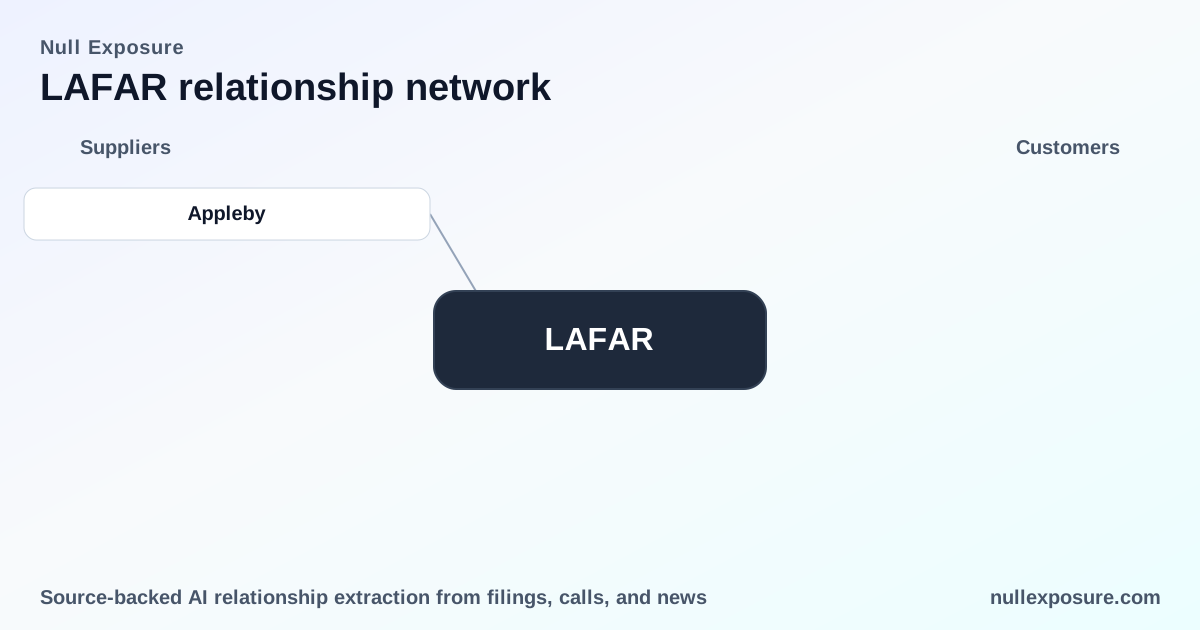
Lafayette Acquisition Corp. (LAFAR) — supplier relationships and what they reveal for investors
Lafayette Acquisition Corp. operates as a special-purpose acquisition company that monetizes primarily through an underwritten IPO trust and sponsor economics tied to a future business combination; the company’s financial trajectory depends on IPO proceeds, transaction execution, and the quality of its service providers. Supplier engagements are concentrated and mission-critical at this stage: legal counsel for a Cayman-structured listing is not a routine vendor but an operational linchpin that enables capital formation and cross-border listing mechanics. For investors and operators evaluating LAFAR’s vendor posture, the supplier record is short but directional — it signals an offshore incorporation and a classic SPAC operating model anchored to capital-raising and deal execution.
Discover more supplier intelligence at the NullExposure homepage: https://nullexposure.com/
The single disclosed supplier relationship — what it is and why it matters
Appleby, Cayman Islands legal counsel
- Appleby served as Cayman Islands legal counsel to Lafayette Acquisition Corp. in connection with a $115 million initial public offering on the Nasdaq Global Market. According to Cayman Finance coverage dated November 4, 2025, Appleby’s role was explicitly linked to the IPO process, which confirms the company used offshore counsel for its listing mechanics.
- The use of Appleby as counsel is directly material: offshore counsel handles entity formation, offering documentation for non‑US issuers, and regulatory work required for a Nasdaq IPO with a Cayman holding structure. (Source: Cayman Finance, November 4, 2025.)
What this supplier pattern implies about LAFAR’s operating model
The disclosed relationship with Appleby gives clear signals about Lafayette’s operating posture:
- Contracting posture — transactional and high-skill suppliers. Lafayette is contracting selectively for specialized cross‑border legal services rather than broad, recurring vendor panels. This is consistent with a newly public SPAC that outsources discrete legal and listing tasks to top-tier offshore counsel.
- Concentration — supplier roster is sparse and targeted. Public records show a concentrated supplier footprint in the disclosure set; one material legal advisor is sufficient for IPO formation, but concentration elevates single‑vendor dependency on critical matters.
- Criticality — supplier services are mission-critical. Legal counsel for Cayman incorporation and a Nasdaq IPO is essential for the entity’s ability to bring capital to market; failure or disruption in this relationship would have immediate operational consequences.
- Maturity — early lifecycle, capital-formation phase. The FY2025 IPO indicates Lafayette is in the capital-raising and transaction-sourcing phase of its lifecycle rather than in a diversified operating phase that would require broader supplier networks.
These are company-level operational signals drawn from available supplier disclosures and the nature of the transaction, not from constraint documents.
Risk and governance considerations investors should weigh
Legal and structural choices expose investors to a small set of concentrated risks and require active due diligence:
- Single-provider concentration risk. A heavy reliance on a single offshore counsel for formation and offering documents increases counterparty risk; investors should look for board-level oversight practices that mitigate vendor concentration.
- Jurisdictional and structural risk. Cayman incorporation introduces specific corporate governance, insolvency, and regulatory regimes that differ from US domestic issuers; investors need comfort with the firm’s conflict‑management policies and escrow/trust arrangements backing IPO proceeds.
- Execution dependence. For SPACs, the critical path to value realization is the business combination; therefore, the quality and continuity of advisors who structure deals and navigate regulatory filings directly influence execution timing and costs.
- Disclosure sparsity. The supplier record here is concise; the absence of broader supplier disclosures is itself a signal that Lafayette currently operates a lean supplier model focused on capital formation. Investors should expect supplier disclosures to expand once dealflow and post‑combination operations begin.
Relationship-by-relationship detail (complete list from our records)
Appleby — Cayman Islands legal counsel for the IPO
- Appleby acted as Cayman Islands legal counsel to Lafayette Acquisition Corp. for its $115 million IPO on the Nasdaq Global Market, providing the legal structuring necessary for the Cayman entity to list. The engagement was reported in Cayman Finance on November 4, 2025. (Source: Cayman Finance, November 4, 2025.)
Practical implications for portfolio managers and operators
- Operational checklist for investors: verify escrow/trust documentation, review counsel conflict disclosures, and confirm continuity plans for legal advisors. The legal advisor’s role is operationally essential and should be evaluated just as critically as underwriters or auditors.
- Due diligence focus: demand transparency around future supplier plans (investment bankers, target diligence advisors, regulatory counsel) and get a clear read on vendor concentration limits the sponsor will accept.
- Contracting posture to monitor: ensure that vendor agreements contain change-of-counsel provisions, fee schedules tied to deliverables, and performance remedies to reduce single-point failures during deal execution.
If you are mapping third-party dependencies across a SPAC lifecycle, get deeper coverage and monitoring at NullExposure: https://nullexposure.com/
Final investor takeaways and recommended next steps
- Primary takeaway: Lafayette Acquisition Corp’s public supplier footprint is narrowly concentrated on specialized offshore legal counsel for its Nasdaq IPO; this is consistent with a SPAC-focused capital formation model. Appleby’s engagement is material and operationally critical to the company’s ability to list and hold capital in trust.
- Action items for managers: confirm continuity and conflicts with legal counsel, assess exposure to Cayman‑jurisdiction mechanics, and insist on more comprehensive supplier disclosures before a business combination is announced.
- Where to go from here: track subsequent advisor additions (underwriters, auditors, target-sector consultants) as they will materially change supplier concentration and operational risk profile.
For ongoing supplier intelligence and alerts on Lafayette and comparable issuers, visit NullExposure and sign up for monitoring: https://nullexposure.com/